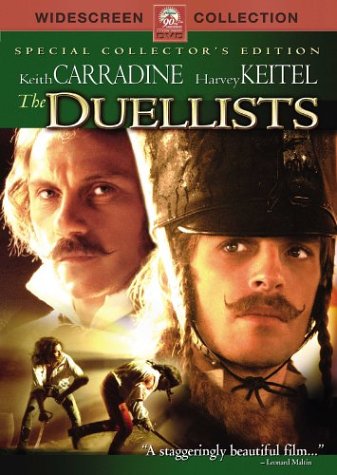
The Duellists (1977)

More than anything else Ridley Scott’s directing debut, The Duellists, tells the story of an obsession. I’m glad Guy (Phoenix Cinema) suggested it as I wasn’t aware of the movie and found it oddly captivating and very beautiful too. Plus I find duels fascinating. I can’t really say why.

Based on the short story The Duel by Joseph Conrad The Duellists tells the story of a lifelong enmity. Two officers of Napoleon’s army, d’Hubert (Keith Carradine) and Feraud (Harvey Keitel), pursue each other for years and fight one duel after the other. While the first duel might have made some sense, at least at the time, the following duels are less and less understandable. Although d’Hubert tries to reason with Feraud, the latter becomes more and more obsessed as the years pass by.

The movie has a lot more to offer than a fascinating story and two interesting characters. It’s visually stunning and brilliantly acted. I couldn’t even say which of the two actors I liked better. Carradine as d’Hubert who seems more complex, more humane or Keitel as Feraud who is relentless in his pursuit of d’Hubert. If you like sword fighting you will adore The Duellists anyway as the choreography of the fights, as many reviewers have commented, is excellent.

The movie starts in 1800 and ends around 1815. After almost every duel the men lose sight of each other for a few months or even years as they are often posted in other places. They sometimes meet under quite improbable circumstances, once for example while retreating from Moscow where they fight a group of Cossacks together.

The code of duels was quite complex, I suppose every country had its own set of rules. I felt we learned quite a lot about the rules in France at the time. What made it especially dramatic was the fact that if one of them had been promoted but not the other one it would have become impossible to go on fighting. So every time d’Hubert is promoted he hopes the folly is about to end, only to find out later that Feraud meanwhile has been promoted to the same rank.

The Duellists has been compared to Barry Lyndon but I don’t think they are that similar. Be it as it may, I’ feel more inclined to rewatch The Duellists, I thought it was more captivating. And I really must read the novella soon.

War Movie Watchalong – Johnny Got His Gun – Sunday 23 September

The poll has decided and the movie we are going to watch and discuss is:

Johnny Got His Gun (1971 US)

It was quite close. Johnny Got His Gun received 5 votes, The Bomber – Ballada O Bombere was following with 4 and The Hurt Locker with 3 votes.

I think it’s a good choice and I’m looking forward to the discussion.

If you’d like to join and have a blog, please post on the same day, if you don’t have a blog, just watch the movie and join the discussion.

The discussion will take place on Sunday 23 September 2012

Waltz With Bashir (2008) – A Guest Post by The War Movie Buff

I’m glad to have another guest post today. This time it is from one of my oldest blogging friends, Kevin aka The War Movie Buff. He started his war movie blog only a few months after I started mine and I was glad to find someone who doesn’t only share the interest and posts regularly and writes in a very detailed and passionate way but also someone who answers comments and likes a good discussion.

********

In August, 2010, I went to see a movie called “Julie and Julia”. Little did I know that taking my wife to a chick flick to get brownie points would change my life. The plot of the Julie half of the movie involved a blogger cooking a different recipe a day and writing about it. That gave me the idea to start a blog where I would review the greatest war movies. I had recently encountered Military History magazine’s issue on the 100 Greatest War Movies so I used it as my guide. My plan was to review one movie per week starting with #100. I started as simple a blog as I could handle (being computer-challenged) and journeyed into uncharted territory not knowing what to expect. I truly did not expect to get much traffic and being a high school history teacher I am used to lack of recognition. However, my very first post resulted in a response from a blogger named “All About War Movies”. This person quickly became my mentor, colleague, and friend. In recognition of that, I have chosen to write this guest post on a movie I never would have seen without her influence. When I became a faithful follower of “All About War Movies”, I realized that there were some very good foreign war films that I should watch. Being an American, this was news to me. In my whole life of watching hundreds of films, I could recall having watched only one foreign film (“The Seven Samurai”). I quickly came to respect Caroline’s recommendations and anytime she mentioned a movie I had never heard of, I checked on it. I decided to expand my parameters to include categories beyond the 100 Greatest. One of those categories is what I decided to call “Should I Read It?” which refers to subtitled movies. The first foreign war film I blogged on was one of Caroline’s favorites – “Joyeux Noel”. I was hooked on foreign films instantly. I now even watch non-war, subtitled films. I am proudly less Americentric now.

I give this background because the movie I am going to write about is not only a foreign film, but the best war film I have seen since I started my blog. It reinforced my belief that modern war films can and should be superior to old school war movies, even the classics. Technology and experience are huge advantages for modern war movie makers. “Waltz With Bashir” is an Israeli film released in 2008. The movie blew me away because it hit several of my buttons. It is historically accurate, I learned about an event that I knew little about, it is realistic in its depiction of the military and combat, and it is striking in its cinematography.

Writer and director Ari Folman spent four years creating what he calls an “animated documentary”. If not the first of this type, it is still ground-breaking. It won numerous awards and was critically acclaimed. The film is autobiographical. Folman takes as his theme the effects of war on memory. The movie begins with a jaw-dropping three-dimensionally animated scene of a pack of dogs running through the streets to a man’s apartment building. The dogs represent a memory flashback for a friend of Ari. The friend tells Ari each dog represented the 26 dogs he sniped during the Lebanon War of 1982. This conversation causes Ari to confront the fact that he has holes in his memory of his experiences in Lebanon. That very night he has his first flashback which involves himself and some naked comrades coming ashore on a beach at the city of Beirut. Another friend theorizes that people sometimes fill in gaps in their memory with fiction. He encourages Ari to try to fill in those gaps with the truth. Don’t fear opening those doors, “memory takes us where we want to go”. He assures Ari he cannot get hurt by learning the truth.

Ari goes on a quest to talk to comrades he served with and other veterans of the invasion. Their individual stories are vignettes that powerfully depict the nature of modern war. Several universal truths about warfare and young soldiers shine through. The adrenalin-fueled fear in a firefight is followed by the overwhelming silence of death. Soldiers tend to fire their weapons at nothing and nowhere when traveling through enemy territory. Soldiers are clueless pawns of the brass and the pols. Surviving members of a unit suffer guilt feelings. Unlike some anti-war movies, “Waltz with Bashir” does not glamorize the appealing aspects of armed combat.

The movie and Ari’s quest builds to the infamous Sabra and Shatila refugee camp massacre. Ari’s unit is sent into western Beirut after the assassination of the Christian Phalange leader Bashir Gemayal. The film takes its title from an incident in which a member of Ari’s unit waltzes with a machine gun in the middle of a Beirut street while under fire from snipers and RPGs and as Lebanese civilians spectate. Time seems to stand still as he twirls amidst the bullet casings and ricochets. The dance symbolizes Israel’s relationship with Bashir.

The film concludes with the Israeli Defensive Forces allowing vengeance-minded Christian Phalange militia to enter the Muslim camps. The individual Israeli soldiers exhibit cognitive dissonance as they are slow to grasp what is clearly taking place before their eyes, abetted by their lighting the night skies with flares. It takes three days for an Israeli general to order a stop to the killings. The movie makes it clear that the Israeli government (Defense Minister Sharon and Prime Minister Begin) was complicit in the massacre, but Folman is not on a crusade. He lets the audience connect the dots. The memory theme comes full circle as Ari realizes that he had filled in the black hole of his memory of being near the atrocity by imagining that he and his comrades were instead at a beach. The movie closes with real footage of the massacre victims as though to remind the audience that although animated, the story is true.

I love war movies because I love Military History. I have been attracted to war stories since I was a child because of the action, but also because war brings out all the emotions and character traits in human beings. I prefer war movies that have action and are true to human nature. They don’t have to be historically accurate, but I insist they not be ridiculous and unrealistic. When you have seen as many war films as I have, you also are impressed when the movie takes a different approach to telling a war story. “Waltz with Bashir” fits this description (as do “300” and “Oh! What a Lovely War”). Movies like these prove that although the war movie genre (starting with “Birth of a Nation”) is almost a century old, there are still new ways to tell a war story.

“Waltz” looks very different from every other war film I have seen. Folman uses a variety of animation. The movie is mostly a blend of cut-out and classic animation. It is influenced by graphic novels and has a scene reminiscent of Japanese animation. He includes some three-dimensional scenes, but used the technique sparingly and only for spectacular shots. His use of color varies depending on the mood of the scene. The war scenes tend to be monochromatic. The home front scenes are much more vibrant. (He makes the point that although he was fighting only twenty minutes away, at home the public was unaffected by the war and life went on as usual.) The shading and shadows are amazing. The look is mesmerizing. Blu-ray was made for movies like this.

The movie is true to human nature mainly because these are real people who Ari interviewed and built the story on. From my reading of men in combat, I have a good idea of how men behave under that stress. For those vast majority of people who do not want to read extensively in this difficult area, movies can serve the purpose of educating civilians about what their young warriors go through. This is important because these young men deserve to be understood. Civilians need second-hand memory. Undoubtedly, some Israelis were offended by what they saw in “Waltz”. The fact is that atrocities happen on both sides in every war. Good war movies like this show what really happens in war, but also provide the why.

As an American, I admit to being ignorant about most modern non-American wars. My blog experience and Caroline’s influence have opened up my eyes to several conflicts that I would have remained clueless about. I have watched movies on the Bosnian War (“No Man’s Land”, “Pretty Village, Pretty Flame”), the First Chechan War (“Prisoner of the Mountain”), and the Lebanon War (“Beaufort”, “Lebanon”). They are all good movies that taught me something and encouraged me to research the war. My modus operandi when I read books is usually to read books that I can learn from. I am not as strict with movies, but it’s an added bonus when the movie is instructive.

In conclusion, we war movie lovers all have our reasons for loving this genre. But don’t forget it is a genre with many fascinating subgenres. Be willing to sample from them all, even the ones where you have to read. And try out the newest one – animated war documentary.

Thank you Caroline for giving me this opportunity to spout.
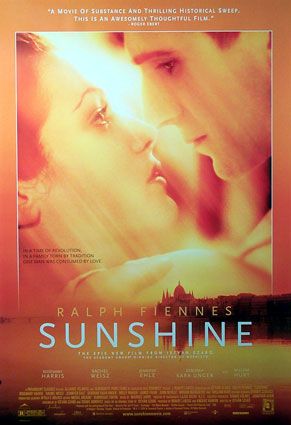
István Szabó’s Sunshine (1999)

I’m in two minds about István Szabó’s epic movie Sunshine. It tells the story of a family of Hungarian Jews, the Sonnenscheins (which means Sunshine in German), from the end of the 19th century until the end of the 20th. While I think it told me a lot about Hungary and the treatment of Jews in Hungary, I was far less thrilled about the length (3hrs) and the choice to have the three main characters, grandfather, father and son played by the very same actor, namely Ralph Fiennes. I would have found this artificial with any actor but given my dislike of Fiennes, it added annoyance. If you do not mind seeing the same actor in three different roles and are fond of Ralph Fiennes, you will probably like this movie a lot. I do not understand why Szabó chose to do it like this, why couldn’t there be three actors? I remember the Archers chose the same approach in The Life and Death of Colonel Blimp in which Deborah Kerr plays three different women but that worked much better.

The Sonnescheins are a modest family but then the patriarch invents a recipe for a tonic which makes them incredibly rich. As a direct result of their social ascendance, the two sons, Gustav and Ignaz, both study and become doctors, of medicine and law respectively. While Ignaz is loyal to the Emperor, Gustav feels more and more alienated by monarchy and becomes a communist. WWI changes not only Hungary but Europe as a whole. The biggest change in the lives of the Sonnenscheins’s however is that they choose to change their name from Sonnenschein to the more Hungarian sounding Sors. Long before WWII breaks out, the Jews are seen as a nuisance and it is very hard for them to integrate.

Ignaz’s and Valerie’s son Adam becomes the Hungarian fencing champion and wins at the Olympics in 1936. After having changed their name, the Sors also change their religion and the family converts to Catholicism. Still, this doesn’t help them, when WWII breaks out, the family first lives in the ghetto, some are killed, some escape and Adam and his son Ivan are sent to a concentration camp where Adam is tortured and killed. His son will never forgive himself that he just stood there and did nothing. After the war he joins the communist party. Anti-Zionist sentiments are spreading. The government changes often and depending on who is in charge, other groups are persecuted but what they all seem to have in common is that anti-Semitism reigns again.

When the end of the communist state has finally come, Ivan realizes that the only way to be really free, is to be true to yourself. He decides to change his name back to Sonnenschein and to be proud of his heritage, no matter what government and changes the future will bring.

While I wasn’t blown away by the movie and would have preferred if the main character had been played by three different actors instead of one, the movie isn’t bad at all. It had a lot of thought-provoking elements. There is the incident in the concentration camp in which three guards control 2000 prisoners. Ivan’s uncle later tells him that it is unforgivable that they didn’t do anything. This is a reproach one hears occasionally. People don’t understand why 2000 wouldn’t fight against 3 or 10 even if those were armed. The movie implies an answer which is interesting. It is obvious that if they had fought back the guards, some of the Jews would have been killed. The majority would have been saved but that would have needed the sacrifice of a few others.

Another interesting element is the fact that Hungarians sent Jews to the camps and not Germans. There were a lot of collaborators among the Hungarians. The movie underlines that the Hungarian society, whether it was during the monarchy or later under communism, was to a large part anti-semitic.

What I really liked is that the movie focusses on one family only and like that manages to give a much better feeling of the incredible changes which took place. To enhance authenticity Szabó included some original footage which in some cases was quite chilling. When Adam takes part in the Olympics of 1936, Szabó included original footage of the opening in which we see Hitler.

Because it’s a very long movie, it’s a very complex movie and I know I didn’t do it justice. There are for example some very troubled love stories which I didn’t mention in my summary but which are quite important. I liked the story between Valerie (Jennifer Ehle) and Ignaz but didn’t care for the love triangle including Adam, Hannah (Molly Parker) and Greta (Rachel Weisz).

I would recommend Sunshine if you like epic films and have an interest in the history of Hungary and the Holocaust from another perspective.

http://www.youtube.com/watch?v=–DgEEmYTm4&feature=player_embedded

The Big Parade (1925) A Guest Post by nem baj

Today’s review is a Guest Post by one of my regular visitors, nem baj. It’s a post on one of the great war movie classics. I hope you will enjoy it.

The Big Parade (1925), the mother of all war movies?

The biggest hit of american cinema until Gone With the Wind was a war movie. Its commercial success was a surprise: in 1925, so close to World War I, the subject was still considered to be doomed at the U.S. box-office. King Vidor’s The Big Parade definitely reversed the tide, and its later influence on so many filmmakers makes it a must-see for the readers of this blog (1).

The Big Parade follows Jim, a young American man from an upper-class family who, like many others of different backgrounds, enlists in the Infantry and goes fighting in Europe. He will experience military life and love in the French countryside, then the horrors and glories of the Great War. This simple storyline is a perfect vehicle for a very strong theme in the director’s work: that of the individual at grips with society, the pressure of one’s social circles and the collective passions of the time (from The Crowd to The FountainHead).

Between two ‘book-ends’ sequences about Jim’s (John Gilbert) civilian life, the story is two-fold, almost perfectly symmetrical. The first part looks like a ‘military comedy’, young troopers making buddies and flirting with French women despite the language barrier, getting into rows, coping with the oddities of service… It is nicely shot, funny like only silents can be, and full of Vidoresque traits. For instance the scene when Mélisande (Renée Adorée) watches Jim’s buddy naked under their improvised shower – this was of course pre-code – which will find its clothed replica in The FountainHead; the moment when she rubs on her skin a rose she just picked, in order to smell good, and of course the chewing-gum initiation…

At some point the first time viewer might be tempted to wonder where this is going. After all isn’t this depiction of, well, American sex tourists, while so many others were dying, outrageous? Now, if these idyllic moments got to you by their simple poetry and lust for life, you’re in for a dramatic turn right in the middle of the film. In a masterful eight minutes scene – the departure of Jim’s unit for the front, leaving Mélisande behind – your heart should be wrenched, and you’ll start to feel exactly what humans leave behind when a war starts.

Then comes the second part, with its emblematic shots. The symmetry between the column of rookies riding to the front and the column of ambulances bringing back the wounded (Monicelli’s train scene in La Grande Guerra), the claustrophobia of the shell-holes (Milestone’s All Quiet…, Kubrick’s Paths of Glory), the difference between war and murder (Kobayashi’s Human Condition), the ensemble march in the woods (Kubricks’ Full Metal Jacket final shot), the contrast between disciplined fighting and the rage when your friends are killed (too many to list), etc.

Sure, you’ve seen all this in later movies. But this is the original grammar book, and Vidor is at his best: the cinematography, the editing are amazing, constantly switching between very wide shots and intimate ones to compose a lyrical vision of… hell. For war is undoubtedly a man-made hell in this film. Yet, the tour de force of Vidor’s movie is that it is beyond the pacifist debate: « The Big Parade charts a modern progress through a crazy world. Neither picaro nor pilgrim, [Jim] drifts, marches, stumbles upon a landscape he never made »(2).

The last ‘bookend’ sequence, the return to civilian life, might seem quaint. Yet it does not depart from the lyricism of the work, torn between human despair and hopes. The flashback in the mind of Jim’s mother, the ending between Jim and Mélisande (a soft rehearsal for Duel in the Sun‘s finale?) should please any opera lover, and the ‘lost generation’ gaze of John Gilbert when he rides home with his father is probably the best introduction to Scott Fitzgerald ever filmed…

1) No DVD yet, you may watch clips here (click twice on the “play now” links on the right to avoid the ads).
2) Raymond Durgnat & Scott Simon, King Vidor, American, Berkeley: University of California Press, 1988.

Thanks, nem baj, for a great contribution.