Clash of the Titans (2010)

I always end up watching movies in which Mads Mikkelsen is starring. So far I have never been disappointed. So far. Clash of the Titans has a weird cast but I think it says more about the cast than about the movie. While it’s a guilty pleasure with a war theme it’s not exactly a good movie with the exception of a few scenes. Despite all that, it’s fun. I liked the giant scorpions. They are really cool. Now briefly to the cast before I summarize the whole film.

Liam Neeson. There was once a time when he made good movies but recently he’s a major disappointment and since he is even in Battleship I start to have a feeling that whenever his name is on the cast list this could very well mean “avoid”. Ralph Fiennes. Yes, Ralph Fiennes. What the heck is he doing in this movie? Neeson and Fiennes both play powerful gods, while Fiennes plays the role of the bad guy – Hades, Neeson plays the role of the good one – Zeus. Both sport odd haircuts and halos that make them look like drag queen putti. Apart from these two the other actors mostly do a decent job  – or at least one that makes the movie watchable. I haven’t given up hope on Mikkelsen – he is even good in this one – but I’d advise him not to accept too many roles like this.

Perseus (Sam Worthington), a demi-god, son of Zeus is dragged into a battle between the Gods and the mortals. Hades, God of the underworld and master of the Kraken, demands the sacrifice of Princess Andromeda, the daughter of King Cepheus of Argos who won against the gods. If Andromeda isn’t sacrificed, Hades will unleash the Kraken. King Cepheus asks Perseus, the only human capable of fighting against gods due to his half-god nature, to find a way to defeat the Kraken. Perseus accepts because Hades has killed his step family and he wants revenge. The only way to win against the Kraken is by defeating the Medusa and cutting off her head.

Many people have been offended by the liberties the movie took with Greek mythology. I didn’t expect it to render the myth of Perseus and the Medusa, I thought it would be an action movie with a Greek mythology flavour. And that’s exactly what it is. Nothing more and nothing less. If you look for two hours of entertainment and haven’t seen the first one, try it. It’s quite fun.  Did I mention the scorpions? I really liked them.

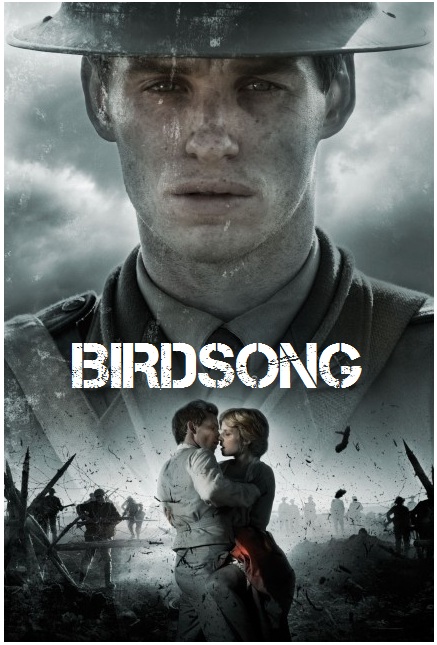
Birdsong (2012) Part II of the WWI Drama

This is just a very quick post, an update really. I watched Part II of Birdsong, the BBC One TV drama based on Sebastian Faulk’s novel, on the weekend.

Here is what I wrote at the end of post I.

I didn’t mind watching it, I even liked it, but it isn’t great, it’s just very watchable. I’ll tell you my final impressions once I have watched part II.

Well, here are my final impressions. While part one was heavy on the romance element of the story, part two is much more about the war. The story is still told alternating flashbacks and episodes in 1919. Stephen has been at war for the whole duration of the war. Part II managed to change my view of the whole series completely and I have to say, I liked it a lot. I even thought that Eddie Redmayne was after all the perfect choice for this role of a heartbroken man trying to survive the horrors of the trenches.

Don’t miss it if you get the chance to watch it.

The Dam Busters (1955)

The British classic The Dam Busters is and will always be one of my very favourite movies. It shows eloquently that the best stories are often those which are true. It’s the story of two men and a mission which was as ingenious as it was heroic. One of these men was inventor Barnes Wallis (Michael Redgrave), the other one Wing Commander Guy Gibson (Richard Todd). The movie is based on two books, Paul Brickhill’s The Dam Busters and Wing Commander Guy Gibson’s Enemy Coast Ahead.

The movie has a two-part structure. In the first we see how Willis invents the revolutionary bouncing bomb. The idea was to use the bombs and blow up the Ruhr dams in Germany. The destruction of the dams would not only  flood a huge area  but disrupt the German wartime industrial production as two big hydroelectric plants would go off-line. In order to blow up a dam the bomb had to land exactly on target which was only possible with extreme precision. The planes had to fly very low and used a cunning device to make sure they were at the right altitude and distance when dropping the bombs.

While Wing Commander Gibson was training the 617 Squadron – a special squadron of Lancaster planes – to fly at night at extremely low altitude, Willis was still conducting one trial after the other until he got the right bomb. Once he had the bomb and the date had arrived, it was in the hands of the pilots to make it work. This second part is extremely suspenseful. Of the 19 planes who flew on this mission only 11 returned. After the mission was accomplished, Willis said to Gibson that if he had known the cost, he wouldn’t have devised the bomb but Gibson assured him that each and every one of the dead pilots would have flown anyway.

The story of The Dam Busters is so amazing because there was such a lot of adversity. If it hadn’t been for Willis believing until the last moment that it would work and for Gibson and his men who thought the unthinkable was feasible, it wouldn’t have happened. It’s really amazing watching them, each on their side, adjusting, inventing and probing until they got it right.

Most of you may know that the remake of The Dam Busters should soon be out. This is one of the remakes I find almost sacrilegious. The movie has no great special effects but it tells a great story and the two main actors are very good. Eric Coates music is very famous and still considered to be one of the best war movie scores.

I’m sure the special effects of the remake will be better but I’m afraid it will be a very slick movie, lacking the warmth and enthusiasm that came across in the first. We will see.

Birdsong (2012) Part I of the WWI Love and War Drama

I finally managed to watch Part I of Birdsong, the BBC One TV drama based on Sebastian Faulk’s excellent eponymous novel. They chose to tell the story moving back and forth between 1910 and 1916.

Stephen is fighting in the trenches and thinking back on how he meet Isabelle, in France, in 1910. He stayed at her house and helped her husband, a factory owner, develop new machines. Those machines were going to make a lot of the workers lose their jobs.  The marriage is an odd one. The children are from a former wife, Isabelle and her husband have no children together. At night Stephen hears her cry, during the day he watches her sneak around. She tells him later that she brings bread to the worker’s families.

Isabelle is clearly what the French call a “mal-mariée” – a woman unhappy in her marriage. Stephen is much younger than her husband. He is kind, caring and very attentive. We can’t blame her for falling in love.

All this is shown in flashbacks while Stephen is fighting in the trenches. He is a Lieutenant and has the reputation of being very quiet and superstitious. He seems to have no family, friends or a sweetheart. The trench they are in is above a tunnel system dug out to lead under the German trenches where they could be blown up. The diggers hear that the Germans are digging on the other side as well and are quickly approaching. Usually miners were sent down, not infantry men, but the commanding officer decides that Stephen and his men have to go down as well. Stephen had a problem with one of the miners before and now he is sent down with him.

I’m looking forward to part II as I have forgotten the rest of the story. Or at least the rest of the love story. When I read the book I was much more impressed with the parts on WWI. Although the movie starts in the trenches, it still is much more of a love than a war movie and can’t even be called a war romance as I would only call a movie “war romance” when the romance is set during the war.

I didn’t mind watching it, I even liked it, but it isn’t great, it’s just very watchable. I’ll tell you my final impressions once I have watched part II.

The Round Up – La Rafle (2010) – Operation Spring Breeze or The Round Up of Vel d’Hiv

The French/German/Hungarian co-production, The Round Up – La Rafle, is a powerful and intense movie based on true facts. In the nights of July 16 and 17 13000 Parisian Jews were arrested in a raid in Paris and confined in the Vel d’Hiv (Winter Velodrome) or Drancy internment camp and from there to the extermination camps in Poland. Of the 13000 arrested Jews only 25 survived. Many among them, at least 4000, were children. Not one of them survived. The aim was to round-up 25000 Jews but 10000 escaped and were hidden by the people of Paris. The most shameful part was played by the police who actively contributed to make this happen. French President Jacques Chirac apologized in 1995 for the complicit role that French policemen and civil servants served in the raid.

The movie begins with original black and white footage. We hear Edith Piaf sing “Paris” while we follow Hitler on his tour through the city. That sent shivers down my spine. To think that if the Germans had won the war, Hitler would have made Paris his capital. In the pictures he looked like a guy inspecting real estate, deciding on what walls to knock down, what to keep. Horrifying. Here is an account of Hitler’s tour, written by his pet architect Speer.

After the opening we see people in a Parisian street located in Montmartre. The street scenes show that French and foreign Jews amicably lived together with non-Jewish Parisians. Many French people are friendly towards the Jewish population, but others are openly hostile and hate them. The movie focusses at first on a few Jewish families. It shows how secure they felt. They didn’t think the French government would ever give in. But it did. In exchange for privileges it promised to round-up the Jews and deport them eventually.

After the round-up we see the scenes in the Vel d’Hiv and the point of view changes. A young French nurse, Annette Monnod (Mélanie Laurent), has been sent to help alongside a Jewish doctor (Jean Reno). The doctor and a handful of French nurses are the only health care professionals for 13000 people. There is almost no food, no water, no toilets and the hygiene is abominable. Many of the children are ill. There are doctors willing to come and help but they are not let in. Operation Spring Breeze, as this round-up is called, should be kept a secret. While there are many collaborators among the French, there are many more who are hostile towards the Nazis and willing to risk their lives to save Jews.

Annette becomes very attached to the children and does everything to help them survive. She follows them to camp Beaune where they stay until they are finally deported to Auschwitz. Until the last day many think, they are sent to Poland to work. Rumours that those camps are extermination camps are only spreading very slowly.

I really loved this movie. It moved me, I found it very touching and emotional.  I would say that of all the Holocaust movies I’ve seen, this is my favourite. I liked that it focussed on a few Jewish families with different backgrounds. Some rich French Jews, others immigrants and people who fled from other countries. Those individual stories are more interesting and touching than the story of a mass of deported people. In chosing Annette, a French nurse, we see how far the “good” Parisian people went, risking life and health for others. It’s such a shameful chapter in the history of France, its important to remember that there were courageous people as well.

The only thing I didn’t like so much was the end. It should have been different but I cannot tell you why or I would spoil the movie. Considering how excellent the rest is, this is a minor fault. I added The Round-Up to my Children in War Movies List. It’s an excellent example. Other Holocaust movies can be found here: 13 Holocaust Movies You Should See.