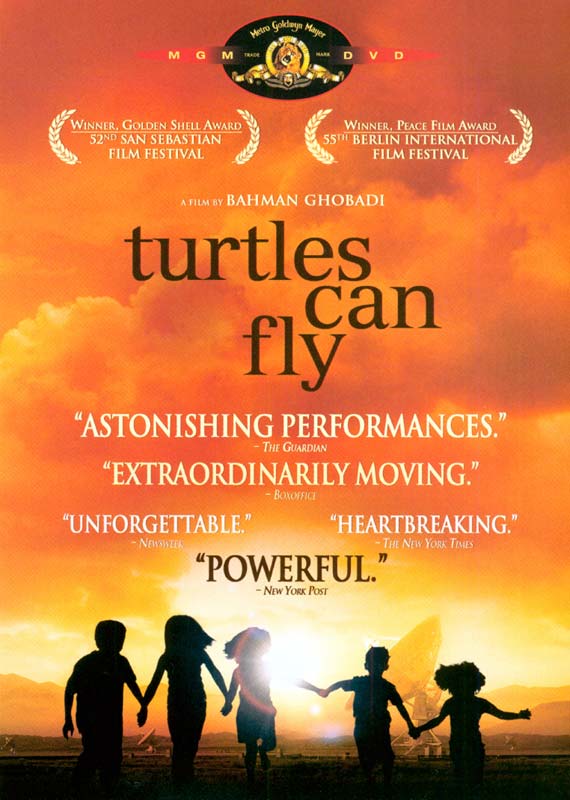
Turtles Can Fly aka Lakposhtha parvaz mikonand (2004) Iraqi – Iranian Movie on Children During Wartime

turtles-can-fly-2004-lakposhtha-parvaz-mikonand

Occasionally I’m tempted to stop watching war movies. After all, it’s hardly ever cheerful. But there is a huge difference between “not cheerful” and “utterly depressing”. And while combat movie’s are rarely cheerful, they are often not utterly depressing. On the other hand movies focussing on the way common people, and especially children, are affected by war, are often extremely depressing. Among all these depressing movies on the fate of the civilians the Iraqi-Iranian movie Turtles Can Fly, might be the saddest I’ve ever seen. While it’s an excellent film, it’s almost unbearably bleak.

The film starts with a small girl committing suicide. She jumps from a cliff. The story then rewinds and we get to know why she did it.

Somewhere near the Turkish border, just before the war in Iraq breaks out, a group of people live in some houses close to a refugee camp. The elders of the village hire a young boy to buy and install a satellite dish. They want to know if war is coming. The boy is funny, entrepreneurial, and clearly relishes being the only one who knows something about technology and a few English words. He’s maybe 12 or 14 years old (sorry I’m bad at judging the age of children) and runs many small businesses. One of them consists in having other children collect mines which he then sells on the local markets. The whole area is a huge minefield and collecting them is vital because as long as they are on the fields, the farmers cannot work.

Many of these children who collect mines are missing limbs from the one or the other unlucky encounter. The film maker used only children with real deformities and missing limbs which adds authenticity and makes watching it even more harrowing.

“Satellite”, as they call the young boy, falls in love with one of the refugee girls. A very pretty girl who is there without parents but with her older brother who has lost both arms and a small child who has a problem with his eyes. She is the girl who will commit suicide and to learn her story was almost too much.

While there are some funny scenes dedicated to “Satellite” and his business, I’ve rarely seen such a bleak movie. The poverty of these people is extreme. They live in the cold and the rain, there are hardly any trees or buildings, just some huts and tents and a lot of mud. Their situation has a lot to do with former wars. They are surrounded by danger and helpless. Without a proper system of information they are at the mercy of everyone. They never know what hits them or why.

I wasn’t enjoying watching Turtles Can Fly but I was glad I did. This movie is bleak, depressing and heartbreaking but at the same time, it’s very good. The young actors are astonishing, the message is eloquently anti-war.

Here’s the trailer

And the full movie

El Alamein – The Line of Fire aka El Alamein – La linea del fuoco (2002) An Italian War Movie

El Alamein

Italian movies on WWII are rare, so when I saw El Alamein – The Line of Fire aka  El Alamein La linea del fuoco in a DVD shop I had to buy it right away. Thankfully it was well worth buying as I will certainly watch it again. Sure, the year is still young but I think it’s safe to say that this one will be on my Best of 2013 List. I liked it a great deal.

El Alamein is told from the point of view of philosophy student Serra. Serra has volunteered in 1942 after hearing that the Italian troops were in urgent need of reinforcements. Following the point of view of a young, naive and inexperienced private is common in war movies but in this case it works particularly well as Serra is the philosophical, introspective type. Seeing through his eyes gives the movie a lyrical feel that is underlined through a beautiful score.

Serra expects to see action right away but the Pavia Division, located on the southern line in Egypt, is more like an outpost. Boredom, inertia, heat, hunger, thirst and endless days of waiting for an enemy they cannot see but who bombards them frequently is the daily fare. This allows the men, to get to know each other, to experience the desert fully; its harsh beauty and the dangers it brings.

When they go on reconnaissance they have to fear for their lives as the terrain around the outpost is covered in mines and walking about is dangerous.

The situation is also very absurd. What are they doing there? What are they guarding? Nothing much is happening. I felt reminded of Dino Buzzati’s excellent novel The Tartar Steppe (Il deserto dei tartari).

When the British finally attack, the Italians do not stand a chance. There are twice as many British troops, they are better equipped, better fed, their morale is much higher. The Italians are demoralized for many reasons. The Germans don’t take their ally seriously, they let them do the dirty work. As it was so often the case, the high command of the Italain’s proves to be clueless. In one scene it is shown that while there is no food or water, truckloads of shoe creme are sent through the desert for a parade.

After the attack during which almost the whole of the Pavia and other Divisions died, the troops flee in confusion, not knowing where to go and what will happen next. Serra, Sgt Rizzo and Lt Fiori end up on their own and try to get through the desert with hardly any food or water.

While the first half of this movie is very quiet and takes a lot of time to give us a feel for the situation the Italians faced and to introduce the characters, the second half is action driven.

The funny thing is that while watching this, you soon forget that the Italians were fighting on the wrong side. The characters are so likable and they seem such helpless victims of their government that you can only feel pity.

I liked the many intimate moments, the discussions between the soldiers, the mood, the atmosphere. At times the movie felt like a combination of All Quite on the Western Front and Ice Cold in Alex.

I highly recommend this wonderful movie to anyone interested in war movies and WWII.

I couldn’t find a trailer, let alone with English subtitles, but here’s the full movie – in Italian.

http://www.youtube.com/watch?v=iTprjxwjz8M

Carriage to Vienna – Kočár do Vídně (1966)

Carriage_to_Vienna

A comment by Stillwell on my post War Romances: A Very Long List led me to the Czech movie Carriage  to Vienna  aka Coach to Vienna – Kočár do Vídně. While it’s not exactly what we would call a romance, it’s a love story and I will include it in the list once I get a chance to update things.

The movie can be watched on YouTube as a whole in Czech and while I was a bit startled by Stillwell’s comment that we don’t need the subtitles, after having watched it, I agree. All you need to know is what is written in the intro.

The movie, which is set towards the end of WWII, focusses on one long scene, the trip through a forest in direction of the Austrian border and Vienna. The back story, as mentioned before, is written as an intro. Krista’s husband has been killed by Germans as he was suspected to have stolen something. She buries him and when she’s finished two young soldiers who know nothing of what has happened come to the farm and force her to drive them through the forest. The two soldiers are Austrians, one of them is badly wounded.

Hans is a very lively young man and chats constantly with Krista although she doesn’t seem to understand a word of what he is saying. The way this is filmed, the forest seems endless and as it is winter or just before spring, the trees are naked. A very bleak scenery for sure and the focus is on the three people on this carriage. As Krista is never speaking, we have to deduce her hostility from her actions and her expressions.

There is an axe hidden under the carriage of which the soldiers know nothing. Krista tries to hide it and to get rid of the soldiers’ weapons. Whenever the carriage stops for one reason or the other, she throws away something; a knife, a pistol, a gun…

The drama culminates when she is found out by Hans and he chases her from he carriage into the woods.

Where is the love story in all this, you may wonder, but that’s something you have to find out for yourself.

Not a lot happens in this movie. The protagonists do not understand each other but it’s clear that Hans is a kind man who has been dragged into the war and is on the wrong side because of his nationality. Krista who is full of hatred at the beginning of the film, slowly learns that not all Germans are the same.

This movie wasn’t appreciated in Russia, maybe even forbidden. It’s obvious why. At the end, the Czech woman and the Austrian soldiers, try to flee from the Russians who show no mercy once they get them.

I found this a very captivating, sad and impressive movie and am glad for the recommendation.

They Were Not Divided (1950)

THEY WERE NOT DIVIDED

I’m usually quite lucky in my choices of older British movies. Some I’ve watched in the past make my extended best of list. However, They Were Not Divided will not be on that list. It’s not a bad movie but it felt at times as if the director had intended to make a war movie – based on true events (!) – which is suitable for the whole family. The result is a bit too cute for my taste.

At the core of the movie is the friendship between a British, an American and an Irish soldier. Especially the Englishman Philip Hamilton and the American David Morgan are very close. After having undergone intense training which we are shown in a long boot camp sequence, which reminded me a bit of Full Metal Jacket, the three men are promoted and assigned to serve in the tank company of the Welsh Guards.  Two thirds of the film are taken up by the boot camp and further tank training episodes, occasionally interrupted by leaves which they spend at Philip’s home. During one of those leaves, David meets an English girl and falls in love with her.

There is a lot of emphasis on the relationships in the movie. The marriage between Philip and his wife is explored as well as the relationship between David and his future fiancée.

The last part of the film, could finally be called the real war movie part. The three main characters land at Normandy weeks after D-Day as part of the Welsh Guard’s Armoured Division. They quickly see combat and have to cope with fighting a war in another country, far from their wives and girl friends. The film then picks up speed and we see many of the crucial moments of WWII: Operation Market Garden, The Battle of the Bulge. We see how the Welsh Guards join American paratroopers at the Grave bridge before moving to Nijmegen during Operation Market Garden. The film ends with the Ardennes Offensive and the Guards’ unknown operations around the east side of the river Meuse. I suppose it isn’t spoiling the movie too much if I mention that not everyone survives.

I think They Were Not Divided isn’t exactly a must see but I’ve seen far worse. It’s an ok movie, it just doesn’t really have anything that stands out with the exception of some quite humorous scenes during the boot camp sequence. It’s safe to say that even the very squeamish can watch this. If you’re looking for a WWII film to watch with the whole family, this could be your choice.

b00tgdkn_640_360

Platoon (1986) Oliver Stone’s Iconic Vietnam Movie

Platoon-PosterArt

Platoon is one of those war movies I have seen quite a few times and every time I discover something new. It’s one of those which has stayed among my Top 10 after each viewing, I never even considered to remove it like I did with some of the others.

It’s a powerful anti-war and anti-Vietnam movie. There is no doubt about Oliver Stone’s position. Stone is a veteran of the Vietnam war, Platoon was the first in his Vietnam trilogy, Born on the 4th of July and Heaven and Earth were the other two.

Reviewing it seems odd as I have a feeling it’s one of the most famous war movies and almost everybody who likes war movies knows the story to some degree. I will therefore only give a very short summary.

Chris (Charlie Sheen) volunteers to go to Vietnam. He is a college student unlike most of the others who are in his company and wouldn’t have had to join up but since his father fought in WWII and his grandfather in WWI he felt it was his duty. He is the typical naive recruit, one of those who usually get killed in the first week but he survives. He learns a few things which will help him to survive and looses a lot of his illusions.

The main story is certainly Chris’ transformation only I never saw it as that before. It’s only now that I’ve watched it for the third time that I realize how important it is. Until now, the story that I was most interested in was the story between the morally good Stg Elias (Willem Dafoe) and the bad Sgt Barnes (Tom Berenger). Barnes represents everything I hate in a character while Elias is – together with Lt David Manning from When Trumpets Fade – my favourite war movie character. Barnes shows the worst aspects of the war in Vietnam while Elias shows the best. The fight and hatred between the two makes for intense viewing.

Barnes and Elias never get along and after a massacre in a village they become open enemies. Based on a true event (My Lay Massacre), the massacre is one of the most sickening scenes I have seen in any war movie.  

Elias is a saviour figure or sacrificial hero and, as I have written elsewhere (see below), it’s not surprising he was cast as Jesus in The Last Temptation of Christ, just like Caviezel was cast as Christ after having been in The Thin Red Line in a similar saviour role.

Many elements speak for the comparison of Elias and Christ. The most obvious is the iconic poster showing him with his arms outstretched. In the movie there are different instances which emphasize this further. One person says that he thinks Elias is Christ, Barnes says of him that Elias is one of those who think they can walk on water. And there are more.

What I had forgotten is the character of Chris who is at first naive and then gets swept away by the collective acts of violence. This shocks him, it shocks him to see that he is capable of such violence at all. I think that at the end, Chris is the most important character as he is neither black nor white but just an “ordinary good” guy who becomes violent under certain circumstances. What is interesting is the fact that the movie shows that he cannot go back to the state he was in before he acted brutally. This seems crucial too and is exemplified by his final actions.

Platoon is certainly a must-see war movie and will always be one of my favourites.

Platoon is a war movie to which I return frequently and I’ve written a bout it quite a few times before:

Is Platoon a War Movie?

History versus Story or Platoon versus Hamburger Hill

Obnoxious and Unlikable War Movie Characters

My Favourite War Movie Character

Christ and the War Movie Hero

http://www.youtube.com/watch?v=daN61E2JO3c