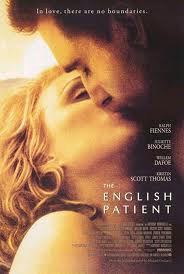
Anthony Minghella’s The English Patient (1996)

Rarely did a movie deserve the Academy Awards as much as The English Patient. It is one of the most beautiful war romances that I have ever seen. Or, to be accurate, two of the most beautiful romances as the movie tells two parallel stories. Based on Michael Ondaatje’s wonderful eponymous novel, The English Patient combines everything that an accomplished movie needs. Beautiful pictures, a touching story, an intriguing plotline, wonderful music, great characters  and outstanding actors. This is one of the movies that I have watched at least three times and every time I discovered another layer. It is surprisingly rich and, I would argue, flawless.

They call him “The English Patient” (Ralph Fiennes), the mysterious man, they rescued from a shot down airplane in the desert during WWII. He is heavily burned, will probably not survive. They bring him to Italy and a young nurse, Hana (Juliette Binoche), volunteers to stay back and take care of him. She moves with him into an abandoned villa. He doesn’t know his identity but Hana finds a notebook and with its help the memory returns slowly and the story unfolds in flashbacks.

They are not alone for long, Kip (Naveen Andrews), a young Sikh and the thief David Caravaggio (Willem Dafoe) join her. Kip is part of a bomb disposal unit and the growing love between Hana and him is the second love story in this movie. It is beautiful but by far less tragic than that between the English patient and his lover. Caravaggio adds even another story line to the already rich plot. He is someone who thinks he knows who the badly burned man is. In fact he is sure that the patient is someone who wronged him once.

The flashbacks show us the mysterious patient, the Hungarian Count Almásy, 1930 in the Sahara desert. He is a mapmaker of the Royal Geographical Society. At the beginning of WWII he is still in the Sahara where he meets the British agent Geoffrey Clifton (Colin Firth) and his beautiful wife Catherine  (Kristin Scott Thomas). Despite their fighting the attraction, they fall in love. They have an affair that ends abruptly when Catherine breaks it off. They meet again later and the following events make this probably one of the most tragic movie romances of all time.

The figure of Count Almásy is actually based on a real person, only his story was a different one.

The nurse Hana is certainly one of the most appealing nurses in any war movie. The gentleness and devotion with which she takes care of the dying man is touching. I am sure that there were many nurses like her in different wars and they deserve an homage.  I have a great deal of admiration for these courageous, disinterested women.

The intensity of the interwoven stories, the mysteries, the wonderful settings (the desert, Italy during the war, the Italian villa), the gripping part of the bomb defusing, all this together make this an absolute must-see.  Last but not least I’d like to mention the beautiful score by Gabriel Yared (you can listen to it here).

Patton (1970) A Great Actor in an Excellent Biopic

Patton is a fascinating, surprising movie and totally not what I had expected. Especially not after the first ten minutes in which we see George C. Scott perform the so-called Blood and Guts Speech. Quite off-putting, to be honest. As much as I like transparent and open communication, this wasn’t promising. What I sensed at the beginning is exactly what the movie has been reproached of doing, namely not taking an anti-war position. 1970 was not exactly a time in which people were in favour of a movie that seems to glorify warriors. Well, that is not what it’s a l about as I discovered when I watched the rest. No, this is an excellent biopic with an absolutely amazing main actor. A portrait of a character with numerous dazzling facets.

The movie follows Patton’s WWII years, starting in Africa, continuing in Europe, until the moment when he comes to rescue the by now famous 101st Airborne at Bastogne.

Patton is mentioned in many a war movie but we do not see him so often. We know that there was a lot of competition between him and the British General Montgomery and ultimately also between him and Feldmarschall Rommel. Rommel seemed to have had a lot of respect regarding Patton’s skills, whereas Montgomery was too full of himself to register anyone else (what a peacock).

Patton is an epic character, a larger than life figure but what puzzled me most is his belief in reincarnation. This isn’t what I had expected and it was the element of the movie that fascinated me the most. He was convinced to be the reincarnation of an ancient warrior, he even remembered some battle fields from former lives. On the other hand he was a believing Christian. Truly a man of many contradictions or rather complex aspects. He wrote poetry but despised cowardice which led to an unlucky event – the unfair slapping of a shell-shocked soldier – that cost him his position.

Precisely this event surprised me even more than his belief in reincarnation. I’m not saying people should be slapped, no matter what for, but that this led to his removal from command seems very surprising, humiliating and also unfair. I rather assume that Washington didn’t approve of his being to outspoken. Plus he was absolutely not Russian friendly and didn’t make a secret of it.

All in all I think this is truly one of the most spellbinding biopics or character studies I have ever seen. Such a fascinating personality and what a splendid actor. 5/5

Candlelight in Algeria (1944) A Forgotten British War Time Classic

Candlelight In Algeria is one of the forgotten classics from the Golden Age of British Cinema. Just like Tomorrow We Live or First of the Few.

Candlelight in Algeria is a short, fun movie, mixing facts and fiction. James Mason plays a British spy who is chased by the Germans and helped by a very feisty American girl. They form a very funny duo and flavour this spy story with elements of the screwball comedy. She is an endearing heroine, really, and in stark contrast to the British spy. She never reacts the way he would expect a woman to react. She is courageous and foolhardy at the same time and pretty much living every moment to the fullest. I don’t think she cares too much about politics. She gets involved with Mason’s character because she loves adventures.

The location, Algeria, makes for some interesting decor, the black and white works well but don’t expect a Casablanca like movie. It is totally different. You won’t find heartache, sorrow, betrayal or an alcoholic brooding silently.

The protagonists meet in Algiers, when the agent Alan Thurston (James Mason) hides in the house of friends of Susan Foster (Carla Lehmann). He is looking for a camera which contains photos that will reveal the exact location where the Allies rehearse the invasion of North Africa. Susan is fascinated by Mason and probably also fancies him from the start and spontaneously decides to help him. The unlikely couple will try to get the camera back and in doing so are constantly  hunted by Dr. Muller, an evil Nazi sympathiser. Dangerous and comical moments alternate.

Maybe it isn’t the greatest achievement of British cinema history but it is very likable and I often enjoy the contrasting of British and American characters in movies of the 40s. I found it particularly fascinating as I had just watched Patton before that begins at the very same moment in history which is at the heart of Candlelight in Algeria. This movie is occasionally also mentioned in lists of forgotten noir movies.

Under Fire (1983) War and Journalism or Whose Side Are You On?

I don’t take sides, I take pictures (Nick Nolte as Russel Price in Under Fire)

The least you can say about Under Fire is that is an extremely interesting movie with four fascinating character portraits played by four outstanding actors.

Under Fire belongs to the war movie subgenre of War and Journalism. There are quite a lot of movies in this sub-genre and a great many are from the 80s. The Year of Living Dangerously, Circle of Deceit, The Killing Fields, Salvador, Missing and later movies like Welcome to Sarajevo (see my post).

The movie opens in Tchad. The photographer Russel Price (Nick Nolte) and the mercenary Oates (Ed Harris) meet and discuss their work. Oates points out that Price isn’t much better. He is profiting as much from every war there is as Oates is. None of them is more interested in politics than the other. When they part we know that they will meet again.

Before Price departs to the latest war zone, Nicaragua, we are introduced to two other journalists, Claire (Joanna Cassidy) and Alex Gazier (Gene Hackman). Claire and Alex are a couple but she breaks up with him before leaving to Nicaragua and we already sense she will be romantically involved with Russell.

At first when arriving in Nicaragua, Price isn’t interested in background information. He wants to know if the beer is good and what the food is like. Fortunately the movie nevertheless fills us in on the basics. We hear that the revolutionaries, headed by a guy named Rafael, fight the government of president Somoza who is supported by the US and a few other details. Claire and Price meet the French agent Jazy (Jean-Louis Trintignant), a dubious character, that seems to be in favour of the rebels, they also meet the president and his press officer.

While they are in Nicaragua – falling in love, getting to know the country – something happens to Price. He meets Oates again and sees him kill one of the revolutionaries in cold blood. This makes Price understand his own actions and how cynical they are.  He becomes aware that he cannot stay out of this anymore. It bdawns on him, that the Sandinistas are right, that the government is corrupt and supported by the US who are afraid of a communist Nicaragua. In order to support the revolution, he takes a fake picture. He serves the rebels but triggers a flood of violence during which Alex is killed by the president’s soldiers (this is based on a true story). He takes a picture of this as well and triggers a reaction in the US…

What I really liked about this movie is how subtle it portrays the different people. Nolte, Hackman and Harris are very convincing, each takes another position, stays for another point of view. The cynic mercenary Oates is probably the most stringent character, the one who will make you the most uneasy, although Jazy isn’t a bad example of double standards either. Claire was the least convincing character, she rather served as a enhancer for the others.

Apparently the movie has been considered to be problematic in the US because it openly takes position for the Nicaraguan revolution. I think this is great and daring. It is an ugly chapter in US politics and many efforts have been made to forget about it as soon as possible (Noam Chomsky has written quite eloquently about this).

The movie is visually extremely convincing. John Alcott, Kubrick’s cameraman, has filmed it documentary-style.

The topic of War and Journalism always makes me uneasy. I think we should be informed but I cannot understand how people can take pictures like vultures of dying and dead people and stay uninvolved. Maybe it is not so much journalism as photo journalism that I find problematic. I am really glad for movies like Under Fire. They are valuable and important and illustrate how everything is linked, how one deed leads to another.

There is a trailer on iMDB.

Here is just a video with scenes from the movie and the original soundtrack by Jerry Goldsmith.

Paths of Glory (1957) Kubrick’s WWI Anti-War Masterpiece

Paths of Glory was forbidden in the UK and in Switzerland until the 70s. French troops disturbed the opening in West Berlin. The movie was forbidden in American cinemas for soldiers. It was forbidden in France during the war in Algeria. It was shown in Paris for the first time in 1975. What’s that telling us? That this is a radical anti-war statement that openly criticizes high command. It is powerful and thought-provoking and absolutely unambiguous as to its goal. I felt a bit uneasy that Kubrick chose to criticize French command. Didn’t he have plenty of opportunities to criticize American command? Be it as it may, Paths of Glory, which is based on a true account, is a great achievement.

The movie opens  with the Marseillaise and a voice telling the horrors of  WWI, the numbers of soldiers that get killed daily to no avail. The incident on which the movie centers took place in 1916 in France. The movie moves back and forth between the trenches and the high command residing in an elegant Château.

An ambitious general asks of the equally ambitious general Mireau to take a hill, held by German troops, the so-called “Ant Hill”. A highly symbolical name if there ever was one as people are treated no better than ants and wiped out with one simple gesture. When general Mireau informs colonel Dax (Kirk Douglas) of the order to attack the ant-hill, he is met with incredulity. Dax tells him that it is impossible and will cost an incredible amount of lives. The answer is a sarcastic calculation. 65% of the men will not survive and the outcome is not even sure. Dax wants to refuse the order but is threatened to be replaced.

The futility of the attack becomes obvious right away. Dax fights in the front line with his men who die one after the other. He and many others retreat after seeing that they can’t make it. Many stayed in the trenches, knowing damn well they would be killed and nothing could be won. Seeing the men’s reluctance to run into certain death, general Mireau orders to open fire on them but the officer who receives the order refuses.

The frustrated general then orders a court-martial. Three men are chosen in lieu of all the others and accused of cowardice. Colonel Dax, a lawyer in civilian life, takes up their defence. Like the court-martial in Breaker Morant, this is a pure sham.

Kubrick’s movie has a lot of interesting elements. Colonel Dax is one of the great war movie characters. A officer of high moral standards, free of carrerism and ambition, a just and human being. Kirk Douglas was very well-chosen for this role. He is very believable and gives a great performance.

The contrasts between the high command who is far from the action and thinks they can mock simple soldiers who are afraid, slap those who show signs of shell-shock and judge others that refuse to run into certain death, is fantastic. Paths of Glory is one of those movies that has scenes that will stay with you forever because they are emotionally true and powerful. The utter cynicism of the high command, the way they calculate losses without giving further thought to the fact that each number equals a human being, will make you cringe.

It is a movie that belongs to two sub-categories. The court-martial movies like Breaker Morant and the “Taking a hill movies” like Hamburger Hill, Pork Chop Hill, Gallipoli and The Thin Red Line.

Apparently there is a more recent French TV film Le Pantalon (1996) that quotes Paths of Glory in its major parts.

As much good as I may have said, I had my reservations. I did not understand the use of black and white. The movie doesn’t work so well from a cinematographic point of view. There are not so many contrasts and shadows as there normally are in black and white movies. Even Pork Chop Hill (far less good as a whole) looks much better. Kubrick is famous for the use of colours in his movies… I don’t see it as entirely logical that he didn’t shoot this in color. But that is the only flaw I could find. It still deserves a solid 4.5/5.