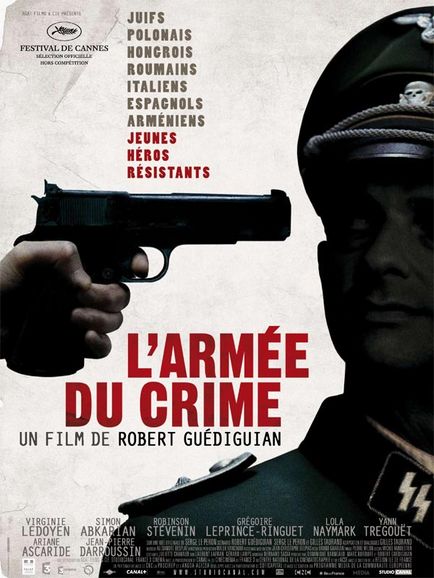
The Army of Crime aka L’Armée du Crime (2009) The Latest Addition to my Top 10 War Movies or A Gut-wrenching Movie on the French Resistance

Robert Guédiguian‘s movie L’armée du Crime or The Army of Crime is one of the best war movies I have ever seen. I already said that it entered my Top 10 immediately. The question that remains: which one I am going to kick out? I’ll have to think about this later. For now let me tell you why I think The Army of Crime is such a brilliant piece of filmmaking. Apart from being based on actual events and being historically very accurate it is beautifully filmed. The actors are outstanding. The protagonists are heroical like not many but at the same time the movie doesn’t shy away to point its fingers not only at the Germans but also at the extremely shameful role the French government played during WWII. We had the heroism of the Resistance and Partisan groups on one side and the cowardly collaborators in the government, the police and among normal people on the other side. Shame on all of them. The movie shows all these aspects, nothing is hidden.  This is the third French movie I have seen in a short period, L’armée des ombres aka The Army of Shadows being the first, The Officers’ Ward aka La chambre des officiers the second.  I must say these movies manage something that not many others achieve. They get under your skin. You don’t only watch these movies, you live them. They don’t let you indifferent. Especially not this one.

1943, Paris, the Armenian poet Missak Manouchian (Simon Abkarian) becomes the leader of a special unit of the French Resistance. His people, men and women, are all very young immigrants. They are Hungarian, Polish and Romanian Jews and Spanish, Italian and Armenian Communists. They decide to form a group and fight for France, the country of the Human Rights, to free and to defend her. They are determined and well-organized and soon will be declared enemies number one. The German occupiers and the French police strike back savagely. They hunt them and use every possible way to capture and destroy them, be it bribery, torture or coercion. In the end they are betrayed and all of them are shot.

The movie tells not only the story of the group and their actions as a whole but shows many intimate portraits of all the individual members. I have hardly ever seen a movie displaying so much diversity. This is underlined by a brilliant score with influences of the music of all the different countries that came together in this fight.

The torture scenes are very graphic. We are not spared anything. The most incredible is that with the exception of one person none betrayed the others. Not even under the worst of torture I have ever herad of. While they were operating in the underground most of their families were being deported to camps. Manouchian is an exemplary man. A larger than life character. He does not use arms lightly unlike some of the other reckless young people. He is a poet, an orphan, a gentle man, married to a beautiful French wife, Melinée (Virginie Ledoyen), whom he loves dearly.

I would like to urge each and every reader to watch this movie as my words will never really manage to convey its utter beauty. It is also worth mentioning that we see a lot of Paris.  The Army of Crime is one of those very rare movies that are, simply put, masterpieces in which every element is perfect.

The following people died for France: (AR = found on the Red Poster or Affiche Rouge):
Celestino Alfonso (AR), Spanish, 27
Olga Bancic, Romanian, 31
Joseph Boczov [József Boczor; Wolff Ferenc] (AR), Hungarian, 38
Georges Cloarec, French, 20
Rino Della Negra, Italian, 19
Thomas Elek [Elek Tamás] (AR), Hungarian, 18
Maurice Fingercwajg (AR), Polish, 19
Spartaco Fontano (AR), Italian, 22
Jonas Geduldig, Polish, 26
Emeric Glasz [Békés (Glass) Imre], Hungarian, 42
Léon Goldberg, Polish, 19
Szlama Grzywacz (AR), Polish, 34
Stanislas Kubacki, Polish, 36
Césare Luccarini, Italian, 22
Missak Manouchian (AR), Armenian, 37
Armenak Arpen Manoukian, Armenian, 44
Marcel Rayman (AR), Polish, 21
Roger Rouxel, French, 18
Antoine Salvadori, Italian, 43
Willy Szapiro, Polish, 29
Amédéo Usséglio, Italian, 32
Wolf Wajsbrot (AR), Polish, 18
Robert Witchitz (AR), French, 19

The Great Escape (1963) Tells Actually the Story of a War Crime

Maybe 90% of my readers are yawning now. I am very sorry but since I have seen The Great Escape for the first time only recently I had no clue. I thought it was basically the story of an escape, which it is, of course. The scene of Steve McQueen on a bike was very familiar as well (one of those memorable movie scenes), but apart from that: zero. I never heard it mentioned anywhere that it is based on the true story of a war crime. Are there any others out there like me who haven’t seen it yet? Maybe. For their sake I am not going to reveal why it is the story of a war crime. Just telling you, that it is.

Apart from that? Did I like it? Obviously when everybody tells you how great a movie is you start to expect something and if that is not what you get then you are slightly disappointed. So I was slightly disappointed. I didn’t expect such a summer camp like joyousness in the beginning. I rather expected something in the vein of The Colditz Story. Something a tad bleaker and grimmer. The feel of The Great Escape is much more adventure story than war movie. Plus English actors who play Englishmen  who pretend to be Germans and get away with it despite their heavy accents are not the height of realism.

What is my final conclusion? No, you are wrong, I don’t write it off but I will have to watch it again without the weird expectations that are never going to be fulfilled. A proper review will be due by the time I have watched it for the second time. After all its a classic, with a fabulous all-star cast and it’s just bad luck  I never watched it as a kid when it was on TV cause everyone who watched it then has the fondest memories. It’s definitely nice to have fond childhood movie memories. My only childhood war movie memory is A Bridge Too Far. Yeah well, not a bad one either, right?

Antwone Fisher (2002) or How One Man Was Saved by the Navy

Some movies don’t work for some people. This one did not work for me. If I hadn’t been so tired yesterday, I would never have promised a post. Maybe no one cares if I keep my promise. I don’t know, but I care. Just one little thing about the statement on the DVD cover “This is a film that can change people’s lives”. I agree. I slept incredibly well afterwards.

I am a bit sorry for being this sarcastic. Antwone Fisher tackles a topic we need to talk about, namely child abuse. If this movie manages to raise awareness, then I am sorry for my comments, but for me this was done in such an over-sentimental way… Insufferable.

Antwone Fisher is based on a true story. Antwone wrote the script himself.

Antwone (Derek Luke) was born in prison, shortly after his father had been shot dead by one of his girl-friends. The boy was taken away and given in foster care. A hellish place. He was beaten and abused. Sexually and psychologically. At 16 he is sent to a men’s shelter but he does not stay. He flees and joins the Navy. He likes it there a great deal but he has problems fitting in. He has what we term today “an Anger Management problem”. Lucky Antwone has a very kind superior officer and is sent to a Navy psychologist (Denzel Washington) with issues of his own. At first he won’t talk but then he opens up and has a real chance to heal. The psychologist urges him to find his family and in the end he does. During the sessions with the psychologist we hear the truly awful story.

There is also a love story involved. It is ok. I did not mind it as much as all the other corny details.

What is actually more interesting than the movie  – which is frankly a total failure what might explain why I hadn’t heard of it – is the extras on the disc. The real Antwone tells that the Navy was his first real home. It gave him a chance and opportunities to build up self-esteem and confidence. This is a picture of the Navy that we seldom get to see. At least over here in Europe where we are highly suspicious whenever anything to do with the American military is mentioned. It is still widely believed that the military is a place for those who have no other choice and where they might get worse than they already are. The film director is also interviewed and says that all the officers they met on the ships were kind and intelligent people and nothing like the abusive bastards we often get to see in movies.

All in all, thanks to the extras, this soppy movie has broadened my horizon a little bit.

One last element I would like to mention before finishing this post. Antwone is an African-American kid. His foster family is African-American and so is the psychologist. What the psychologist actually tells Antwone in the beginning is that the abusive behavior (the beating, not the sex) is an inheritance from the slavery days. It is passed on from one generation to the next. Rightly Antwone protests, saying that this sounded like an easy excuse. I believe, this is giving the wrong message. Child abuse is universal. Sadly it is extremely common everywhere.

I am glad for Antwone that he survived his childhood and became a very gentle and creative person. He writes poems, draws and, as already said, wrote the script himself.

Antwone Fisher

Friday Night Watching: Antwone Fisher (2002)

Until last week I had never heard of this movie before.

In order to be a 100% sure if Antwone Fisher is good or not I will have to watch it. And that is what I am going to do tonight. And hopefully I will post a review tomorrow.

Rescue Dawn (2006) or One Man´s Ordeal in a Vietcong Prison Camp

Dieter Dengler, a young American fighter pilot of German origins, is shot down over Laos, in 1965, just when the Vietnam war is about to start. Naïve and enthusiastic he doesn’t think that much harm could come his way but when he is captured by Vietcong he learns otherwise. Thanks to his astonishing resourcefulness, his unabashed optimism and his sense for camaraderie he survives the worst imaginable circumstances. He endures torture, hunger, pain and humiliations by sadistic guards, petty accusations and nagging by fellow prisoners. He carefully plans their escape and finally succeeds, only to find his ordeal is not over.

Werner Herzog is known for movies that often have lush jungle vegetation as a backdrop. No difference here. The same cinematographic language that I knew from movies like Aguirre, Fitzcarraldo, Cobra Verde and Grizzly Man that have made Herzog famous. The beauty of the forest, the plants and giant insects are captured here as well, but  then the comparison to other movies stops. Rescue Dawn was one of the most revolting films I have ever seen. Probably it is shockingly true to the events that Dieter Dengler had to endure, nevertheless I found it hard to watch. Seeing people eat handfuls of larvae and maggots was not my cup of tea. Sure it is well done and all but yuk, yuk, yuk.

Apart from being disgusted I am also awed. It´s incredible what some people can endure and how they manage to survive the worst.

Christian Bale is very good although  he acts quite badly at the beginning. Steve Zahn and Jeremy Davis are outstanding.

Required viewing for Werner Herzog fans, POW movie fans and every one like me mad enough to think they have to see every decent war movie no matter what´s at stake for the stomach nerves.