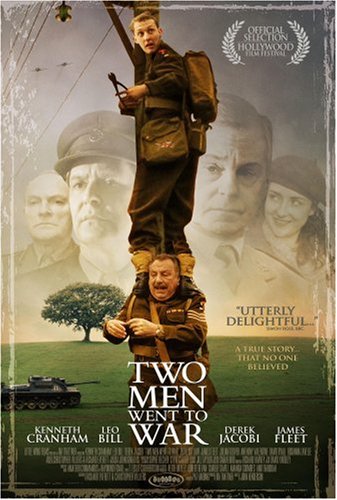
What a funny little movie. Typically British I would say. Two Men Went to War is apparently based on a true story although this is quite hard to believe. One can hardly imagine such naïve and idealistically enthusiastic men existed. Quite eccentric really.
During WWII in Britain two army dentists who are fed up with looking after teeth while others take part in the action decide to take things into their own hands. The older, a dignified character, who has seen action in WWI, convinces the younger one to follow him and invade occupied France on their own. The general idea is to blow up some German ships in the harbor. While sneaking off they send a letter to Churchill informing him of their planned operation.
Once in France they realize that things are not exactly as easy as planned. First there are no ships to blow up and second they seem a bit lost. So they need to come up with a back-up plan that includes cutting through electrical wires (just barely escaping their own extinction in the process), blowing up railway lines and a lot of other little sabotage acts. Many times they escape by sheer luck and after attempting to blow up a main Operations Room, which goes quite wrong as well, they are forced to flee and escape back home to England. On the way home by ship they are hit by a stray bomb, captured and promptly arrested for desertion. They are very lucky to avoid being court-martialled as Churchill sends someone to their help. He did indeed receive their letter and was cheered up a great deal by this picaresque little adventure.
This is a tale of heroism of the comical kind, burlesque but very touching. It is quite a silly but all in all an entertaining, well acted little movie. By the way, Leo Bill, who stars as the younger dentist, plays Hamish in Alice in Wonderland.
This was a surprisingly good movie with a profound anti-war statement. I don’t know why I did not watch it earlier. Somehow it escaped my radar. I have seen quite a few Iraq war movies and thought I had seen all possible aspects. Well, I was wrong. In the Valley of Elah is a very unusual, interesting look at the war in Iraq and what it does to young soldiers, but it is also a reflection on the changes in values of soldiers. It’s a quite complex movie. To choose the form of a thriller to tell what the director wanted to tell is quite cunning. Even though it’s not a fast movie and it takes its time to unfold what happened, it is still gripping. The time was needed as it also tries to illustrate a change in perceptions. The father who is looking for his son at the beginning of the movie will not be the same person at the end. There will be no more idealizing the military or the value and honor of soldiers.
Tommy Lee-Jones plays the above mentioned father, the retired military police officer, Hank Deerfield. He did tours in Vietnam and Korea. The military is his life. No wonder both of his sons follow the same career path. The older one became a chopper pilot, the younger, Mike, is a private who served first in Bosnia and then in Iraq.
At the beginning of the movie Hank gets a phone call informing him his son Mike is AWOL. Hank thought he was still in Iraq and doesn’t understand why Mike did not contact him. He immediately drives to the base that is located a few thousand miles away. Being a former military police investigator, he wants to look for his son on his own. This is not much appreciated by Mike’s superiors. Hank has another reason for wanting to look for Mike. A strange phone call from his son while he was still in Iraq made him very uneasy. Something terrible must have happened there.
Hank does not get much assistance at the beginning. Neither Mike’s superiors nor his comrades are helpful. And when he goes to the police and speak to Detective Emily Sanders (Charlize Theron) he is turned down. The military has to look for its personnel, as she informs him.
Even though she seems to be hardened, Emily has a very soft spot. And when Mike’s´ severely mutilated body is found and she realizes the military wants to cover up the murder she decides to help Hank to find out who did it. They start to investigate together. The closer they come to the truth, the more Hank has to accept the fact that he did not really know his son and that he has no clue what is going on in Iraq. With the help of a film on Mike’s phone and bits and pieces of information from comrades he understands that this is not Korea or Vietnam and these soldiers are of a different kind. He is disillusioned and shocked about what he finds out. And so is the viewer.
This is a multi-layered, well written and well told tale that is apparently based on true events. We have a multitude of themes here. Changes in the society and its values that also affect soldiers. What does it mean to be a good father? What values do you teach your children? Will they be able to live according to these values when everything around them falls apart? How do you keep young soldiers sane when they become aware that they are part of something that is pointless and wrong?
It is also interesting to think that a veteran probably does not equal a veteran but that it makes a big diference what war a soldier fought in.
The cast of this movie is very well-chosen. Tommy Lee-Jones looks convincingly tired, disillusioned and world-weary. Susan Sarandon‘s despair is palpable and Charlize Theron manages to play a woman whose life is all but a picnic and still looks perfectly beautiful as ususal. Although not Jason Patric´s best role, he is OK as well.
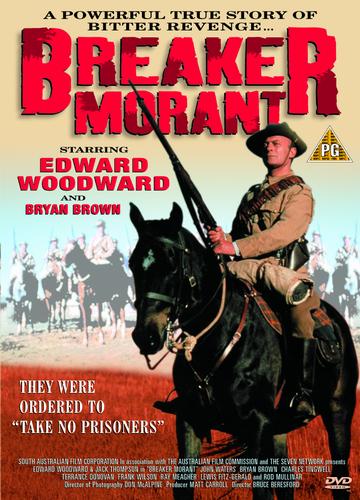
The Australian movie Breaker Morant is one of those movies that leave you thoughtful and pensive for quite a long time. It leaves you feeling helpless and infuriated as well by unmasking the hypocrisy of those in charge. It brilliantly illustrates the absurdity of war and deserves to be named together with the most important anti-war films ever done.
The movie is based on the true story of the court-martial of three Australian officers Lt Harry “Breaker” Morant, Peter Handcock and George Witton by a British court. They were accused of having shot first one, then six POWs and subsequently a German missionary. Their defense attorney Jack Thompson who was inexperienced and soon tried to accuse those in charge of the trial as well.
The movie tells the storiy alternating court-room scenes with flashbacks.
The second Boer war (1899-1902) was by far worse than the first. The Dutch started to fight a guerilla war against the British who then fought back and organized a special troop, The Bushveldt Carabineers, for wich they appointed Australian soldiers. The idea was to fight the Boer with their own means.
Harry Morant volunteered to go to South Africa because he believed in the British Empire. How utterly tragic. In Australia he was famous as a breaker of horses and poet. Edward Woodward plays this proud, upright and poised character with an excellence I have rarely seen. This is such a brilliant actor I wonder why he never made it to more fame.
The longer we watch the trial the more we realise that it is a sham. The British need scape goats to save their reputation. What those officers are ultimately accused of is what they were told to do. Only now no one wants to take responsibility for it. Of course this is also a meditation on what is good or bad during war.
Breaker Morant is interesting for cinema historic reasons as well since it is part of the so-called Australian New Wave, of which Gallipoli and The Lighthorsemen are other great examples.
Salamo Arouch, a young Greek of Jewish descent became middle weight boxing champion of the Balkans in 1939. All his 24 fights ended with a KO. An absolute record. Surely he would have had a stunning career. Instead after Germany invaded Greece he and his family were deported to Auschwitz-Birkenau together with thousands of other Greek Jews in March 1943.
While the women of the family were gassed on the first day of their arrival, Salamo, his father and his brother were coerced into forced labour. Once the guards found out that he was a famous boxer they forced him to fight other prisoners for the entertainment of the Nazis. The loser would be gassed mercilessly. Somehow Arouch survived Auschwitz winning 208 fights by KO. After the liberation he emigrated to Palestine and witnessed the foundation of the state of Israel.
This incredible story, starring Willem Dafoe (at his absolute best) as Salamo Arouch is told in Triumph of the Spirit. Shot on location at Auschwitz this is one of the most impressive movies on the Holocaust I have ever seen. It feels spooky to know that we are actually seeing the very place where all this happened. Salamo Arouch came back to Auschwitz as an advisor during the shooting of this movie. He died in April 2009.
I had so many questions while watching this… So many thoughts… What was it like to go back there after having endured all this? What was it like for the actors to play in such a movie in such a place that was saturated in pain? Can you still feel this? And what was it like to play a prisoner of Auschwitz? I think this must be one of the hardest roles for any actor. I was also wondering if this movie would not be good material to teach Auschwitz and the theme of the concentration camps in schools. And I was wondering, once more, how all this could have happened. When you see the guards, hit the prisoners, see how malnourished they are, so hungry that they would almost kill their own for a tiny piece of bread. The way they had to sleep with such little space. When you watch how thousands are forced to take showers but were ultimately gassed. When you see the piles of clothes, shoes, hair, jewelry… and the piles of bodies that had to be cremated. How could anyone help in any of this? How could that happen? I think we need to have such movies, we need to know what humans are capable of, and stay alert and never let this happen again.
Another question I was asking myself was: Would I like to visit Auschwitz? I must admit, I wouldn´t. I believe that places can store pain. I would not want to get this close to it. What about you? Would you want to visit Auschwitz?


 All About War Movies