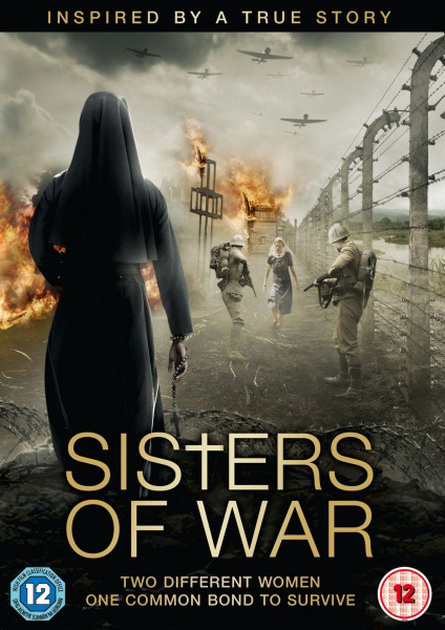
Sisters of War (2010 TV) The True Story of the Australian POW Nurses and Nuns

Sisters of War is an Australian TV movie based on the true story of Lorna Whyte and Berenice Twohill, a nurse and a nun who were held captive for several years by the Japanese during WWII. The film looks a bit “made for TV” but other than that I liked it. There are so many of these forgotten stories and it’s great when a director decides to bring them to our attention.

1942, Vunapope, Papua New Guinea, an Australian hospital camp and mission. Nurses and nuns help the wounded alongside the army doctors. When the troops withdraw, the doctors follow them to help them and, to everyone’s dismay, decide to abandon the nurses, nuns and the wounded. Some of the troops remain hidden in the surrounding forest.

The remaining sisters scan the horizon daily, hoping for the Americans to come to their rescue. When they see boats land they are at first extremely happy until they realize their mistake. The landing troops are Japanese and their mission is soon turned into a prison camp. In this mess and confusion two women, the nurse Lorna whose fiancé is among the troops hidden in the forest and the devoted sister Berenice become close friends and are a moral support for each other.

The months that follow are hard. The American bombard the mission thinking it is Japanese, while the Japanese rule with a fierce hand, punishing everyone who doesn’t comply and torturing and executing all the soldiers they capture. It’s particularly harrowing for Lorna when they capture her fiancé.

The food is scarce and the few buildings they have are constantly bombed. The mission has to be abandoned in the end. Bishop Scharmach decides to send the nurses away. They suspect that they have been sold as “comfort women” to the Japanese. This isn’t true but the plans the Bishop had, to have them exchanged against Japanese prisoners of war, doesn’t work and the nurses are sent to a labour camp in Japan.

I thought the movie was quite well done, not too sentimental and managed to show a forgotten story and is also a testimony to the great strength and courage of those nurses and sisters. As we are told in the closing credits, those nurses, as they were mostly not military nurses, didn’t get any recognition until quite recently.

It’s a nice touch that we see the real Lorna Whyte and Berenice Twohill, now elderly, sit together on a bench and chat at the end of the movie.

I really wonder how this could have happened, that the whole military, especially the doctors, just left those women on their own. They knew so well how the Japanese treated prisoners. At first I thought that the depiction of the Japanese soldiers was overly negative but towards the end, the portrayal is balanced.

The only instances in which you can see that it must have been a low-budget production is the make-up. They all look pretty odd but if you can forgive that, it’s a highly watchable movie, quite tragic but suspenseful and fascinating too.

Defiance (2008) The Bielski Partisans

After having moaned about the accent situation in Defiance (which you can read here) it’s now time to get to the review and I must say, all in all, I didn’t think the movie was all that bad. And we have to bear in mind that it’s based on a true story, the story of the Bielski partisans or Bielski brothers.

After having found that their parents had been killed by the Nazi’s who systematically exterminated Polish Jews, the four Bieski brothers flee to Belorussia and hide in the woods. The two older brothers Tuvia (Daniel Craig) and Zus (Liev Schreiber) have both lost their wives and children as well. While hiding in the forest they are joined by a group of Jews and decide to stay together and try to survive in the forest. After a while, more people seek refuge in the woods and the Bielkis take them up. Tuvia in particular brings back people from every food searching expedition which creates huge tensions between the brothers. It is clear that Tuvia is the leader and this is another source of tension as their leading style is different.

After a few weeks or months the camp in the forest is almost a little village, there are now hundreds of people who need to be fed, who need shelter and protection as the Germans swarm these woods. On the other hand there is strength in the number as they have people with all sorts of professions among them. Nurses, carpenters, teachers. After a few more months the tension between the brothers escalates and Zus leaves the group and joins Russian partisans. This is initially ideal for the group as this means additional and armed protection.

The movie shows how they struggle. The winter is particularly hard for them, many fall ill. It’s incredibly difficult to find food for so many people and they are surrounded by enemies. They have to fight quite often and there are combat situations as well. There are also a few love stories that will lead to relationships that last a life time. We also see them execute different missions, like saving people from the ghetto before they are sent to the camps.

I found the movie interesting and fascinating because it is a true story. In the end the Bielski brothers saved at least 1500 people. That’s quite amazing. I’m quite fond of Daniel Craig and thought he was a good choice for Tuvia.

While I wouldn’t say this is a must-see movie, it’s not bad at all and when you are not familiar with the story, it’s quite interesting. In any case what these brothers achieved is amazing.

Here is a photo of the real partisans

If you want to read about them here are a few articles The Bielski Partisans and Tuvia Bielski and a wikipedia article Bielski partisans.

Bertrand Tavernier’s Capitaine Conan – Captain Conan (1996)

Have you seen Capitaine Conan? You haven’t? Well then I’d like to know why you are sitting here, reading this blog when what you should really do, is chase a copy of this unique and brilliant movie? This is one of the best war movies I have seen in a while. I’m doing pretty bad with movies these days and have found my attention span is quite short but this movie had me glued to the screen. WWI movies tend to be a bit repetitive, it’s either the atrocity of the trenches, facial wounds, the analysis of the shortcomings of the high command or the incredible amount of dead and lost soldiers. All of it worthy themes but done a few times and quite brilliantly too. That’s why it was such a surprise that there is hardly any of this in Capitaine Conan. 

Capitaine Conan is based on the largely autobiographical novel Captain Conan by Roger Vercel who won the prestigious Prix Goncourt for the book. Vercel based the main character on one of his comrades.

The most interesting aspect is that the movie (and the book) takes place on the Bulgarian border where French and English troops fought a guerrilla like war against Germans and Bulgarians. There are trenches but a lot of the combat is hand-to-hand combat, man against man.

The lieutenant Capt Conan is an insubordinate, extremely wild and brutal soldier. But also someone who cherishes camaraderie. Instead of eating with the fellow officers, he rather sits somewhere with the men. He leads a group of 50 men that he calls his wolves. They are all equally fearless, brutal and, as it seems, addicted to violence but also a tight-knit group, ready to do anything for each other. There is nothing they like more than fighting man against man and mostly with knives. Because Conan is highly efficient and can turn around the course of hopeless battles, his superiors let him do as he pleases but when the war ends, things go wrong. His bloodthirsty men are too easily bored. They start to commit one crime after the other. Pillaging, raping, robbery. Conan who calls himself a warrior, as opposed to a soldier, isn’t any better and let’s his men get away with everything. Conan has long-lost his sense of right and wrong and all that he cares about are his men. War has turned him into a brute.

Among this violent crowd is a more gentle lieutenant, who wants to become a school teacher in peace time. If it wasn’t for him, who is appointed as prosecutor, Conan and his men would be court-martialled. The friendship between these two men grows slowly but once it’s established, it is indestructible.

It’s quite difficult to do this movie justice as it is very complex and quite fast-paced. Conan is a fascinating character and the way Tavernier depicts him we can’t help but admire him. In the world of WWI, in which there are so many officers who never dirty their hands but make the most important decisions without having a clue, someone like Conan, with a sense of honour and dignity, despite the brutality, becomes admirable. He is ruthless but he has a sense of loyalty and justice. The problem is, that men like him cannot go back to a normal life, once the war is over. They have gone too far.

After the war has ended, they are boarding a train and sent around without really knowing where they go. They stop in Sofia for a long time and are finally sent to the Russian border to fight the Bolsheviks. The scene in which the general informs them of the Armistice is one of the greatest scenes in any war movie ever. It’s so absurd. We see the guy talk about victory and glory, while the rain is pouring down, half of the men are running away because of diarrhea and the highly decimated band plays an off-key Marseillaise and looks like a bunch of flea-infested hobos.

I really hope I could give a halfway good impression of this wonderful movie and how rich it is. It’s very witty with super fast dialogue that I hope is well captured in the subtitles. I have a French DVD so I turned them off. It’s one of the huge problems of French cinema in translation. French cinema does live to a large extent from the dialogue which is usually fast and a lot of it isn’t translated. This isn’t a comedy but it has a lot of funny elements because it shows how absurd war is and because it juxtaposes many different levels of French society and different French regions.

As I said, the movie is available with English subtitles but the only trailer I found is a French one with Spanish subtitles. It still gives a good impression of the movie.

Lucie Aubrac (1997) A True Story of the French Resistance

I’m fascinated by Resistance stories and one of my projects is to watch at least all the French resistance movies that I can find. Claude Berri’s Lucie Aubrac is one of them. Like many other resistance movies it is based on a true story.

Lucie Aubrac is a quiet movie and despite some scenes of great violence, including torture, it has a gentle keynote.

At the beginning of the movie Lucie and her husband live in Lyon. He is in one of the resistance groups and, one afternoon, when they meet in the apartment of one of the members, he and his friends are arrested. If it wasn’t for his wife, who invents a cunning plan, he wouldn’t have been released so easily.

After this incident, they know, they have to move. Lyon isn’t safe anymore. They leave their apartment, get new passports and travel with their child to the South of France.

There are many different resistance cells all over France and Lucie’s husband is in the one that is in direct contact with de Gaulle. This is, of course, dangerous and it doesn’t take long and he is arrested again. Arrested and tortured, like his friends.

And that’s when the story takes off. Lucie’s love for her husband is so strong, she will do everything to get him out and save him from the firing squad. Her plan is amazing and to think that it worked amazes me even more.

This isn’t a very fast paced or dramatic movie, as I already said, it’s rather quiet and gentle. The focus is on the two main characters, Lucie (Carole Bouquet) and Raymond (Daniel Auteuil), their love and courage. The role of the nasty German is played by Heino Ferch.

If you are interested in the story of Lucie Aubrac here is the link to her book Outwitting the Gestapo.

The movie is available with English subtitles but I couldn’t find an English trailer.

Uprising (2001) TV Movie on the Rebellion in the Warsaw Ghetto in 1943

Uprising is a made for TV movie based on the true account of the rebellion in the Warsaw Ghetto in 1943. A group of young and very determined Jewish people managed to do what some of the biggest armies weren’t capable of doing, namely fighting back the Nazi’s for a few weeks. It’s not a flawless production, some of the dialogue is  a bit “What-the-Heck”, including the fact that all the actors talk with a heavy accent, but apart from that I found it very interesting. The actors are mostly good and it focuses on a few historical facts I hadn’t known too much about and that I found very interesting. I can only hope it’s accurate. At least it felt so.

The movie begins with the Germans entering Poland and Warsaw and forcing all the Jews to live in the ghetto. They endure famine, illness, daily abuse. The conditions in the ghetto are harrowing. The most controversial role is played by Donald Sutherland as Adam Czerniakow, head of the Jewish council. He thought that by collaborating with the Germans he could save the Jews from being deported. When he realized his error and the daily transports to Treblinka started, he committed suicide.

The rebellion is led by Mordeachai Anielewicz (Hank Azaria), Yitzhak Zuckerman (David Schwimmer),  Kazik Rotem (Stephen Moyer) Tosia Altman (Leelee Sobieski) and Mira Fruchner (Radha Mitchell). The danger to smuggle out information from the ghetto to the Polish side and weapons back in, is shown in great detail. Those people were incredibly courageous. Still they had to fight at lot of internal opposition. The Jewish Council didn’t want to support them as nobody wanted to believe that the camps were extermination camps. When they finally coudln’t doubt this anymore and Czerniakow had committed suicide, more and more people joined them. At first they planned little terror attacks until the Nazi’s seent tanks to erase them.  The Nazi leader Stroop is played by Jon Voight, accompanied by filmmaker Dr.Hippler (Cary Elwes), who was responsible for propaganda. In Goebbel’s name he films The Eternal Jew – Der Ewige Jude, a horrible piece of shit that should help make Germans hate the Jews, as – according to Goebbels  – they were not sufficiently anti-Semitic.

The movie can’t be compared to The Pianist, that’s for sure, but it’s well worth watching and quite informative too. David Schwimmer is surprisingly good in this and so are most of the other actors. Many, I’m sure,  will be delighted to see Stephen Moyer in his pre True Blood days.

It’s often been said that it was hard to understand that the Jews didn’t fight back. This movie shows why they didn’t or couldn’t and what happened when they did and how incredibly difficult it was to organize a rebellion. Most of these young people didn’t make it but some did. Their story is a testimony of how courageous people can be.