300 (2006) This is Sparta!

Whether you like 300 or not, the least you can say is that it is quite original. I can’t think of any other war movie relying so heavily on CGI and adding so many fantastic elements.

This is a Rock’n Roll retelling of the Battle of Thermopylae. Part fact, part highly fictionalized story, it is a romp no less starring some of today’s best-loved stars like Gerard Butler (Good-bye Frankie, P.S. I Love You, Beowulf & Grendel), Lena Headey (The Broken, Terminator series) , Michael Fassbender (Centurion, Fish Tank, Inglorious Basterds) and Dominic West (The Wire, The Devil’s Whore, Centurion).

At the beginning of the movie we are introduced to the Spartans and their ways. They are warriors and already trained to become warriors at a very early age. They don’t like deficiencies or disabilities. A child that shows sings of weakness will be discarded. Discipline, endurance and self-control are the key words. At school we were taught the story of a Spartan boy who hid a fox under his coat. The fox started to eat him alive but the boy wouldn’t flinch. Every thing that we see about the Spartans in the movie is factual. Also the role of the women. Unlike in Athens, women were highly educated and treated like equals.

The war started because the Spartans did not, as demanded by the King of the Persians, Xerxes, kneel down and subdue. No way. On the contrary. Why would they, after all, this was Sparta. They were not even impressed by Xerxes huge Army against which a little number of 300 Spartan soldiers looked almost ludicrous and would probably not stand a chance. Surprisingly as this may seem, they defended themselves incredibly well. The Persians really got their asses kicked.

If you want to know what the outcome of the battle was you will have to watch the movie.

300 is quite impressive and, although it isn’t one of my favourites, it is entertaining and, despite some fantastic elements, historically accurate. I always found the Spartans highly fascinating. Somewhat crazy but interesting.

The King of Sparta and his wife are very attached to each other which gives the opportunity for a bit of romance as well.

Is this movie purely a guilty pleasure or is it more? I think it is a mix.

Les femmes de l’ombre aka Female Agents (2008) Women in the Resistance

Not every slick-looking movie with good-looking actresses on the French Resistance is a good movie. Unfortunately not or Les femmes de l’ombre would have been great. Don’t get me wrong, it isn’t bad it’s just not great. If you want an entertaining period drama, this is your movie (ok, there are a some torture scenes that dampen the experience a bit but nice clothes and make-up make up for it). It’s a little bit like Black Book aka Zwartboek but less convincing. The theme would have been interesting and worth dedicating a movie to.

Based on true events, it follows the story of Louise Desfontaine (Sophie Marceau), a sniper with the French Resistance. When things heat up in France she leaves for England and joins the SOE. One day she is contacted by an agent who happens to be her brother Pierre (Julien Boisselier) whom she suspected of being a collaborator. He hires her and four other women to rescue a British spy who has been captured in France by the Germans. The Germans aren’t aware of his identity and think he is German. The women will have to team up, two disguised as nurses, two as exotic dancers (yes, you will see them topless, it’s a French movie) and the fifth will place bombs under German cars.

The five women are a composite group, one is an ex-prostitute (Julie Depardieu), one the ex-girlfriend (Marie Gillain) of the Nazi officer (Moritz Bleibtreu) who tries to hunt them down.

What at first looks like a success soon goes awry. Louise’s brother get’s caught and we all know what that means.

The women go back to Paris on another mission and here things goe definitely very wrong as one gets captured and immediately crumbles under torture (one finger nail off and she spits it all out).

I can really not say why exactly I wasn’t too convinced. Because I have seen the brilliant L’armée du crime aka The Army of Crime before? Or some of the movies on Nordic Resistance that are truly good? I think it is in part due to a slightly off-key cast. Every woman wears heavy make-up which is nice, only Sophie Marceau has to look somewhat stony faced and unattractive (she isn’t successful, she’s too beautiful to look unattractive). I think the producers and directors were aware they would be criticized for their choice of too pretty women and tried to balance this out by not showing a heavily made up Sophie Marceau. She is the sniper after all… Why, if they didn’t want her to look her very best, did they not cast another actress? Because she is a great actress? I always suspected her to be far from accomplished, and she really isn’t too good. I would have preferred her to look as beautiful as she can and not try so hard to look efficient. (I’m thinking of Demi Moore as G.I. Jane who was much more convincing.) I think you can actually be cold-blooded without looking it. And I am not a big fan of Moritz Bleibtreu either. At least not in supposedly serious roles (I have seen him in German movies in which I found him very good). Julien Boisselier and the other four actresses are very good, especially Julie Depardieu and Marie Gillain.

Les femmes de l’ombre aka Female Agents is entertaining, just don’t expect to much of it. If you want the real deal, watch L’armée du crime.

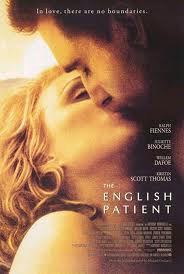
Anthony Minghella’s The English Patient (1996)

Rarely did a movie deserve the Academy Awards as much as The English Patient. It is one of the most beautiful war romances that I have ever seen. Or, to be accurate, two of the most beautiful romances as the movie tells two parallel stories. Based on Michael Ondaatje’s wonderful eponymous novel, The English Patient combines everything that an accomplished movie needs. Beautiful pictures, a touching story, an intriguing plotline, wonderful music, great characters  and outstanding actors. This is one of the movies that I have watched at least three times and every time I discovered another layer. It is surprisingly rich and, I would argue, flawless.

They call him “The English Patient” (Ralph Fiennes), the mysterious man, they rescued from a shot down airplane in the desert during WWII. He is heavily burned, will probably not survive. They bring him to Italy and a young nurse, Hana (Juliette Binoche), volunteers to stay back and take care of him. She moves with him into an abandoned villa. He doesn’t know his identity but Hana finds a notebook and with its help the memory returns slowly and the story unfolds in flashbacks.

They are not alone for long, Kip (Naveen Andrews), a young Sikh and the thief David Caravaggio (Willem Dafoe) join her. Kip is part of a bomb disposal unit and the growing love between Hana and him is the second love story in this movie. It is beautiful but by far less tragic than that between the English patient and his lover. Caravaggio adds even another story line to the already rich plot. He is someone who thinks he knows who the badly burned man is. In fact he is sure that the patient is someone who wronged him once.

The flashbacks show us the mysterious patient, the Hungarian Count Almásy, 1930 in the Sahara desert. He is a mapmaker of the Royal Geographical Society. At the beginning of WWII he is still in the Sahara where he meets the British agent Geoffrey Clifton (Colin Firth) and his beautiful wife Catherine  (Kristin Scott Thomas). Despite their fighting the attraction, they fall in love. They have an affair that ends abruptly when Catherine breaks it off. They meet again later and the following events make this probably one of the most tragic movie romances of all time.

The figure of Count Almásy is actually based on a real person, only his story was a different one.

The nurse Hana is certainly one of the most appealing nurses in any war movie. The gentleness and devotion with which she takes care of the dying man is touching. I am sure that there were many nurses like her in different wars and they deserve an homage.  I have a great deal of admiration for these courageous, disinterested women.

The intensity of the interwoven stories, the mysteries, the wonderful settings (the desert, Italy during the war, the Italian villa), the gripping part of the bomb defusing, all this together make this an absolute must-see.  Last but not least I’d like to mention the beautiful score by Gabriel Yared (you can listen to it here).

Under Fire (1983) War and Journalism or Whose Side Are You On?

I don’t take sides, I take pictures (Nick Nolte as Russel Price in Under Fire)

The least you can say about Under Fire is that is an extremely interesting movie with four fascinating character portraits played by four outstanding actors.

Under Fire belongs to the war movie subgenre of War and Journalism. There are quite a lot of movies in this sub-genre and a great many are from the 80s. The Year of Living Dangerously, Circle of Deceit, The Killing Fields, Salvador, Missing and later movies like Welcome to Sarajevo (see my post).

The movie opens in Tchad. The photographer Russel Price (Nick Nolte) and the mercenary Oates (Ed Harris) meet and discuss their work. Oates points out that Price isn’t much better. He is profiting as much from every war there is as Oates is. None of them is more interested in politics than the other. When they part we know that they will meet again.

Before Price departs to the latest war zone, Nicaragua, we are introduced to two other journalists, Claire (Joanna Cassidy) and Alex Gazier (Gene Hackman). Claire and Alex are a couple but she breaks up with him before leaving to Nicaragua and we already sense she will be romantically involved with Russell.

At first when arriving in Nicaragua, Price isn’t interested in background information. He wants to know if the beer is good and what the food is like. Fortunately the movie nevertheless fills us in on the basics. We hear that the revolutionaries, headed by a guy named Rafael, fight the government of president Somoza who is supported by the US and a few other details. Claire and Price meet the French agent Jazy (Jean-Louis Trintignant), a dubious character, that seems to be in favour of the rebels, they also meet the president and his press officer.

While they are in Nicaragua – falling in love, getting to know the country – something happens to Price. He meets Oates again and sees him kill one of the revolutionaries in cold blood. This makes Price understand his own actions and how cynical they are.  He becomes aware that he cannot stay out of this anymore. It bdawns on him, that the Sandinistas are right, that the government is corrupt and supported by the US who are afraid of a communist Nicaragua. In order to support the revolution, he takes a fake picture. He serves the rebels but triggers a flood of violence during which Alex is killed by the president’s soldiers (this is based on a true story). He takes a picture of this as well and triggers a reaction in the US…

What I really liked about this movie is how subtle it portrays the different people. Nolte, Hackman and Harris are very convincing, each takes another position, stays for another point of view. The cynic mercenary Oates is probably the most stringent character, the one who will make you the most uneasy, although Jazy isn’t a bad example of double standards either. Claire was the least convincing character, she rather served as a enhancer for the others.

Apparently the movie has been considered to be problematic in the US because it openly takes position for the Nicaraguan revolution. I think this is great and daring. It is an ugly chapter in US politics and many efforts have been made to forget about it as soon as possible (Noam Chomsky has written quite eloquently about this).

The movie is visually extremely convincing. John Alcott, Kubrick’s cameraman, has filmed it documentary-style.

The topic of War and Journalism always makes me uneasy. I think we should be informed but I cannot understand how people can take pictures like vultures of dying and dead people and stay uninvolved. Maybe it is not so much journalism as photo journalism that I find problematic. I am really glad for movies like Under Fire. They are valuable and important and illustrate how everything is linked, how one deed leads to another.

There is a trailer on iMDB.

Here is just a video with scenes from the movie and the original soundtrack by Jerry Goldsmith.

Attack on Leningrad aka Leningrad (2009) Russian/UK Movie on the Siege of Leningrad

There are numerous ways to tell a story. Numerous point of views to choose. Sometimes choices are convincing. Often they are not. Attack on Leningrad belongs to the second category. The choices the film director and his team made to tell this story were absolutely not convincing. I am very disappointed. This is very sad as this movie had incredible potential. Told another way this could have been one of the very great. As it is now it’s just an average movie on a shocking theme. How sad this is, became fully clear to me after I watched the interview with film director Aleksandr Buravsky on the DVD. He had the chance to create something great, why didn’t he do it?

The Siege of Leningrad is one of the unspeakable atrocities that the Germans committed during WWII. Hitler had the idea to starve the people of Leningrad within a few weeks, maximum two months in order to gain superiority on the Eastern Front. The siege lasted 872 days. Leningrad was a big city of almost 5 million people at the time. At least 1.5 million died during the siege. I was interested in this topic since I had read Helen Dunmore’s excellent novel The Siege. It’s a daring book from a master storyteller. I had hoped for an equally good movie (the movie is NOT based on Dunmore’s book).

In 1941 a young ambitious British journalist is flown to Leningrad, together with a whole group of foreign correspondents, to cover a story on Leningrad. While the journalists are there, Leningrad is attacked by the Germans and cut off from the rest of the world. She is believed to be dead and left behind while some of the other journalists manage to escape to Moscow. A young female Russian police officer helps her. Those two extremely different women form a bond that becomes a friendship. The two women fight for their life and the lives of a few others, almost until the end of the siege. The circumstances are horrible. It is extremely cold, people are famished and die in the streets, they cut open animals that are still alive, they eat dead humans, lick glue from paper hangings. It’s all very drastic and well shown. Still the movie didn’t work because of the invention of this English journalist. It’s a tacky, pretty unbelievable and unnecessary story. The movie has Russian and English parts and whenever we see Russian parts it is strong and convincing and as soon as it moves to the English parts it is just sadly arbitrary.

Why invent a story like that when there was such a lot of material at hand? Accounts of eye witnesses, for example. In the interview Buravsky mentions the famous Russian composer Shostakovich who was in Leningrad during the siege where he composed his 7th symphony. Wouldn’t that have been a great story? Or what he said about Stalin… Apparently he could have freed Leningrad much earlier but decided against it. He deliberately let them starve as Leningrad, the former St.Petersburg, the home of the Tsars was the center of the intelligentsia and the arts. In doing so he could get rid of people who were undesirable in his regime… A dictator like Stalin was certainly not fond of intellectuals and artists or other people who were used to thinking for themselves. That would have been a great story as well.

Since it is a Russian/UK co-production I suspect the choices had something to do with funding. Too bad.

Still, for people who have never heard or are not very familiar with the siege of Leningrad this movie is a good opportunity to learn something about it. And it is watchable. The Russian cast is very good, the pictures are very nice but all in all it’s a lost opportunity for something that could have been better than average. 3.5/5