When Trumpets Fade (1998)

Eerily beautiful is what comes to mind when speaking about this overlooked war movie gem. I discovered it thanks to Gary Freitas’ book on war movies.

The movie starts with black and white original footage and a voice telling us that it is 1944, just after Paris has been liberated.

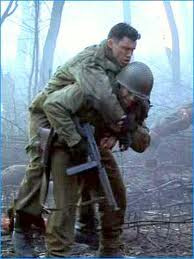
After this introduction we are thrown into action and see one soldier, private Manning (Ron Eldard),  carrying his mortally wounded comrade whom he finally must abandon. All through watching this movie I was reminded of Goethe’s ballad the Erlkoenig in which a father rides with his son through the woods at night. The child keeps on saying it sees the Erlkoenig in the darkness who tries to tempt him and take him away. A very spooky ballad. When the father finally arrives at his destination he finds out that his little son has died in his arms.

Maybe John Irvin, the director, did think of this ballad when he shot this movie. The woods always had a special place in German mythology and references to this can be found in many a movie or book about WWII.

The soldiers in this movie are fighting a senseless battle, one that cost a horribly high amount of lives. The battle of Hurtgen forest is only not spoken about so often since it was shortly followed by the more famous Battle of the Bulge.

When Trumpets Fade tells the story of private Manning the only survivor of his company who is – due to his ability to survive under such circumstances – promoted to sergeant and gets to lead a group of replacements. In a bloody battle where they are to secure a bridge he is again one of the only survivors and gets promoted to lieutenant. Both times he protests. All he wants is to survive and  get out. He’s not the only unhappy soldier. The battle seems sense- and fruitless, casualties are high, soldiers and officers complain and rebel.

Manning is a very interesting character and his development makes this movie one of the rare psychologically interesting of its kind. This and the eerie scenes in the woods where the fog is thick, Germans lurking everywhere and naked, burning trees stand lonely and dark against the background,  makes this a haunting experience to watch.

The final credits are shown over endless rows of dragon’s teeth that are slowly covered in snow to  Bing Crosby singing White Christmas.

Mean Old Private Ryan

People did talk about Saving Private Ryan. They talk about it and they will continue to talk about. Occasionally it seems that it is the only war movie that has ever been made. At least the only one the general public is aware of  – until, of course The Hurt Locker got the Oscar – but that is another story and if I believe it deserved it…). It is a fact that even the most war movie illiterate seems to know Saving Private Ryan or has at least heard  of it. One could almost go as far as to talk about a before and after era. Occasionally this can become slightly annoying especially considering that this movie overshadows some very well done other movies that would be talked about, appreciated and mentioned if it wasn’t for mean old Private Ryan.  On top of that it  led to my worst Popcorn moment ever, something that up to that point in time  I wouldn’t even have thought possible and , by the way, was never repeated since. I was on holiday in  some southern English town. Salisbury or Bournemouth. At the beginning of the movie I was actually  sitting in one of the rows in the middle munching Popcorn.  Shamefully I must admit that I was not aware of the nature of the movie that would be shown (How could that happen? Living in Switzerland which I did at the time and am doing again now doesn’t really put you in the position to talk about the latest releases of the film industry. US movies are usually already classics by the time Swiss  movie theaters start to show the previews). Fifteen minutes into the beginning of the movie it dawned on me: Popcorn was the least appropriate thing when watching a movie like this. And everybody knows what I’m talking about when referring to the first 15 minutes of Private Ryan. This is probably one of the most hellish moments in the history of war movies (put aside the episode Bastogne in Band of Brothers) and what’s even worse: There is no escaping it. You don’t watch it , you’re literally in it. These 23 minutes are very probably part of its success story. They lead to  an extremely close  and  maybe for some spectators  totally unwanted identification with those poor unfortunate soldiers landing on  Omaha Beach. A nightmare and absolutely not encouraging popcorn eating. I almost threw up.

After having said all this, adorned with some little anecdote of the life of a moviegoer, I’d like to put this straight: I do appreciate Saving Private Ryan. It is one of the best WWII infantry combat movies, no doubt about that, but it is just unfair it gets all the credit when The Thin Red Line is so much more emotional and poetic, and When trumpets fade so much more moving. Ahh… I hear some of you wonder …When trumpets fade… ?What the heck is she talking about?…See? Overshadowed by Saving Private Ryan. 1998. What a year for war movies.