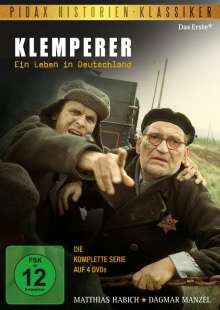
Klemperer – Ein Leben in Deutschland – A Life in Germany (1999) German TV Mini-Series

When Klemperer was first aired on German TV, I watched the first episodes but because I was moving I had to stop after the fourth. I always meant to re-watch the beginning and finally finish the whole series which consists of 12 episodes.

I had really liked the beginning at the time and now that I have finally re-watched those first four episodes I’m glad I still like it, maybe even more and I’m keen on watching the rest. However it’s very depressing. I didn’t remember it to be this upsetting but maybe it’s just me and I’m in a funny mood.

The series is based on Viktor Klemperer’s war diaries, 8 volumes of several thousand pages (here in English Viktor Klemperer’s diaries and in German here). The diaries are a fascinating document. I’ve read the first and it’s breathtaking. Klemperer was a professor of French literature, highly intelligent and with an amazing knowledge which all goes into the diary. He was also Jewish. The amazing thing in the series and the diary is the fact that it shows a man who is incapable of seeing what is going on and that we witness an amazingly intelligent person’s blindness. I find it must have taken a lot of guts to publish this diary because while it is very human it is still such an incredible flaw to be this blind.

To watch the series is eerie. It starts in 1933, just after Hitler was elected. At first there are just a few warning signals. Klemperer isn’t allowed to test non-Jewish students anymore, later he will not be able to publish anymore, they will remove him from certain classes and finally he will be fired. While many of his friends leave Germany very early, he doesn’t want to leave, he always thinks that maybe he will be exempt from the next measures only to find out that he wasn’t. His wife is not Jewish and since he himself isn’t religious, he always thinks they will make an exception for him. They even start to build a house.

Klemperer’s wife is an amazing character as well as she is so flawed and naive. She still moans about not being able to go on holidays when he has already been fired because he is Jewish.

As I already mentioned, the series is quite long. There are 12 parts of 45 minutes each, which means they have taken a lot of time to show the whole story and include a lot of details. I already know that the Klemperers will end up being sent to a camp but survive. Because it spans such a long time, 1933 – 1945, it really feels at times like having been there, having experienced some of it.  It is one of the best TV series I’ve ever seen. It has been very carefully executed and with Matthias Habich and Dagmar Wenzel, they have chosen two of the best German actors. Habich is one of my favourites, and one of the rare I like almost as much as Bruno Ganz.

A far as I know, there is no version with English subtitles available which is a pity. At least the diary is available in English too.

Mephisto (1981)

I wonder what took me so long to watch Mephisto for the first time. István Szabó‘s movie is an absolutely riveting and chilling tale of one man’s betrayal of everything he once believed in and all the many self-deceiving lies he tells himself.  I have always been fond of Klaus Maria Brandauer but this must be one of his very best roles. He is simply astounding.

Mephisto is loosely based on Klaus Mann’s eponymous novel. The story is quickly summarized. Henrik Hoefgen is a famous actor in Hamburg in the early 30s. Hamburg is provincial compared to Berlin and Hoefgen has dreams and hopes and sees himself already as Germany’s most famous actor in the future. While he is most certainly very talented he is equally narcissistic. On the other hand he is full of idealism and flirts with communism. When he plays Mephisto in Goethe’s Faust, he is discovered and receives an invitation to Berlin. Finally his dreams come true. He will be an actor at Germany’s leading theater. In Berlin, as well, it is the role of Mephisto which brings him a lot of admirers, some of which are prominent Nazis. It doesn’t take long and the Nazis try to instrumentalize him. In love with himself and his success he doesn’t see this at first. Soon he becomes the governments pet actor, speaks in its name at openings and supports the government.

While he may be oblivious of the consequences at first, when he starts to realize he has sold out, he begins to lie to himself and pretends it isn’t the artist’s duty to be political. He even goes so far as to pretend that an artist lives outside of everything.

Mephisto is a riveting character portrait and an in-depth analysis of what can become of someone whose conformity and lust for success make him forget that he has a responsibility. The movie looks especially into the responsibility of the artists. While many chose to leave the country as soon as possible, those who stayed often pretended it was their duty not to abandon the country in its hour of need and that those who left were cowards. It’s obvious that the famous actor Gustaf Gründgens, who also worked with Klaus Mann, has served as a model for Hoefgen.

Mephisto is certainly one of the best movies I have seen this year; it’s intelligent and entertaining and the acting is amazing.  So far this is my favourite of István Szabó’s movies. I haven’t seen Colonel Redl yet, – equally starring Klaus Maria Brandauer – but I’m very keen now.

Die Flucht – March of Millions (2007) German TV production about the Flight from East Prussia

This is one of those stories that needed telling. East Prussia, this vast and beautiful region in Germany, was quite peaceful during the war until the Eastern Front collapsed and the Russians started invading Prussia and moved towards Berlin. The people living there had but two choices. Stay and face the Russians who were not exactly going to handle them with care. Or  to flee and leave all their possessions behind. East Prussia was the home of many aristocratic families who lived at ease on huge estates. Theirs was a life of wealth and tradition. Leaving was extremely hard on them and for many it took a long time until they made up their minds. Too long in some cases. For those who had less, it wasn’t any easier. Not only did they have to leave everything behind, they didn’t know where they were going or if they were not going to be outrun by the Russians.

You see, a lot of potential for a great story and all of the above is shown in Die Flucht – March of Millions. Unfortunately even historical events like this need good storytelling and that’s where I’m not happy with this two-part German TV production. While it’s not bad, I would have preferred if they hadn’t decided to turn the second half into a love story.

Lena, countess von Mahlenberg (Maria Furtwängler), leaves Berlin and returns to her family’s estate in East Prussia. Things still look pretty much the same as they did before the war with the exception of French POWs – led by cranky François (Jean-Yves Berteloot) – working on the estate. And there is also a  panicky feeling underneath the surface. Things do not look good for Germany. That they will win the war is not very likely anymore and what this could mean for them, this close to the Eastern front, starts to dawn on a few people.

The von Mahlenberg’s are friends with another aristocratic family, the von Gernstorffs. Lena is going to get married to their older son although she doesn’t really love him. The younger son who is in love with her as well, is one of the only ones to clearly say that Germany will lose the war. He is fighting on the Russian front and scared of dying. When he deserts, the family breaks apart.

Meanwhile Lena wants to flee together with the POWs who have been working for her and with all of the people who live on the estate.

The first part of the movie is dedicated to the time before they flee, the second focusses entirely on that long march.

Many of the elements are interesting and dramatic. The tensions among the Germans, the justified fear of the Russians, the tragedy to lose your home and to be unwelcome wherever you go, is shown quite well.

What I liked too were the pictures. I have never been in East Prussia but those vast landscapes seem very beautiful and they were beautifully filmed. What did not work is the love story. I think this movie could have been dramatic without a love story but on top of that it didn’t seem very realistic.

In any case, a watchable movie but not as good as I had hoped for. I think however this would be successful in the US or the UK as, like Dresden or Anonyma, it shows aspects of German history and suffering we sometimes tend to forget. Of the three movies I liked Anonyma best but I’m fond of Dresden as well, although it has corny elements.

I’m not sure Die Flucht is available in English. I attached the German trailer and for those interested in the history of East Prussia during WWII, a documentary in English which looks quite good.

Another Movie I Couldn’t Finish – Iron Sky (2012)

For various reasons I am not watching a lot of movies these days but finally I had a bit of time this weekend and what do I pick? Iron Sky. I hardly got through the first half hour.

A brief look at the IMDb user reviews tell me that people “laughed all the way through this movie”, “enjoyed it incredibly”, thought it was “the best sci-fi” movie ever. What the heck?

I found the humour heavy-handed, from the Nazi to the Sarah Palin parody. And I couldn’t shake off the feeling that the producers liked the paraphernalia, symbolism and imagery of the Nazis  a bit too much for my taste. Plus Laibach made the music? Hmmmm.

Maybe this is the new Starship Troopers,  another one I found insufferable and couldn’t finish. If so, then this is simply not a movie for me. Or maybe it is really crap. I can’t finish it just to find that out.

Tell me, what did you think of Iron Sky?

Habermann (2010)

The German/Czech/Austrian co production Habermann tells a chapter of German history which is easily forgotten. The movie is based on a true story and tries to exemplify the destiny of the Germans living in Sudetenland. This is one of those movies which touch on a historical fact which is so painfully absurd in its arbitrariness one can hardly believe it.

Habermann is a rich mill owner in Sudetenland. The tragedy of the Sudetenland was that it belonged to Czechoslovakia before the war but almost 90% of the people living there were Germans. When Germany decided to annex the Sudetenland in 1938 this posed a huge problem to people like Habermann who lived peacefully with the Czechs. Habermann’s best friend is a Czech (Karel Roden), many of his mill workers, his accountant and other people in important positions are Czechs. Being so friendly with the Czechs makes him look suspicious to the German authorities who take up residence in the small village in which he lives. When the despotic and sadistic Sturmbannführer Karl Koslowski (Ben Becker) arrives in the village, things go from bad to worse. He wants Habermann to get rid of the Czech workers, spies on him and the Czechs, bullies and controls him.

But the worst isn’t even known to Habermann and his wife yet. Although she grew up as an orphan and was  brought up by Catholic nuns, her father was a Jew. When Koslowski finds out, the tragedy cannot be averted.

Another dramatic story line circles around Habermann’s young brother you joins the Nazi’s.

There were a lot of things I liked about this movie and the story of the Sudeten Germans is a story which needed telling. The real tragedy for most only started after Germany lost the war and the Czechs turned against them. This drama is shown well but what I didn’t find too good is that there is too much emphasis on the character of Koslowski. Ben Becker is one of my favourite actors and I watch every movie he’s in. I think he is simply brilliant but he is also the type of character who just crushes everyone around him. He is often chosen to play a nasty Nazi villain and does that well, only giving him this role, putting so much emphasis on this characters, almost makes you think that the whole tragedy was linked to this one man while this was a collective tragedy and not just related to one sadistic character.

Still overall I think Habermann is well done, not one of the best but a very watchable movie and the actors, Ben Becker, Karl Roden, Mark Waschke as Habermann, Hannah Herzsprung as his wife, are really good.