Warriors aka Peacekeepers (1999) UNPROFOR Peace Units in Bosnia

Warriors is an almost three hour long TV  production starring Ioan Gruffud (Hornblower, King Arthur), Matthew Macfadyen (Robin Hood, Pride and Prejudice) and Damian Lewis (Band of Brothers). Unlike some other great TV productions it isn’t capable to get rid of the TV feel. At every moment we are aware of it having been made for TV. I don’t know how this was aired, probably on two consecutive evenings, watching it like I did in one go wasn’t the best idea. If there hadn’t been some famous actors I would have thought it is a documentary.

You may have gathered already that I didn’t like it that much but it still is an important movie. Many movies depict the absurd mandate that most UN troops have to follow. Unless directly attacked they are not allowed to fight. They are not allowed to take sides. Mostly, like in this case, they aren’t even allowed to evacuate people unless they are seriously injured. This means they have to watch innocent civilians getting killed.

The movie starts in England where we see the soldiers and officers on leave and get to know the main characters. From there we follow them to Bosnia where they are instructed about their mandate which doesn’t really pose any problems for them at the beginning.

Our three main characters will stay in the region for six months. Starting as mostly joyful men who want to make a difference they undergo some serious changes and at the end none of them is remotely comparable to the man he was before he was sent to the region at war.

It is one thing to be told to not interfere when there are soldiers involved but a totally other matter when you see how civilians are raped, butchered and tortured. All these young UN soldiers ask for, is to be able to evacuate those who might get killed. Their superiors stay firm, there is no helping that couldn’t be misunderstood. Soon enough they get proof of this. In a few instances, when no superior officer is around, the one or the other soldier attempts to help and each and every single time the consequences are fatal.

In one instance Lt. Feeley (Ioan Gruffud) assists an elderly Muslim couple whose dog is shot and whose house is plundered. He intervenes and chases off the aggressors only to find the couple executed, when he returns a few days later. Instances like these are numerous and the movie shows more and more atrocities towards the end.

The final part shows the three main protagonists back in England. None of them can cope. Having helplessly witnesses gratuitous acts of violence against children, women and old people has left them shattered. Two have a severe anger management problem and the third attempts to commit suicide.

If you are interested in the peace work of the UN troops and want to see in great detail how they operate, this is a good movie in this respect. There are others who show this very well too but not in so much detail. If you want to watch really good movies on the war in Bosnia I suggest you rather stick to Welcome to Sarajevo (see my review), Savior (see my review) and No Man’s Land (review upcoming).

I couldn’t find a trailer so I attached part 4 of the film.

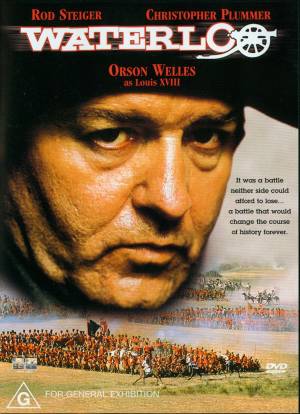
Waterloo (1970) “Next to a battle lost, the saddest thing is a battle won”

Waterloo was more than just a movie for me. Watching it meant jumping head first into childhood memories.

“Waterloo, Waterloo, morne plaine…” No, this isn’t the French version of the AbbA song. I am afraid the words are not bound to tell you much. I can still hear my father’s voice drone this part of  Victor Hugo’s famous poem L’Expiation (an endless poem by the way) on Sunday mornings. I said it in my last post, I went through a bit of an obsession with Napoléon as a child and guess I deserved a little punishment and therefore frequently had to listen to the long and never-ending recitation of that poem. Sorry for this little digression… Back to my review.

I haven’t seen this movie before and I must say it was high time. It is a worthy candidate for a place among my Top 20. I loved every minute of it (with the exception of the animal stunts. Being reminded that this a Russian production and the well-being of horses might not have been high on the agenda did NOT help. It is funny how all of a sudden one likes the idea of CGI. I never thought I would ever write such a sacrilegious thing.)

As the title indicates, this is not a Napoléon biopic. It doesn’t show the great man’s life, only a fatal and tragic part of it, the battle of Waterloo. Maybe the best known of all the French battles (apart from Austerlitz) in France.

The movie starts with what has become in French the synonym for something long, endless and wearisome, namely “Les adieux de Fontainebleau” or “The Goodbyes at Fontainebleau” in which Napoléon, before being exiled to Elba,  says goodbye to his troops. He states in the movie that he deplores that he can not say goodby to each and every one of them still it is said that it took hours. After having been defeated on the battlefield he was forced to abdicate and go into exile to the island of Elba.

Rod Steiger manages masterfully to show how emotional Napoléon was. This man was driven by strong emotions and passions. And it seems that the troops loved him for this display of feelings.

He stayed at Elba some ten moths and then returned to Paris where Louis XVIII (Orson Welles) had taken back the throne. The moment when he meets the troops is another highlight in this movie. He wins them back easily and becomes emperor once more.

After this episode he heads the troops and marches towards Belgium to engage the troops of Wellington.

Before the movie takes us to the battlefield it briefly stops in a ballroom in Belgium where Wellington (Christopher Plummer) and his men are introduced.

Two thirds of this movie are dedicated to the battle of Waterloo. I think it is incredibly well done. I liked those costumes and the way we could see the battle formations. There was such a huge difference whether cavalry charged against cavalry or against infantry. The moment when the French cavalry attacks the British infantry is horrible. The horses are shot down one by one. The square battle formations of the infantry made it impossible to win for the attacking cavalry. Like this the horses could be shot down from every angle.

At moments, while I watched this and saw the tactics the two men applied, how they overlooked the battlefield, sent troops from here to there, removed them from somewhere else, I was reminded of chess.

The two great men, Napoléon and Wellington are shown as complete opposites. Naploéon goes through every possible emotional change while Wellington stays poised and self-possessed. While one is of very humble origins, the other is an aristocrat through and through.

We all know the outcome of the battle and when it is over, not even Wellington is unmoved and he says the famous words:

Next to a battle lost, the saddest thing is a battle won.

I really enjoyed Waterloo. I liked the costumes, the uniforms, the battle formations, Wellington’s poise, Napoléon’s sadness, the composition of the British regiment, the Irish troops with their rosaries and the Scottish with the bagpipes.

I would recommend this movie to every one who is interested in French and British history and the Napoleonic Wars, who likes costumes and has an interest in miltary tactics of the time.

Movies on the Napoleonic Wars (1792-1815): A List

I watched the Hornblower series last year and enjoyed it very much. I re-watched Master & Commander and thought once again that it is really a good movie. Finally I discovered the Sharpe series with Sean Bean and I like it a great deal as well (at least those I have seen so far). Considering that they are all based on the Napoleonic Wars, I thought it might be high time to see what else there is. I found quite a few movies, some I have seen a long time ago, like Abel Gance’s Napoléon, and others that I still would like to watch. I also included movies on the man himself as I figured there will not be many biopics on Napoléon leaving out the wars. When I was a child I went through a bit of a Napoléon obsession and remember contemplating his wax figure at the Musée Grévin in Paris with awe. I should have been awed that even as a ten-year old child I wasn’t that much smaller. There are quite a lot of German and French productions of the topic. I did include them although not all of them have been subtitled.

The movies that I would like to watch soon are Waterloo with Rod Steiger, the mini-series Napoléon and Ridley Scott’s The Duellists.

As ususal any comments, additions or ratings are highly welcome. The Duellists is a movie I wouldn’t have known of, if it hadn’t been for Guy Savage‘s recommendation in a comment.

Neil Jordan’s Michael Collins (1996) The Irish Fight For Independence

Neil Jordan’s Michael Collins is a UK/US/Ireland co-production. International productions guarantee an international cast which can be nice but in this case, I would say, it did prevent the movie from being great. There is no drama teacher in the world who will achieve to make Julia Roberts or Aidan Quinn sound Irish. Liam Neeson as Michael Collins, Alan Rickman as De Valera and a very young Johnathan Rhys Meyers, striking the fatal blow, are well-chosen.

Michael Collins was probably one of the most controversial and tragic figures of Irish history. A charismatic man who knew how to convince those who followed him. A man who wouldn’t shy away from killing yet didn’t take it lightly.

The movie starts with the Easter Rising in 1916 with Michael Collins rallying the masses against the British occupation. It would take another three years until this initial movement lead to the Irish war of Independence. It is a fierce and bloody war. A the end of the war stands the treaty, something that was unthinkable for 700 years. The British government allowed the Irish Free State but kept the Northern Provinces and wanted the Free State to swear allegiance to the king. Michael Collins considered this to be the best he could achieve and wanted to sign the treaty but the men around the future president de Valera wanted a completely free Ireland and this is where the movement for Independence split into two sections who would fight each other fiercly.

The movie shows us a Michael Collins who is tired of fighting and bloodshed and longs for peace. He is sure, if the treaty isn’t signed the bloodshed will be endless.

An important part of the movie is dedicated to the friendship between Michael Collins and his best friend Harry Boland (Aidan Quinn). For four years they are also caught up in some sort of love triangle as both men love Kitty (Julia Roberts). It takes a while until she confesses that she loves Collins. Her confession is not the only thing that drives the men apart. Politically they are not on the same page anymore. Best friends become enemies.

Michael Collins is shot in 1922 by one of de Valera’s men. This is the beginning of the Irish Civil War.

I liked the movie despite its flaws, one being, as already stated, the choice of American actors, the other being quite a few historical inaccuracies. Apparently Neil Jordan had good reasons for altering the facts. I am not sufficiently familiar with the details to point out what is correct or not. There is one particularly awful scene in which a British tank opens fire on a the players in a sports game. In reality this was much more horrible.

Michael Collins is a fascinating character and I could very well see myself read a biography in the future. He was a leader and an adept fighter. His fighting tactics seem to have inspired quite a few future struggles. The group around him was constantly hunted by British secret agents and policemen. Michael Collins’ tactic was to know more about the agents than they knew about them and then to hunt them down. There are a lot of executions to be seen as they operated according to the dictum “who is not with me is against me”. At times the movie reminded me of movies about the resistance. Torture, execution, changing of sleeping quarters etc.

A while back I reviewed another movie on the Irish War of Independence and the subsequent Civil War, The Wind that Shakes the Barely. Michael Collins is never seen but constantly spoken of in the movie so I was really curious to see this. Comparing the two movies I’m afraid I must say, The Wind that Shakes the Barley feels more authentic, it is a truly outstanding movie.

Despite its flaws Michael Collins being a Neil Jordan film offers a lot and is beautifully filmed. It is as much a character portrait, as the story of a friendship and a romance. I enjoyed it and would recommend it.

300 (2006) This is Sparta!

Whether you like 300 or not, the least you can say is that it is quite original. I can’t think of any other war movie relying so heavily on CGI and adding so many fantastic elements.

This is a Rock’n Roll retelling of the Battle of Thermopylae. Part fact, part highly fictionalized story, it is a romp no less starring some of today’s best-loved stars like Gerard Butler (Good-bye Frankie, P.S. I Love You, Beowulf & Grendel), Lena Headey (The Broken, Terminator series) , Michael Fassbender (Centurion, Fish Tank, Inglorious Basterds) and Dominic West (The Wire, The Devil’s Whore, Centurion).

At the beginning of the movie we are introduced to the Spartans and their ways. They are warriors and already trained to become warriors at a very early age. They don’t like deficiencies or disabilities. A child that shows sings of weakness will be discarded. Discipline, endurance and self-control are the key words. At school we were taught the story of a Spartan boy who hid a fox under his coat. The fox started to eat him alive but the boy wouldn’t flinch. Every thing that we see about the Spartans in the movie is factual. Also the role of the women. Unlike in Athens, women were highly educated and treated like equals.

The war started because the Spartans did not, as demanded by the King of the Persians, Xerxes, kneel down and subdue. No way. On the contrary. Why would they, after all, this was Sparta. They were not even impressed by Xerxes huge Army against which a little number of 300 Spartan soldiers looked almost ludicrous and would probably not stand a chance. Surprisingly as this may seem, they defended themselves incredibly well. The Persians really got their asses kicked.

If you want to know what the outcome of the battle was you will have to watch the movie.

300 is quite impressive and, although it isn’t one of my favourites, it is entertaining and, despite some fantastic elements, historically accurate. I always found the Spartans highly fascinating. Somewhat crazy but interesting.

The King of Sparta and his wife are very attached to each other which gives the opportunity for a bit of romance as well.

Is this movie purely a guilty pleasure or is it more? I think it is a mix.