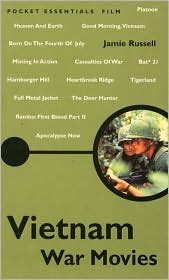
Vietnam War Movies by Jamie Russell (2002)

This useful little book is one of the pocketessential film series books.

It´s dedicated to Vietnam War Movies only.

The movies are ordered by themes:

Combat Movie The Green Berets, The Boys in Company C, Go Tell the Spartans, Platoon, Hamburger Hill, Full Metal Jacket, BAT21, Saigon, 84 Charlie MoPic, Casualties of War, Tigerland

Vet Movie Billy Jack, The Visitors, Taxi Driver, The Deer Hunter, The Exterminator, First Blood, Gardens of Stone, Jacknife, Distant Thunder, Born on the 4th of July, In Country

Drugs and Surrealism Tracks, Apocalypse Now, Apocalypse Now Redux, Good Morning Vietnam, Air America, Jacob´s Ladder

Counter-culture and protest movement The Activist, Letter to Jane, Hearts and Minds, Coming Home, Running on Empty, Rude Awakening, Dogfight, Forrest Gump

1980s return to Nam Good Guys Wear Black, Uncommon Valor, Missing in Action, Rambo: First Blood Part II, Eye of the Eagle

Telling a different story Heroes Shed no Tears, Dear America: Letters home from Vietnam, Bullet in the Head, Turtle Beach, Heaven & Earth, Cyclo

Each movie is summarized, cast and crew are named, some background and sub-text information is given and the movie is rated as well.

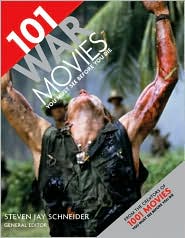
101 War Movies You Must See Before You Die (2009)

101 War Movies You Must See Before You Die (2009)  is a very nicely done reference book, part of a whole series of 101 or 1001 movies you must see before you die books. Picture books actually.

It’s ordered chronologically and contains colour photographs of the movie posters, naming of Cast & Crew, followed by a detailed description of the movie and some words on its importance. Additionally there is a colour photo of a scene depicting one or the other crucial moment of the movie with its description.

It is very nice to look at especially for those enthusiastic about movie posters. The entries are not very critical but this seems only normal since the aim was to choose 101 must-see  movies so one can safely assume the authors rated them all as outstanding.

From a purist’s point of view I think that the editors chose to include a lot of movies that are normally part of subgenres that the die-hard war movie fan would exclude. They therefore added  movies like Schindler’s List (1993) that you could rather call a wartime movie or Last of The Mohicans (1992)which is more of a War/Action Romance film.

Looking at their choices I think one of their main criteria was the esthetics of a movie and to a certain extent it’s blockbuster value, meaning how much of a story beyond the pure historical facts was told (totally contrary to Gary Freitas who would choose accuracy and history over story). This is why Platoon was included but neither Hamburger Hill (1987) nor 84 Charlie MoPic (1989) that are on many levels better.

Since I do not tend to be as strict as many, and would maybe even include Casablanca (1942) (which they didn’t include) I don’t mind their approach.

But what really does it for me are the pictures. I just love those posters. They are an art form in their own right.

On Death and Dying or Why War Movies Teach us a Buddhist Lesson

Without any doubt there will be death and dying in a war movie. As a cultural anthropologist it often struck me how different other cultures handle death. In a society like ours,  in which death is a taboo (there seems to be an even greater taboo when it comes to dying) the war movie is one of the rare places where it is shown with such frequency. When it comes to movies in general  there is only the action and thriller/crime genre where you can count on death with the same certainty only not in such abundance.  Else you are left with rare films about illness, very rarely you’d see an old person dying or, more likely, already dead. A few deal with accidents or rather their consequences  like Atom Egoyan does in The Sweet Hereafter.

I did often wonder where my interest in war movies came from, besides from the urge to understand what happened, why it happened and how it felt for those involved. I think that they teach us a lesson in non-attachment. You see characters that you get to know and like and you know that for sure some of them are going to die. And death seems, for our human eye,  not to choose very carefully in whom he spares and whom not. In the war movie we see death and dying in a magnified overdrawn way. There is everything you could see in daily life: quick death, painful death, slow and agonising dying. Nothing is left out. If you go one step further it makes you contemplate your own perishability. A further lesson in non-attachment.

In the Tibetan Book of Living and Dying Sogyal Rinpoche teaches that it is a good exercise to picture ones own death on a daily basis. It is maybe the most fundamental aim in life to have a good death.

I think it is not arbitrary that the late great American journalist Studs Terkel did as well a book on The Good War: An Oral History of World War II as on Death, Will the Circle be Unbroken: Reflections on Death, Rebirth and Hunger for  a Faith.

For anyone who would like to pursue his/her own reflections on this topic a few more or less random reading suggestions:

The Tibetan Book of Living and Dying Sogyal Rinpoche, 1992

The Pagan Book of Living and Dying Starhawk, 1997

On Death and Dying Elisabeth Kuebler Ross, 1997

R.I.P. – The complete book of death and dying Constance Jones, 1997

Dancing on the Grave: Encounters with Death Nigel Barley, 1995

Tuesdays with Morrie: An Old Man, a Young Man, and Life’s Greatest Lesson Mitch Albom, 1997

Will the Circle be Unbroken: Reflections on Death, Rebirth and Hunger for a Faith Studs Terkel, 2001

Swimming in a Sea of Death: A Son’s Memoir David Rieff, 2008

Staring at the Sun: Overcoming the Terror of Death Irvin D. Yalom, 2008

The Year of Magical Thinking Joan Didion, 2005

Noch eine Runde auf dem Karussel: Vom Leben und Sterben Tiziano Terzani, 2007

Das Ende ist mein Anfang: Ein Vater, ein Sohn und die grosse Reise des Lebens Tiziano Terzani, 2006

Der Tod meiner Mutter Georg Diez, 2009

Das westliche Totenbuch Irene Dalichow, 2001

Gary Freitas’ War Movies (2004)

There are many books and types of books one can consult when interested in the topic of war movies. The first that come too mind are the movie guides. There are some very fine examples of that kind out there (War Movies, Under Fire.…) The next category one would look into are historical books, first hand accounts and the like (A Rumor of War, Band of Brothers, We Were Soldiers Once…). Finally there are a lot of novels that have been the basis for one or the other movie (The Thin Red Line, Catch 22, Regeneration, All Quiet on the Western Front...).

Since I mentioned Gary Freitas before I would like to dedicate this entry to one hell of a fine book, his  War Movies: The Belle & Blade Guide to Classic War Videos. I truly enjoy it every time I take it out and consult it. Freitas did a fine job in reviewing  a big number of movies (347), in rating them and telling you exactly why he thinks they work or why not. He doesn’t shy away from criticising films that are generally well-respected if he disagrees with the overall opinion. His wit and sarcasm are priceless. I laughed quite a few times when reading one or the other entry. The book is organized alphabetically but contains a lot of useful genre lists like Best War Satire, Best War Romances, Best POW Movies, Best Action Adventure to name but a few. Additionally there are lists dedicated to the different wars, Best Korean War Movies, Best WWI, Best Vietnam etc.

I wouldn’t  say I always agree with his views, especially since he doesn’t like the older classics and doesn’t think hardly any Air Combat movie worthy to get a high rating (probably often too propagandist for his taste) but I discovered many a gem through him and, as said before, I really like his sense of humor and the way he makes fun of bad movies (there are many, believe me).

As he would say: Go buy this book immediately. Now!  There aren’t many better ones out there.

Band of Brothers

“The men of Easy Company, 506th Parachute Infantry Regiment, 101st Airborne Division, U.S. Army, came from different backgrounds, different parts of the country. They were farmers and coal miners, mountain men and son of the Deep South. Some were desperately poor, others from the middle class. One came from Harvard, one from Yale, a couple from UCLA. Only one was from the Old Army, only few came from the National Guard of Reserves. They were citizen soldiers.
They came together in the summer of 1942, by which time the Europeans had been at war for three years. By the late spring of 1944, they had become an elite company of  airborne light infantry. Early on the morning of D-Day, in its first combat action, Easy captured and put out of action a German battery of 105 mm cannon that were looking down on Utah Beach. The company led the way to Carentan, fought in Holland, held the perimeter at Bastogne, held the counteroffensive in the Battle of the Bulge, fought in the Rhineland campaign, and took Hitlers`s Eagle`s Nest at Berchtesgaden. It had taken almost 150 percent casualties. At the peak of its effectiveness, in Holland in October 1944 and in the Ardennes in January 1945, it was a good a rifle company as there was in the world.
The job completed, the company disbanded, the men went home.”

Stephen. E Ambrose Band of Brothers: E Company, 506th Regiment, 101st Airborne from Normandy to Hitler’s Eagle Nest, 1992: p. 15, 16