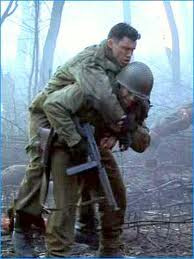
The Pacific versus Band of Brothers: Should we compare?

I finally got to watch the last episode of The Pacific. Even though I had an entry on it a while back I didn´t feel like writing about it before I had seen the whole series. It proved to be  a good decision since I couldn´t really appreciate it at first. I couldn´t help myself, like so many others, and compare it constantly to Band of Brothers. Apart from being a HBO miniseries produced by Spielberg and Tom Hanks, opening with men who were there talking about their experiences, those two series have nothing in common. Sure they both show a lot of very intense and gruesome infantry combat scenes but that is that.

Band of Brothers, as the title eloquently indicates, was about a close-knit group of men, one Army Infantry Company. This is not the case in The Pacific. The Pacific focuses on three main characters, the three marines Sgt. John Basilone, PFC Robert Leckie and Eugene B. Sledge. The last two wrote books about their experiences. The first episodes focus on Leckie, whereas the last ones tell Eugene aka Sledgehammer´s story. This last detail is based on the fact that Eugene went to war much later than the others. He missed Guadalcanal and Cape Gloucester, one main battle and one major experience of the war in the Pacific.

The mini series shows a lot of off the battle ground episodes. Soldiers on leave in Australia, Leckie´s stay at different hospitals and later we see Sledge back home. Many of this off the battleground parts look at the symptoms of post-traumatic stress of which both Leckie (in a very physical way-peeing himself-) and Sledge (more psychological-he´s depressed and has endless nightmares) suffer intensely.

The series has  many crucial moments. Truly gory battle scenes.  Endless rain on Cape Gloucester that grinds down the morale. The realization that all they learn is “killing Japs”.

There is one key scene, the moment when the two friends Sidney and Sledge meet as one leaves and the other arrives in the Pacific. Sledge wants to know from Sidney how it is to be fighting but he doesn´t get an answer. This is actually a recurring theme in war movies (there is a scene like that in The Deer Hunter and in many others): the inability of those who have experienced it to tell those who are about to experience it what it is like to be in combat. Or maybe it is not so much an inability as a refusal. They have been there, they know it´s no use. You cannot talk about something that is so completely different from anything you imagine. No one who hasn´t been there will ever know what it is like and there are no words to really convey this, nothing that equals the experience. All you have got in the face of the innocent and ignorant is silence. The Pacific shows this very well.

I would like  to point out specifically one further scene. It is related to one of my major points of interest namely Death. In The Pacific we see one of the most touching deaths in the history of war movies. I don´t want to spoil anything so I´m not going to tell you who is dying. What makes this scene so different is the way it is shown. We do not see the actual dying, we hear that the person died and then the corpse is being carried  by some soldiers and transported through the lines of men standing there paying tribute and crying. This is a genuinely heartfelt and sad moment. A display of utter futility.

Something else is very different from Band of Brothers. Even though it was WWII, this wasn´t the same war. This is not about a bunch of soldiers freeing occupied countries and captives. We have no rewarding moments like the one in Band of Brothers when they liberate people in a concentration camp. The war in the Pacific seems much more futile at moments. And senseless. And it lasted longer. The war in Europe was already over, Germany had surrendered but Japan had not. Only after Little Boy and Fat Man did this war stop. This must have been some sort of an anticlimax. By the time those soldiers came home, the whole world had already been celebrating the end of the war. The party was over and they had missed it.

Needless to say that this influences the tone of the movie.

For all these reasons I do not think it is doing The Pacific any justice to compare it to its older brother.  It really has its moments this series.

One last thing needs mentioning though and it is something I did not enjoy much. The Japanese are never ever shown in a positive light. You truly get the impression that they were a bunch of murderous automatons. If anyone wants to see a more honest depiction I suggest you watch Tora Tora Tora (1970) or Letters from Iwo Jima (2006). They both try to and  succeed in doing the Japanese justice.

amazon.com

Kokoda, 39th Battalion (2006) or The Australians´ Fight in the Pacific

Kokoda 39th Battalion is an Australian movie by Alister Grierson and tells another story that took place in the Pacific during WWII. Only this time we don´t watch Americans fight for the Australians (as they do, amongst oher things, in the miniseries The Pacific), but the Australians themselves. The Kokoda trail on Papua New Guinea is the main trail that leads directly to Port Moresby. By means of this trail the Japanese were planning to arrive at Port Moresby and from there an invasion of Australia would have been easy.

Obviously the Australians did everything to prevent this. The 39th battalion who is in the center of this movie was essentially a battalion of untrained volunteers. The central story focuses on two brothers who joined this battalion together.

The opening of the movie shows us a sequence of still lives that are very beautiful. Pictures of fauna and flora of the island. After that we see what has to be interpreted as premonition like dream of  Jack, one of the two brothers. This is somewhat an exaggeration of what the terrain was like. Same as in episode 4 of The Pacific there is a constant rain, and the terrain gets muddier and muddier. Jack slips and is almost drowning in mud. In the end he looks like some almost amphibian prehistoric creature. Those first ten minutes make you believe you might watch a film like The Thin Red Line with a lot of flashback elements, daydreams but that is, as you soon realise, not the case. From that moment on Kokoda turns into Hamburger Hill, meaning heavy jungle infantry combat.

The men are surrounded by Japanese soldiers whose camouflage is so much more efficient than their own, whose fighting experience is outstanding, and whose cruelty, as the movie wants to make us believe, is beyond imagination.

This was one of the movies that made me think again and again: Why war? Why did that happen? Why did it have to happen. The efforts of the Australians seem so futile, that even though they won in the end, there is nothing noble in all this. It´s just horrible and hard to watch.

I first thought that this was an average movie but the overall atmosphere is so intense, the desperate fight of these badly trained men is so well depicted that I think it´s quite a good movie that I would recommend you´d watch. And, most important, the pictures of the dense forest and the instances of cruelty in the middle of the jungle aren´t easily forgotten and stay in your mind long after you´ve watched it.

Yes, it´s biased, the Japanese are shown as beastly monsters but still.

Furthermore it tells a quite soulful story of the deep bond between brothers.

DVD on Amazon

Christ and The War Movie Hero

Don’t get alarmed! I’m not going to be blasphemous here. I have just been wondering about this coincidence/symmetry for quite a while and would like to give you something to ponder.

In 1986 Oliver Stone did Platoon starring Willem Dafoe as one of the main characters whose death has written film history and is also depicted on the movie’s poster. The hero who sacrifices himself.

1988 Willem Dafoe played the role of Christ in Scorsese’s The Last Temptation of the Christ.

1998 one of the main characters in  A Thin Red Line, the most pensive one, is played by James Caviezel.

2004 Mel Gibson, who had  major roles in many a war movie, chose James Caviezel as Christ in The Passion of the Christ.

With regards to The Passion of the Christ one must add that there aren’t many movies out there that are more graphic, gory and bloody. One of the longest agonies in film history.

It’ s about death and dying again.

When Trumpets Fade (1998)

Eerily beautiful is what comes to mind when speaking about this overlooked war movie gem. I discovered it thanks to Gary Freitas’ book on war movies.

The movie starts with black and white original footage and a voice telling us that it is 1944, just after Paris has been liberated.

After this introduction we are thrown into action and see one soldier, private Manning (Ron Eldard),  carrying his mortally wounded comrade whom he finally must abandon. All through watching this movie I was reminded of Goethe’s ballad the Erlkoenig in which a father rides with his son through the woods at night. The child keeps on saying it sees the Erlkoenig in the darkness who tries to tempt him and take him away. A very spooky ballad. When the father finally arrives at his destination he finds out that his little son has died in his arms.

Maybe John Irvin, the director, did think of this ballad when he shot this movie. The woods always had a special place in German mythology and references to this can be found in many a movie or book about WWII.

The soldiers in this movie are fighting a senseless battle, one that cost a horribly high amount of lives. The battle of Hurtgen forest is only not spoken about so often since it was shortly followed by the more famous Battle of the Bulge.

When Trumpets Fade tells the story of private Manning the only survivor of his company who is – due to his ability to survive under such circumstances – promoted to sergeant and gets to lead a group of replacements. In a bloody battle where they are to secure a bridge he is again one of the only survivors and gets promoted to lieutenant. Both times he protests. All he wants is to survive and  get out. He’s not the only unhappy soldier. The battle seems sense- and fruitless, casualties are high, soldiers and officers complain and rebel.

Manning is a very interesting character and his development makes this movie one of the rare psychologically interesting of its kind. This and the eerie scenes in the woods where the fog is thick, Germans lurking everywhere and naked, burning trees stand lonely and dark against the background,  makes this a haunting experience to watch.

The final credits are shown over endless rows of dragon’s teeth that are slowly covered in snow to  Bing Crosby singing White Christmas.