Generation War – Unsere Mütter, Unsere Väter (2013) German TV Mini-Series

Unsere Mütter, Unsere Väter

I finally got a chance to watch the German TV production Generation War – Unsere Mütter – Unsere Väter. It’s a Mini-Series in three parts, each 1.5hrs long.

Berlin 1941. Five friends are having a goodbye party. Two of them, the brothers Wilhelm and Friedhelm, are going to the Eastern Front. Wilhelm, the older of the two, has been there before while Friedhelm is just joining up. Charlotte, called Charlie, will follow the troops to the East as a nurse. Greta and Viktor will stay in Berlin. Greta is an aspiring singer, Viktor, her boyfriend, is a Jew. The party is broken up by German soldiers. Somoen reported that the friends were listening to Jazz music, which is strictly forbidden, and they are said to have a Jew among the. They manage to get rid of the solidres but Greta, whose place it is, will be interrogated in the next days.

From that evening on the five friends split but will meet again several times over the next four years. This split allows the movie to tell the story of WWII from different points of view. First we have the scenes set on the Russian front. We see how the brothers change rapidly, becoming colder and more alienated, the longer the fighting goes on. Charlotte covers the point of view of the nurses on the Eastern Front. Greta will become the mistress of an SS officer, hoping to help Viktor get out of Germany. The officer will also help her to become a star. The officer however has no intention to help Viktor. He has him  arrested and sent to Auschwitz. Viktor manges to flee with a Polish girl. Together they escape and join the Polish resistance.

After the war, those of the friends who have survived, meet again in Berlin and drink a toast to those who died.

I wasn’t sure what to make of this series, I liked it but there were elements I found weird, and so I went and looked at a few reviews and was surprised how different the reactions were. The German viewers were cautious, some loved it, some hated it. The rest of the world seems divided. Polish viewers are offended and outraged, viewers from most other countries (Netherlands, New Zealand, UK, US . . . ) love it. The critics are divided as well. What happened?

I personally really liked the scenes set on the Eastern Front. They are the best and I found the portrayal of the two brothers and the situations they encountered believable. These scenes are almost as good as Stalingrad or Enemy at the Gates. The scenes with the nurse Charlie complement this part but are problematic. There is something that Charlie does, which has repercussions, that I didn’t find believable.

The stories of Greta and Viktor didn’t work. Greta’s story is quite clichéd. The young starlet who is promoted to stardom by an SS officer  . . .  The story of Viktor who survives the war joining the Polish resistance is the most problematic part and the one that really offended people. The Polish Resistance is shown as brutal savages who do not care about the fate of the Jews and who would kill Viktor if they knew that he is Jewish. I don’t know enough about the Polish Resistance but I agree, it’s a very negative depiction.

What the movie wanted to achieve is to show how normal German people got dragged into the war. Friedhelm, the younger of the two brothers, is by far the most interesting character. He hates the war, he is no Nazi, but he is changed profoundly.

So, these are the problems. Now, did  I like it? Considering that it’s a 4.5hrs production and that I watched it almost in one go, without noticing the time go by, I’d say, yes, despite of my reservations, I did  like it a lot because it’s extremely well done. The battle scenes look realistic, the actors are above average and the story is suspenseful and interesting.

I’d say it’s highly watchable and for those interested in the Russian front it is even a must-see, just bear in mind that it has problematic elements. It’s a good thing in any case that it led to intense discussions in Germany.

Here’s what I found on Wikipedia

Generation_War

Some German critics praised the series. [11] [3] The American Institute for Contemporary German Studies at the Johns Hopkins University explained the series tried to show how Germans were lured into Hitler’s war and judged it would “not filter the Nazi atrocities”. [12] The Daily Telegraphwrote Generation War explored “the seductive aspect of Nazism”. [13] The Irish Times stated the series was suitable to make its spectators more sensitive for the complexity of Germany’s darkest era. [14] The Hollywood Reporter compared the series to Band of Brothers.[15] In Poland many people got upset and accused the screenwriters of slandering the Polish anti-Nazi underground army of Armia Krajowa.[16] [3] [17] Polish ambassador Jerzy Marganski sent a letter of complaint to German broadcaster ZDF.[18] The broadcaster quickly provided amendments.[1][19] [3] Polish ambassador to the USA Ryszard Schnepf sent a written complaint to Music Box, who bought the rights to the series.[20] When aired in Poland it scored record ratings. A Polish internet project Your Mothers your Fathers criticizing the series has been started [21]. It was also broadcast inSweden where Generation War was one of the most-watched non-English-language international TV programs of all time.[22] Sue Deeks, the BBC’s head of programme acquisition, recognised the “a truly epic sweep and emotionally compelling narrative” of this series.[23][24]
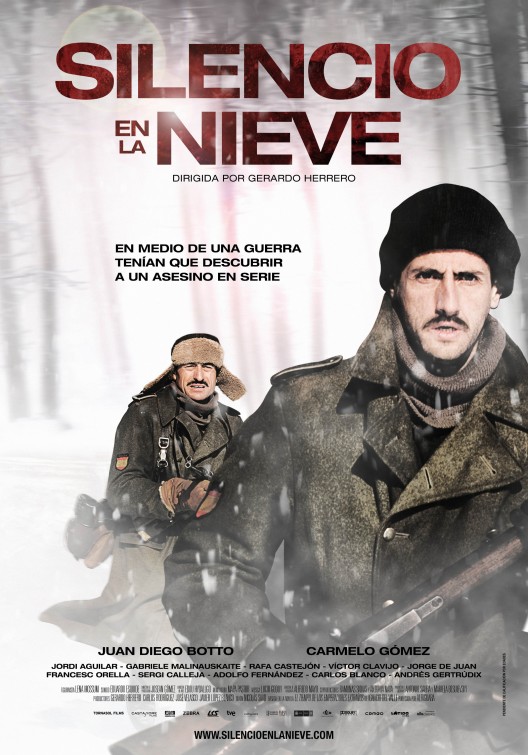
Frozen Silence – Silencio en la nieve (2012) Spanish WWII Thriller

Frozen Silence

Set on the Russian front in 1943, this thriller shows a lesser known aspect of WWII, namely Spain’s participation on the Russian front. I may not be the history buff I should be to write a blog like this, so, in all honesty, I have to admit, I had no clue the Spanish were fighting on the Russian front alongside the Germans. The Blue Division or División Azul  (also called División Española de voluntarios, meaning Division of volunteers) was a division of Spanish volunteers, the 250th Division of the German army. Franco had allowed these volunteers to join up. Most of these men were right-wing, falangists, only a very few were communists.

I knew this was a thriller, therefore I didn’t expect to see all that much about the war as such. The 250th Division must have seen some heavy fighting, but we only get a taste of it. Nevertheless I liked this film a great deal. It works as a gripping thriller, but it also conveys a feeling for what it must have been like for the Spanish to fight with the Germans. There was a lot of hostility, and the Germans made them feel their superiority constantly.

The story starts with a chilling image. A frozen lake full of dead horses. When the soldiers of the Spanish division approach they find a dead man among these horses. His throat has been cut and an inscription has been carved into his skin “God Sees Everything”. The Spanish commander appoints a former police officer, Andrade, to investigate the case.

Arturo Andrade goes about this investigation with great care. At first it looks las if the victim was a pro-Soviet agent, later when there are further murders a possible lead points towards freemasons.

There is a longer sequence towards the end of the movie which is reminiscent of the Deer Hunter Russian Roulette scene, only this one here is even more chilling. I wonder if this is truth or fiction. Did they really play Russian Roulette to the extent it’s shown here?

I liked the mood and the atmosphere of this beautifully filmed movie. It has a lot of great scenes. I enjoyed the characters and the story as well and I’m glad it made me aware of the Spanish participation in WWII. I think this is fascinating material and well-worth a “proper” war movie. I’m afraid though that not many Spanish film makers would want to portray the División Azul. After all they were falangists and, as it seems, quite heroic. Depicting their heroism could be interpreted as pro-Franco, I guess.

The movie is based on a novely by Ignacio del Valle.

I found the Spanish trailer but none with subtitles and another trailer below in which nobody talks.

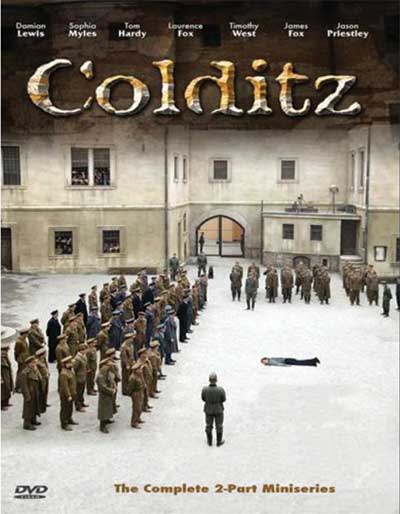
Colditz (2005) British TV Miniseries

Colditz

Often when you expect nothing you’re in for a pleasant surprise. I’d read a few reviews that were critical of the 2005 miniseries Colditz and I expected it to be quite bad but must honestly say, I enjoyed it. Although, truth be told, for the wrong reasons. While the title may give the impression this is a POW series, that’s not the case, the POW part is only one story line. The other is clearly a romance. While the POW part didn’t work all that well, I liked the romance, or rather the tragedy.

At the beginning of the series we are introduced to the four main characters: Nicholas McGrade (Damian Lewis), Jack (Tom Hardy), his girlfriend Lizzie (Sophia Myles) and his friend Willis (Laurence Fox). Jack, Nicholas and Willis escape from a POW camp together. Willis and Jack are captured but Nicholas can make it to Switzerland. Before they are recaptured, Jack tells Nicholas to go and find Lizzie in London and tell her that he is alive. Jack is obsessed with Lizzie and the only thing he regrets is that he was too shy to ask her to marry him before he went to war.

While Nicholas is sent back to England, Jack and Willis are sent to Colditz castle which is said to be escape proof. Prisoners who frequently escaped from other prisons are brought to Colditz. In Colditz the two men meet the Canadian pilot Rhett Barker (Jason Priestley) who trades with different of the German guards. He will help them to escape, buying the silence of some of the guards.

Meanwhile Nicholas who has arrived in London has found Lizzie who is working as a nurse. He knew from Jack’s descriptions that she was a looker but he didn’t expect to fall for her. But he does.

The movie switches back and forth between the two settings. The prisoners make one attempt at escaping after the other and Nicholas tries to win Lizzie’s heart, only she loves Jack and wants to wait for him.

But then Nicholas has a shrewd plan how to win Lizzie despite her love for Jack. I can’t reveal more or it would be pointless to watch the movie.

I like Damian Lewis a lot and I think that’s to a large extent why I liked this series. But I also thought that Nicholas was a great, tragic character. He did a really bad thing and he paid for it but in a way, I think, most people can understand what he did and why he did it. I found it very touching.

The Colditz parts, as I said before, are much weaker. There are many reasons for that but one is certainly Jason Priestley. He’s just not a good actor. This is too bad because Tom Hardy and Laurence Fox are quite convincing.

Watch it if you’d like to see a tragic war romance, stay away if you want to see a movie focussing on Colditz only. Still, there is plenty of action and drama in the Colditz sequences too and interesting war related bits in the London parts. Overall it’s very watchable. Not everyone may like it as much as I did but I’m sure many will appreciate it. It is quite entertaining.

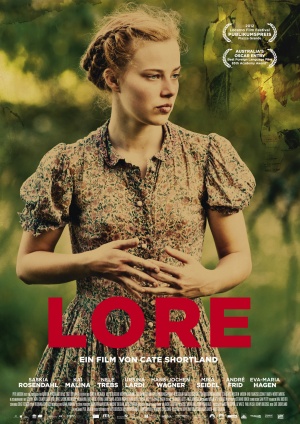
Lore (2012)

Lore

What a pleasant change, I’ve actually watched a movie and really, really  liked it. I’d say it was certainly the best wartime movie I’ve seen in a long while. Lore is a German/Australian/UK co-production. Spoken in German, with German actors and subtitled in English. It’s based on Ruth Seiffert’s highly acclaimed novel The Dark Room. Or, to be more precise, on one of the three interlinked stories in the book.

Lore is the eldest daughter of a prominent Nazi functionary. Indoctrinated with the ideology, she blindly loves her father and the Führer, follows every order without questioning and takes everything she’s ever been taught to be the absolute truth. The movie begins at the end of the war. Her parents are in distress, something has happened but they won’t tell their children. The family flees to a holiday home in the country where people treat them aggressively. Lore has no clue what is going on. She knows her parents are hiding something. The father leaves them, and shortly afterwards the mother leaves too. She is giving herself up and goes to prison unsolicited. Before she leaves she tells Lore that the Führer is dead. Everything is lost. Lore has to take her four siblings, one of them is just a baby, and walk in direction of Hamburg where her mother lives.

The movie follows the children on their difficult journey towards Hamburg. It shows how difficult and dangerous it is for them. They risk starvation, rape, being killed or captured. They have to cross three different sectors, the US, the Russian and the UK sector. Even though they are only children, they are suspected and interrogated. At one point a young man starts to follow them. He carries papers and pretends being their older  brother. This makes all of their lives easier.

Lore is more than a road movie, it delicately portrays the total disenchantment of a young girl. On their journey they are not only confronted with severe deprivations but they learn the truth about their beloved father and the Führer. Everything Lore believed in was built on a lie.

I’ve never seen a movie, which focussed on the children of high Nazi officers. I never wondered what became of them after the war. The movie shows what a long and painful process it was to learn the truth.

The story as such is quite gripping and the way it was told was masterful. I haven’t seen any  of Cate Shortland‘s other movies but she’s a film director I’ll keep in mind. Lore was beautifully filmed and the score, written by Max Richter, enhanced the gloomy atmosphere of the film. The atmosphere and the mood was probably what I liked best: lyrical, melancholic and gloomy.

I’m not surprised Lore has won so many prizes and been nominated for many awards. I’d say it’s the first 5/5 movie I’ve seen this year. Don’t miss it.

Has anyone seen the film?

Roland Joffé’s There Be Dragons (2011) A Movie of the Spanish Civil War? or A Propaganda Piece for Opus Dei?

there_be_dragons_ver3

There Be Dragons is a movie on the Spanish Civil War, focussing heavily on the founder of the Opus Dei José Maria Escrivá. That’s in itself problematic, but the movie has other shortcomings besides reeking of “propaganda”.

There aren’t all that many movies on the Spanish Civil War that’s why I was quite keen on watching this movie. I normally like Dougray Scott and seeing that he’s in this, made me hope it would be good. Unfortunately he’s just a minor character, although the one who gets the ball rolling. Geraldine Chaplin who is also starring in this film has an equally small role.

Roberto Torres (Dougray Scott) is a young journalist researching José Maria Escrivá (Charlie Cox), a priest and founder of the Opus Dei who is a candidate for canonisation. Roberto discovers that his own father from whom he is estranged since years, knew Escrivá. He travels to Madrid, hoping his father will tell him everything he knows about the priest. While Robert’s father Manolo (Wes Bentley) was friends with José Maria when they were kids, they later fought on opposite sides during the war. The movie tells their respective stories in flash backs. They don’t overlap all that often; it’s really the story of José Maria on one side, and the story of Manolo on the other. Only towards the end, they are briefly joined again. A third story line, tied to Manolo, reveals why the relationship between Roberto and Manolo was so difficult. It has something to do with a tragic love story involving Ildiko (Olga Kurylenko).

Due to these different stories, which are only loosely connected, the movie really is a mixed bag. It glorifies the courage and determination of José Maria, his faith, his steadfastness. Although I don’t feel qualified to say much about the Spanish Civil War with which I’m not very familiar and even less about the role of the Catholic Church, I can still say that the depiction was very sentimental and never grabbed me. I was a bit more interested in the frame story between Roberto and Manolo.

Another flaw was the tempo. This was one hell of a slow movie; it never really took off. This is too bad because the cinematography and the score were superior but I felt they were wasted on this film.

I always thought that Roland Joffé was a director who would guarantee a good movie but unfortunately that isn’t the case. I have no clue what drove him to glorify the founder of Opus Dei. Very dubious. I can’t recommend this movie.

I almost forgot to mention that this is another one of those movies in which all the English speaking actors talk in a heavy Spanish accent. Ludicrous.

Have you seen it? Have seen another movie on the Spanish Civil War that you would recommend?