Platoon (1986) Oliver Stone’s Iconic Vietnam Movie

Platoon-PosterArt

Platoon is one of those war movies I have seen quite a few times and every time I discover something new. It’s one of those which has stayed among my Top 10 after each viewing, I never even considered to remove it like I did with some of the others.

It’s a powerful anti-war and anti-Vietnam movie. There is no doubt about Oliver Stone’s position. Stone is a veteran of the Vietnam war, Platoon was the first in his Vietnam trilogy, Born on the 4th of July and Heaven and Earth were the other two.

Reviewing it seems odd as I have a feeling it’s one of the most famous war movies and almost everybody who likes war movies knows the story to some degree. I will therefore only give a very short summary.

Chris (Charlie Sheen) volunteers to go to Vietnam. He is a college student unlike most of the others who are in his company and wouldn’t have had to join up but since his father fought in WWII and his grandfather in WWI he felt it was his duty. He is the typical naive recruit, one of those who usually get killed in the first week but he survives. He learns a few things which will help him to survive and looses a lot of his illusions.

The main story is certainly Chris’ transformation only I never saw it as that before. It’s only now that I’ve watched it for the third time that I realize how important it is. Until now, the story that I was most interested in was the story between the morally good Stg Elias (Willem Dafoe) and the bad Sgt Barnes (Tom Berenger). Barnes represents everything I hate in a character while Elias is – together with Lt David Manning from When Trumpets Fade – my favourite war movie character. Barnes shows the worst aspects of the war in Vietnam while Elias shows the best. The fight and hatred between the two makes for intense viewing.

Barnes and Elias never get along and after a massacre in a village they become open enemies. Based on a true event (My Lay Massacre), the massacre is one of the most sickening scenes I have seen in any war movie.  

Elias is a saviour figure or sacrificial hero and, as I have written elsewhere (see below), it’s not surprising he was cast as Jesus in The Last Temptation of Christ, just like Caviezel was cast as Christ after having been in The Thin Red Line in a similar saviour role.

Many elements speak for the comparison of Elias and Christ. The most obvious is the iconic poster showing him with his arms outstretched. In the movie there are different instances which emphasize this further. One person says that he thinks Elias is Christ, Barnes says of him that Elias is one of those who think they can walk on water. And there are more.

What I had forgotten is the character of Chris who is at first naive and then gets swept away by the collective acts of violence. This shocks him, it shocks him to see that he is capable of such violence at all. I think that at the end, Chris is the most important character as he is neither black nor white but just an “ordinary good” guy who becomes violent under certain circumstances. What is interesting is the fact that the movie shows that he cannot go back to the state he was in before he acted brutally. This seems crucial too and is exemplified by his final actions.

Platoon is certainly a must-see war movie and will always be one of my favourites.

Platoon is a war movie to which I return frequently and I’ve written a bout it quite a few times before:

Is Platoon a War Movie?

History versus Story or Platoon versus Hamburger Hill

Obnoxious and Unlikable War Movie Characters

My Favourite War Movie Character

Christ and the War Movie Hero

http://www.youtube.com/watch?v=daN61E2JO3c

Twelve O’Clock High (1949)

3A1ijr6gqT6zkfOoG3WUyGVBWd3

I wanted to finish the year in style and a review of the black and white movie Twelve O’Clock High seemed fitting. This is one of the most highly acclaimed war movies and while I wouldn’t exactly give it a five-star rating, like so many critics did, I still think it’s a very important movie and the acting is superb.

Most air combat movies I have seen so far, with very few exceptions, showed the point of view of the British or the Germans. This is one of the rare depicting the American side.

In 1942 the US Air Force conducted daylight bombing raids. They thought that the precision of daylight bombing would speed up things and end the war earlier. However this put the pilots under a lot of additional pressure. 918th Bombardment Group was one that took much higher casualties than others. Their morale was pretty low, their squadron leader on the brink of a breakdown. Their explanation for their losses was “bad luck”.

Brigadier General Frank Savage (Gregory Peck) doesn’t want to hear any of this. He believes that leadership or rather the lack thereof is the main reason. The squadron leader is too attached to his men, identifies with them which clouds his judgement.

When Savage takes over the command he faces open resistance. The men don’t want such a hard and seemingly unfeeling leader and want to be transferred. Savage won’t let go. He works on their morale, assigns new leaders, regroups the men, even has the change their sleeping quarters. While they are hostile in the beginning, the first raids show, what he teaches makes sense as there are fewer casualties. On top of that he flies every mission with them.

Outstanding leadership, unflinching command, show results and soon the morale is high again and the men start to admire and even like Savage. Unfortunately the intensity of his assignment comes at a high cost.

While the beginning of the movie is extremely wordy, the second half is perfect. A lot of original footage heightens the authenticity and Savage’s character is one of the most interesting in any war movie. As said before, I wouldn’t exactly give this 5 stars (I found the beginning too slow) but it’s certainly a very good movie and Gregory Peck’s acting is outstanding.

Don’t let the poster fool you, by the way, Twelve O’Clock High is a black and white movie.

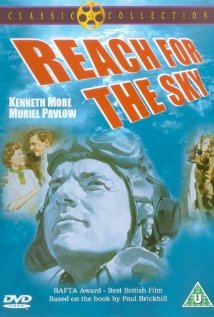
Reach For The Sky (1956) Biopic of a Famous RAF Bomber Pilot

Reach for the Sky

If Reach for the Sky wasn’t a true story it would be one of those movies which you’d just shrug off as way over the top but since it is based on a true story it leaves you astonished.

Reach for The Sky is the story of one man’s love for flying which was so intense that it made him  overcome one of the worst things that can happen to a man and later turned him into a legend.

Douglas Bader is a passionate and reckless young RAF pilot when in 1931, while showing off his talents in front of other pilots, he has a terrible accident which costs him both legs.

Determined and optimistic as he is, he makes the impossible possible and soon learns to walk on tin legs, without help or a crutch. Shortly after leaving the hospital, still on crutches during that time, he meets his future wife and love of his life Thelma.

The only bitter moment comes for him when they don’t accept him as a pilot anymore and he has to do desk duty.

If it wasn’t for WWII he may never have flown again but when war breaks out he undergoes tests and is judged fit for service.

The story which is already quite remarkable until that point, gets truly astonishing now. Not only does he fly one mission after the other, survives the Battle of Britain but he becomes one of the best-loved wing commanders until he is shot down in 1941.

He survives and is captured by the Germans. As a POW he shows the same determination as earlier in his life and escapes several times from different camps until he’s finally sent to Colditz castle where he remains until the end of the war.

Douglas Bader’s story is truly amazing. It would have been so easy to just fall into a deep depression and withdraw from life but Bader was a fighter and nothing, absolutely nothing, could put that man down or stop him. And he was a passionate pilot. As much as he loved his wife, we get the impression that he loved flying even more.

A story like this is quite inspiring but that wouldn’t make this a great movie. What makes it great is the way it is told. While the first half focusses on Bader, his accident and how he learned to walk again, the second half focusses on WWII, the Battle of Britain, the dog fights… It’s quite suspenseful and interesting. It’s not easy for Bader to be accepted at first. The young pilots are a bit taken aback when they find out their wing commander has no legs.

I wasn’t familiar with the main actors Kenneth Moore and the lovely Muriel Pavlow but they were both really good.

It’s certainly a movie I would recommend to anyone interested in WWII, the Battle of Britain and true stories about resilience and overcoming a tragedy.

http://www.youtube.com/watch?v=n9x3r4VWAyE

Machine Gun Preacher (2011)

Machine Gun Preacher is based on a true story, the story of ex Hell’s Angel and bad boy Sam Childers.

At the beginning of the movie Sam gets out of prison. He hasn’t learned anything from that experience and wants to get back to his former life. Drugs, booze, his Harley Davidson and his stripping wife. Unfortunately for him, his wife has found Jesus, works at a mall, doesn’t strip, drink or smoke anymore and goes to church on Sundays. Sam does what he always did, gets drunk and high and ends up fighting with everyone. Then, one night, something really bad happens and wakes him up for good. He joins the church to which his wife belongs, sobers up, sells his bike, gets a decent job.

But that’s not enough for Sam. The way he used to be, lies too heavy on his conscience, he wants more, do more, do better. He builds a church and travels to Africa to see what good the missionaries do there. When he crosses the border into Sudan with a soldier from the Sudanese Liberation Army whom he met in Uganda, he sees things he has never even heard of. Mutilated people, shot women and children, cruelty and violence. He hears about the child soldiers recruited by the LRA (Lords Resistance Army), led by Joseph Kony, sees the many orphans whose parents have been slaughtered. Sam decides that this is his cause. God wants him to help and he will help.

What makes him different from all the social workers down there is that he doesn’t only help and bring money, he also fights. He doesn’t only defend his property, he attacks the aggressors and intimidates them in using the same methods they use. Ultimately he doesn’t mind killing. For him – this is obvious – this is more than just helping, this is fighting a war. A war against oppression, exploitation, violence and cruelty.

If it wasn’t for that, the movie would be average but because of this, it’s a very interesting movie because it seems to state some uncomfortable things and ask interesting questions. Can there be a level of violence which makes it impossible to fight it with non-violence? Could it be dangerous to just try to do good without being prepared to kill and shoot people for the greater good?

I’m not saying I agree with Childers (I personally think we are not meant to intervene everywhere all the time but that’s my opinion. I think if we want to do good, we can start in our own cities, our own neighbourhoods and families.) but I understand his point and found the movie quite interesting.

Machine Gun Preacher reminded me of Lord of War and Blood Diamond and some other movies which make African civil wars and warlords their main topic. While I think it’s a movie which will generate a lot of discussions and I didn’t mind watching it, I still think that movies like Lord of War, Hotel Rwanda and some others were far better. But it’s decent and for Gerard Butler fans certainly a must-see.

The Haunted Airman (2006) BBC TV Drama

The Haunted Airman, starring Julian Sands, Robert Pattison and Rachel Stirling is a 70 minutes BBC TV production based on a novel by Dennis Wheatley (The Haunting of Toby Jugg). I thought it was a great choice for this time of the year as it is quite eerie; a mix between psychological drama and horror story.

A young RAF bomber pilot is shot down. His wounds are considerable and he becomes a paraplegic in a wheel chair. His aunt Julia, a widow, decides to bring him to an asylum where the mysterious Dr. Hal Burns treats soldiers with post-traumatic stress disorder. The asylum is located in one of those huge English country houses.

Toby suffers from different symptoms of post-traumatic stress. Nightmares, hallucinations, visions, phobias. He sees burning cities and dead civilians, relives the night in which he is shot down, imagines being attacked by giant spiders.

Julia is his aunt by marriage. She is gentle and beautiful and Toby is clearly very much in love with her and dreams of marrying her. He writes to her frequently but she never replies. One day he finds out that the sinister doctor has kept back all the letters.

From then on tragic and dramatic things happen. The end is a bit weird and mysterious.

I didn’t mind watching this, it had a gothic, haunted house feel, the images were quite beautiful and Pattison and Sands act quite well. Still, I didn’t really know what to make of it all and didn’t get the end. I went to IMDb and saw that the reviews were extremely mixed. Either 8-10 or 1-2 stars.

I’d say it’s a movie you either love or hate. Being a Robert Pattison fan would certainly influence the reaction.

I don’t like rating movies this much, but in this case, I’ll try to. I’d give it 4 stars for the actors and the cinematography and 1.5 stars for the story. Whether it is OK to turn PTSD into entertainment…