War Requiem (1989) Derek Jarman’s Impressive Interpretation of Benjamin Britten’s Eponymous Requiem

Futility 

Move him into the sun —
Gently its touch awoke him once,
At home, whispering of fields unsown.
Always it woke him, even in France,
Until this morning and this snow.
If anything might rouse him now
The kind old sun will know.

Think how it wakes the seeds —
Woke, once, the clays of a cold star.
Are limbs so dear-achieved, are sides
Full-nerved, — still warm, — too hard to stir?
Was it for this the clay grew tall?
— O what made fatuous sunbeams toil
To break earth’s sleep at all?


I have never seen anything like the War Requiem before. Although I used to like Derek Jarman‘s movies (especially Caravaggio, Sebastiane and The Tempest) I wasn’t aware that this existed before I saw a review on the War Movie Blog. This is certainly not for everybody. If you don’t like classical music, especially requiem’s you will have a hard time. I tell you this right away. Jarman took Britten’s War Requiem, which consists of a proper requiem and sung versions of Wilfred Owen’s poems, and illustrated it. Wilfred Owen is the young poet we also see in the movie Regeneration. He was killed in action one week before the end of in WWI. As you can see I added two of his poems for you.

War Requiem is actually a silent movie so to speak. We see images, acted scenes and hear Britten’s music. In part it’s a reenactment of Wilfred Owen’s story, in part we see actual footage of different wars. Documentary and art are entwined and the result is extremely rich and interesting. The acting is of course somewhat exaggerated as the actors are miming not acting as they don’t talk (silent movie style). The two main actors are Nathaniel Parker (Owen) and Tilda Swinton (The Nurse): Sean Bean (The German Soldier) and Laurence Olivier (The old Soldier) are in minor roles. There is a bit with Tilda Swinton who plays the nurse that is very annoying (scene 10). But that was the only bit I found hard to take. The rest is impressive. Beautiful images. Colors are very important and highly overdrawn as they are in all of Jarman’s movies. In this one it is the color red that is artificially bright. Colors have a special meaning in Jarman’s work. He wrote a book, Chroma: A Book of Colors, dedicated to color interpretations and his last movie is dedicated solely to the color Blue. The tragedy behind all this is that Jarman was going blind towards the end of his life. He suffered from AIDS related illnesses and finally succumbed to them.

War Requiem is remarkable also because it is not only an anti-war movie but also an “anti war movie movie”. If you watch all of it and don’t give up in the middle you might be astonished to see what kind of actual footage you see towards the end. I have never seen anything like it before and felt very uncomfortable. The footage we see – especially from Vietnam and Angola – is horrible and gruesome. What is even more horrible is that you see the difference between wounds in a war movie and these head wounds and other wounds in these documentary bits. It simply doesn’t look the same. You see immediately that these people are really dead. I think to see something like this would be good for every person who regularly watches war movies. The atrocities of war are so much more horrible in reality. It was extremely sobering to say the least.

This is a really special movie. It is an interesting contribution to cinema history as well as to war movies  in general. But it is not for everybody.

Anthem for Doomed Youth 

What passing-bells for these who die as cattle?
Only the monstrous anger of the guns.
Only the stuttering rifles’ rapid rattle
Can patter out their hasty orisons.
No mockeries for them; no prayers nor bells,
Nor any voice of mourning save the choirs, —
The shrill, demented choirs of wailing shells;
And bugles calling for them from sad shires.

What candles may be held to speed them all?
Not in the hands of boys, but in their eyes
Shall shine the holy glimmers of goodbyes.
The pallor of girls’ brows shall be their pall;
Their flowers the tenderness of patient minds,
And each slow dusk a drawing-down of blinds.


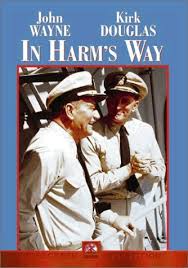
In Harm’s Way (1965) or John Wayne, Pearl Harbor and Some Decent Naval Combat in the Pacific

I don’t know how many war movies John Wayne did. The only thing I know, he did a lot. I’ve seen The Longest Day but apart from that Otto Preminger‘s black and white movie  In Harm’s Way was my first. I actually quite liked it. It’s a decent movie with some interesting female leads and a love story between John Wayne and Patricia Neal’s character that resembles a real relationship and not some ridiculously soppy romance.

I already mentioned it in my post on Pearl Harbor as it starts on the night before the attack of Pearl Harbor. At the center of the movie is Admiral Torrey who is first demoted and then promoted again. The movie analyses what is going on outside of the actual battles; the planning, the men’s love and private lives. Torrey meets his son who is in the Navy for the first time after several years. Their relationship is very conflict-laden but evolves during the movie. Torry gets to know the nurse Lt. Maggie Haynes (Patricia Neal) who is probably one of the greatest nurses in any war movie. Kirk Douglas plays a real asshole, Commander Eddington. We see a few decent battle scenes but nothing too exciting.

Too cut  a long story short, In Harm’s Way is a movie for John Wayne fans, for people who want to watch something older about the war in the Pacific, for those who like a well-told story that focuses on relationships and for those who can overlook a few gender related oddities (Two things struck me. One was the “tea scene” and the other the way people react to Eddington’s crime). As a war movie I would rate it 3.5-4/5.

Don’t miss the trailer. I have never seen a trailer like this. I first thought it was a parody and then I realised it was just unreflected promotion. It has real historical value. Just watch it and thank God that trailers have evolved through the years.

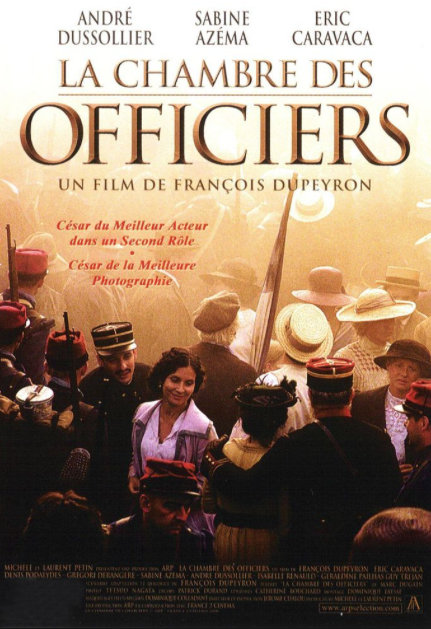
La chambre des officiers aka The Officers’ Ward (2001) France, WWI and the Nightmare of Facial Mutilation

La chambre des officiers

The French movie La chambre des officiers aka The Officers’ Ward may very well be one of the most moving and shocking war movies I have ever seen. I felt sick twice, I cringed endlessly and it made me really sad. It is  a masterpiece. An absolutely brilliant anti-war movie. If you thought Born on the 4th of July was horrible then you haven’t seen this one.

The movie is based on Marc Dugain’s novel La chambre des officiers aka The officers’ ward and tells the story of the young lieutenant Adrien. At the beginning of WWI Adrien is a very handsome young officer. A piece of shrapnel rips half his jaw off. He will spend the rest of the war, a full five years, at the Val-de-Grâce Hospital in Paris. At this hospital they only cure men with facial wounds, burns etc. It is like a freak show only these are human beings.

During the beginning of the movie we never see Adrien. We only see the reaction of those around him. The doctors’, nurses’ and patients’. The profound pity in these faces says more than actually seeing him. Since he cannot talk anymore, we hear his thoughts. The moment when he realises that his face is a gaping hole is so awful…

During the five years at the hospital he fights great pain, despair, horror, suicidal thoughts. Together with the other mutilated officers they try to stay alive and become human beings again.

The music is very intense (Arvo Pärt and Wagner, admittedly the second is a bit strange) and underlines the atmosphere of this saddest of war movies. Funny enough there is also beauty. The beauty in the relationships between the wounded. And the beauty between Adrien and a very gentle and loving nurse. There is also a brothel scene towards the end that is not only lighter in tone but even in a melancholic way funny.

This is a very thought-provoking, must-see, 5/5 star movie.

I only found the French trailer, I’m sorry.