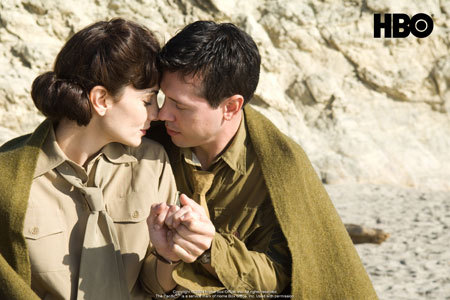
Cross of Iron aka Steiner – Das eiserne Kreuz (1977) or Showdown on the Eastern Front

…Peckinpah successfully stripped the combat of the patriotic heroism and glory that usually accrue to it in war films (Stephen Prince quoted in Under Fire p. 52)

Sam Peckinpah´s only war movie, Cross of Iron, is a UK/German co-production and probably one of the best war movies you can possibly see. It is based loosely on the battle of Krymskaya that took place during the German retreat in 1943. The original source is Willi Heinrich´s Das geduldige Fleisch aka The Willing Flesh. Heinrich fought himself on the Eastern Front. It contains quite a lot of  graphic infantry combat scenes. Steiner is one of my top favourite characters, right after Sgt. Elias, however much more cynical but a good man at heart. I have read reviews of this movie that were not favourable and I admit, it could be misunderstood. If you do not pay very close attention and take into account the opening and final credits, you might simply not see the profundity of the anti-war statement.

Cross of Iron opens on a cheerful children´s tune Hänschen Klein ging allein, in die weite Welt hinein, Stock und Hut, stehn ihm gut… While we hear this tune we see black and white footage of grim content interspersed with pictures and stills of Hitler Youth to show us the slow ideological infiltration of the German youth.

The movie tells us a story from the point of view of a German platoon on the Eastern Front in 1943. At the heart of the story is the antagonism between Sgt. Steiner (James Coburn) a much admired veteran who has already earned two Crosses of Iron and Captain Stransky (Maximilian Schell) an arrogant, conceited Prussian officer whose only goal is to be awarded such a cross. When tensions intensify Stransky does not inform Steiner and his platoon of their retreat and the men are left stranded behind enemy lines. They barely make it back and Stransky let´s his men open fire on them. We get to see a scene that resembles many a Western showdown.

The final credits are quite different from the opening ones. The statement  clearly is: war is pure madness. We hear a hysterically laughing Steiner, the annoying children´s song of the beginning and see black and white photos. Those photos are interesting, the first shows the execution of young Soviet partisans (see more info in B Hellqvists comment below) followed by the pictures of children in different wars, Vietnam, somewhere in Africa…

This movie wouldn’t be the controversial movie it is if there were not other extremely important elements that have not so much to do with the core story. Steiner has an affair with a nurse (Senta Berger) after being wounded. This scene, that has been criticized, is meant to emphasize his cynicism and, I believe, should be seen paired with the other female roles in this movie, namely the female Russian soldiers Steiner´s troop encounters on the retreat. It is rare that you see female soldiers in war movies unless they are Russian. Running out of men and considering women – due to their assumed patience – to be better snipers Russia recruited a lot of women towards the end of the war. There are a few Russian movies dedicated solely to female soldiers (I will review them in due time). But let’s get back to Cross of Iron. The encounter of those female soldiers and Steiner´s men gives us one of the most graphic scenes I have ever seen in a war movie. Not for the fainthearted.

All in all, apart from the central story of hatred between two men from different social classes, the movie is complex and composite. It certainly gains by being watched twice. The actors are all very good. James Coburn is fantastic.  Maximilian Schell is very good and so are James Mason, David Warner and Senta Berger.

What I liked a lot is how daring Cross of Iron is. It does not shy away from touching topics that are normally left out, it goes beyond what we are used to see and stays in your mind long after you watched it.

I must admit that personally and for reasons that elude me, I was always extremely fascinated by the tales of the Eastern front. This dates back to my childhood when I found a book in my grandmother´s library called “Letters home from Stalingrad” (it is as good as Letters home from Vietnam and not less tragic). Thinking that without the British and the Americans the outcome of the war between these two countries would have determined all of Europe´s fate gives me the creeps…

“What will we do when we have lost the war?”

“Prepare for the next one.” (Cross of Iron)

Cross of Iron is among my Top 20, that is for sure.
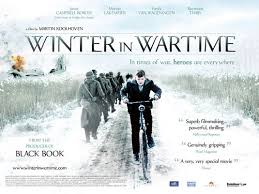
Winter in Wartime aka Oorlogswinter (2008) Resistance in Occupied Holland

Winter in Wartime is a Dutch-Belgian co-production filmed in three languages, German, Dutch and English. The same producers who did the outstanding movie Zwart Boek aka Black Book did also this one. There are some resemblances picture wise but apart from that the two movies are very different. Winter in Wartime is to be classified among the long list of Children in War Movies (please see my post Children in War Movies).

Michiel, a young boy of 14 years, gets drawn into the Dutch Resistance after one of his older friends, an active member of the Resistance, gets shot. Michiel takes it upon himself to help a young RAF pilot who has been shot down in the woods near his village. As young as he is Michiel has a strong sense of right and wrong and despises his father whom he accuses of collaborating with the Germans. He idealizes his uncle Ben who thinks his brother is a coward.

Occupied Holland is swarming with Germans. It is extremely dangerous for Michiel to help the young injured British soldier and he has to let his sister who is a nurse in on his secret. After a German soldier is found shot in the woods the Germans arrest Michiel’s father. Although his uncle says he can help him, the father is shot.

Michiel’s only mission from then on is to save his the young pilot. The ywill attempt to flee several times. Michiel will learn a few important lessons and come out wizened of this experience.

The movie is very beautiful as we see long takes on the snow-covered Dutch countryside. Snow flakes fall softly in many a scene, the whiteness of the woods builds a stark contrast to the dark uniforms of the Germans. Michiel is a wonderful character. Such a young boy with such an incredible idealism and courage. The young actor, Martijn Lakemeier, did a great job. So did  Jamie Campbell Bower as the pilot Jack. I also liked the relationship between the boy and his father or rather how the opinion the boy is change through the events. Apart from that I’m not too sure about this movie. You could watch it with very young people or children to teach them something about the war and values but I think it is too much of a purely invented story and does lack realism. If you watch it you will understand what I mean. There are a few things that just seem extremely farfetched.

Don’t get me wrong, it is watchable. Just not great. If you have never seen a movie on Dutch Resistance, go for Black Book. If you’d like to watch something on Nordic Resistance, try Max Manus or Flame & Citron. All three are great. This one is probably a 3.5-4.

The Guns of Navarone (1961): A Great War Adventure Movie

Some movies age well. Others don´t. The Guns of Navarone,  a splendid UK/US co-production, is one of the first kind. Almost 50 years old but still fresh like on the day it came out. This is thanks to a  lot of things. A gripping story, a great cast (Gregory Peck, David Niven, Anthony Quinn, Irene Papas, Stanley Baker, Anthony Quayle), wonderful cinematography, a nice score. What more do you want from a good war adventure yarn? I hadn’t  seen it before (yes, yes, shame on me) and was really surprised how good it is. And very esthetic. It is one of the most esthetic movies I have ever seen.

The year is 1943. Greece is occupied by Germany.  The Germans who feel they are losing on the Eastern Front try to force Turkey to join them. The Guns of Navarone tells us how a group of men tries to secretly enter a Greek island, meet with the Greek resistance and with their help sneak into a fortress to destroy two powerful German guns that threaten British soldiers who are marooned on another island. The mission is extremely dangerous and no one actually thinks they might accomplish it.

The story, from the beginning to the end, is one gripping sequence after the other. Each one of them could almost stand alone like some sort of short story. First they fight the elements on a boat during a storm. Then they have to climb an impossibly steep rock. Every place they find themselves in is swarming with Germans so they have to hide often.  In one episode one of them gets wounded and they need to decide if they take him along or shoot him. One of them betrays them and they need to decide whether or not to shoot the person. They get captured by the Germans but escape. Many things go wrong and not all of them make it. The best scenes for me are in the fortress. We hear a German song in the background and see this bunker with its typical Nazi esthetics.

It is also a funny movie at times as the German´s really get their asses kicked. In one scene the group is hiding and a German guard hears them. To distract  him they throw something and he runs off like a dog.

There is also some humorous dialogue mostly coming from the stiff-upperlipped British major played by David Niven.

The characters are well drawn, interesting and complex. Major Mallory (Peck) is a mountaineer whose expertise is needed for the mission. Miller (Niven) is an expert in explosives. Stanley Barker plays a trained killer who has problems with his conscience. I was quite surprised to see Irene Papas, the Greek singer, in one of the roles. I didn’t even know she acted. She plays a Greek resistance fighter. Quite a fierce character. Gia Scala´s role Anna is interesting and what happened to her illustrates once more the idea of the absurdity of war.

This movie made me quite nostalgic. You don’t find many movies like this anymore. And no actors like these either.

Do Women prefer The Pacific to Band of Brothers?

In an interview Dale Dye, a military advisor for many war  movies, was asked why The Pacific had many female viewers and here is his explanation for that fact.

“By telling a story that reflects the thousands of whirlwind wartime romances that happened during World War II. There’s this great desperation element—I might get killed in the next six weeks, we’ve got to get married now—and females really identify with that. They get it.” (Dale Dye in The Atlantic)

He also believes that the love story between the two soldiers John Basilone and Lena Riggi made women like it.

Aha? So it is only the romance that makes women appreciate The Pacific? Could it not be that it has more to do with the fact that there are simply more women in The Pacific than in Band of Brothers?And that there is a whole psychological dimension in The Pacific, with all its tales of post-traumatic stress, that might appeal to women?

I would love some comments. Do women like The Pacific? Do they prefer it to Band of  Brothers? Or did they even like both?

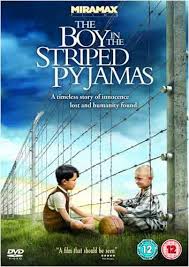
The Boy in the Striped Pyjamas (2008) or An unusual look at the Holocaust

The movie The Boy in the Striped Pyjamas is based on a novel by John Boyne.

The movie tells the story of Bruno, an eight year old boy, whose father is a high ranking Nazi officer newly appointed to be in charge of a concentration camp.

The family leaves Berlin (shot in Budapest, by the way) for a place somewhere in the country, near a concentration camp. The story is purely seen through the eyes of the little boy which creates some very uneasy moments.

I believe that the major theme of this movie is knowing and knowledge. We do know what happened during the third Reich. We know what Endlösung – The Final Solution – means. We know about concentration camps and extermination camps. Watching this movie with all this background information makes for a lot of discomforting moments. All the signs, the chimneys and the smoke, the people in the striped pyjamas… We know what to make of them. Bruno does not. And neither does his mother as it would seem.

The crucial moment is when Bruno meets the boy behind the barbed wire, the boy in the striped pyjamas, Shmuel. An impossible friendship begins. Bruno understands after a while that this boy is a Jew; at the same time he is taught by a fanatic private tutor that Jews are vermin.

Boyne says in an interview that he wanted to tell a different story, add something new to a topic that has been taken up so many times. He is very successful. One thing is for sure, no one who watches The Boy in the Striped Pyjamas is going to forget it easily. The whole way it is told plus the more than atrocious end is by far too unusual to be forgotten.

I am sure it is one of the best movies to teach children the Holocaust.

To be honest, I am still a bit speechless. The whole film and especially the ending are like being kicked in the gut. I am quite awed by the little actors. Asa Butterfield, who plays Bruno, is amazing. This little kid has a way of talking with his eyes that is rarely found in grown up actors. To cut a long story short: Watch it!

See also Children in War Movies: A List