The Pacific versus Band of Brothers: Should we compare?

I finally got to watch the last episode of The Pacific. Even though I had an entry on it a while back I didn´t feel like writing about it before I had seen the whole series. It proved to be  a good decision since I couldn´t really appreciate it at first. I couldn´t help myself, like so many others, and compare it constantly to Band of Brothers. Apart from being a HBO miniseries produced by Spielberg and Tom Hanks, opening with men who were there talking about their experiences, those two series have nothing in common. Sure they both show a lot of very intense and gruesome infantry combat scenes but that is that.

Band of Brothers, as the title eloquently indicates, was about a close-knit group of men, one Army Infantry Company. This is not the case in The Pacific. The Pacific focuses on three main characters, the three marines Sgt. John Basilone, PFC Robert Leckie and Eugene B. Sledge. The last two wrote books about their experiences. The first episodes focus on Leckie, whereas the last ones tell Eugene aka Sledgehammer´s story. This last detail is based on the fact that Eugene went to war much later than the others. He missed Guadalcanal and Cape Gloucester, one main battle and one major experience of the war in the Pacific.

The mini series shows a lot of off the battle ground episodes. Soldiers on leave in Australia, Leckie´s stay at different hospitals and later we see Sledge back home. Many of this off the battleground parts look at the symptoms of post-traumatic stress of which both Leckie (in a very physical way-peeing himself-) and Sledge (more psychological-he´s depressed and has endless nightmares) suffer intensely.

The series has  many crucial moments. Truly gory battle scenes.  Endless rain on Cape Gloucester that grinds down the morale. The realization that all they learn is “killing Japs”.

There is one key scene, the moment when the two friends Sidney and Sledge meet as one leaves and the other arrives in the Pacific. Sledge wants to know from Sidney how it is to be fighting but he doesn´t get an answer. This is actually a recurring theme in war movies (there is a scene like that in The Deer Hunter and in many others): the inability of those who have experienced it to tell those who are about to experience it what it is like to be in combat. Or maybe it is not so much an inability as a refusal. They have been there, they know it´s no use. You cannot talk about something that is so completely different from anything you imagine. No one who hasn´t been there will ever know what it is like and there are no words to really convey this, nothing that equals the experience. All you have got in the face of the innocent and ignorant is silence. The Pacific shows this very well.

I would like  to point out specifically one further scene. It is related to one of my major points of interest namely Death. In The Pacific we see one of the most touching deaths in the history of war movies. I don´t want to spoil anything so I´m not going to tell you who is dying. What makes this scene so different is the way it is shown. We do not see the actual dying, we hear that the person died and then the corpse is being carried  by some soldiers and transported through the lines of men standing there paying tribute and crying. This is a genuinely heartfelt and sad moment. A display of utter futility.

Something else is very different from Band of Brothers. Even though it was WWII, this wasn´t the same war. This is not about a bunch of soldiers freeing occupied countries and captives. We have no rewarding moments like the one in Band of Brothers when they liberate people in a concentration camp. The war in the Pacific seems much more futile at moments. And senseless. And it lasted longer. The war in Europe was already over, Germany had surrendered but Japan had not. Only after Little Boy and Fat Man did this war stop. This must have been some sort of an anticlimax. By the time those soldiers came home, the whole world had already been celebrating the end of the war. The party was over and they had missed it.

Needless to say that this influences the tone of the movie.

For all these reasons I do not think it is doing The Pacific any justice to compare it to its older brother.  It really has its moments this series.

One last thing needs mentioning though and it is something I did not enjoy much. The Japanese are never ever shown in a positive light. You truly get the impression that they were a bunch of murderous automatons. If anyone wants to see a more honest depiction I suggest you watch Tora Tora Tora (1970) or Letters from Iwo Jima (2006). They both try to and  succeed in doing the Japanese justice.

amazon.com

Kokoda, 39th Battalion (2006) or The Australians´ Fight in the Pacific

Kokoda 39th Battalion is an Australian movie by Alister Grierson and tells another story that took place in the Pacific during WWII. Only this time we don´t watch Americans fight for the Australians (as they do, amongst oher things, in the miniseries The Pacific), but the Australians themselves. The Kokoda trail on Papua New Guinea is the main trail that leads directly to Port Moresby. By means of this trail the Japanese were planning to arrive at Port Moresby and from there an invasion of Australia would have been easy.

Obviously the Australians did everything to prevent this. The 39th battalion who is in the center of this movie was essentially a battalion of untrained volunteers. The central story focuses on two brothers who joined this battalion together.

The opening of the movie shows us a sequence of still lives that are very beautiful. Pictures of fauna and flora of the island. After that we see what has to be interpreted as premonition like dream of  Jack, one of the two brothers. This is somewhat an exaggeration of what the terrain was like. Same as in episode 4 of The Pacific there is a constant rain, and the terrain gets muddier and muddier. Jack slips and is almost drowning in mud. In the end he looks like some almost amphibian prehistoric creature. Those first ten minutes make you believe you might watch a film like The Thin Red Line with a lot of flashback elements, daydreams but that is, as you soon realise, not the case. From that moment on Kokoda turns into Hamburger Hill, meaning heavy jungle infantry combat.

The men are surrounded by Japanese soldiers whose camouflage is so much more efficient than their own, whose fighting experience is outstanding, and whose cruelty, as the movie wants to make us believe, is beyond imagination.

This was one of the movies that made me think again and again: Why war? Why did that happen? Why did it have to happen. The efforts of the Australians seem so futile, that even though they won in the end, there is nothing noble in all this. It´s just horrible and hard to watch.

I first thought that this was an average movie but the overall atmosphere is so intense, the desperate fight of these badly trained men is so well depicted that I think it´s quite a good movie that I would recommend you´d watch. And, most important, the pictures of the dense forest and the instances of cruelty in the middle of the jungle aren´t easily forgotten and stay in your mind long after you´ve watched it.

Yes, it´s biased, the Japanese are shown as beastly monsters but still.

Furthermore it tells a quite soulful story of the deep bond between brothers.

DVD on Amazon

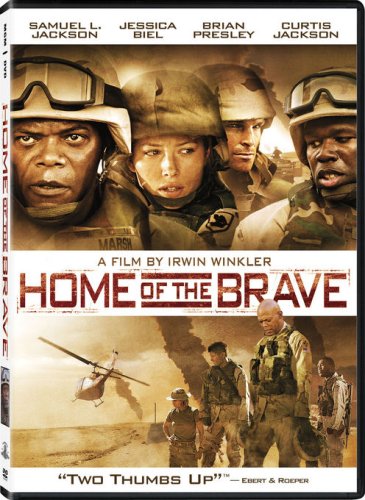
Home of the Brave (2006) or When a movie really fails

Home of the Brave is about a group of soldiers who came under heavy attack shortly before being sent home. After their return they try to cope with what they have been through. They all fail to some extent before they realise they need psychological help.

What a bad, bad, bad movie! I´m embarrassed I watched it. Worst acting ever. Ridiculous dialogue, dragging storyline, wrong cast, pathetic music…

And yet, there are a lot of people who like this movie and say: that´s exactly how it was.

I don´t doubt for one sec, that this is how it was. I don´t doubt for one sec that the returning soldiers need medication, treatment, can´t make their relatives understand, despair, start to drink, get violent, blame everyone including themselves and the government.

Fine. But DO NOT show a message like this in such a way. After a while you start to wonder, why there is not a constant voice in the off telling you: ha…that was impressive, ha…see how horrible, ha….start to blame the government and now ha….

This doesn´t work. It´s like someone telling you a joke and immediately explaining you afterwards why it was funny.

The opening is quite similar to many other opening scenes of movies located in Iraq, be it Battle for Haditha, Stop-Loss or any other. But the similarity is a purely exterior one. The acting is too bad to actually induce feeling. The convoy gets ambushed, people die and get mutilated. And all this happens after we have been told that exactly these people are about to go back home. This is repeated so many times that the thickest moviegoer starts to scratch his head thinking: Are they telling me something here? Fate playing tricks is an old theme in war movies, after all it´s one of life´s themes, but usually it is handled with more subtlety.

Next thing, they are all back home. One has lost his best friend, one (a doctor) had to amputate many limbs, one had her hand amputated and now they start to struggle and stumble and fail like the movie.

Sad. They meant well. They wanted to tell us: This should not happen. America shouldn´t meddle. This is not WWII. We won´t get statues and memorials and see people with tears in their eyes still thanking us years later. No, they hate us, they want us out and if we don´t get it, they shoot us up.

A few final words on the actors.

Jessica Biel: Very bad start but then okish.

Samuel L. Jackson: He can’t really be very bad, can he? No, unless he unconvincingly tries to play a drunk. But he has his moments still.

Brian Presley: Who´s that geek? He´d be good in a movie like My Beautiful Laundrette. But only for the looks. Talentwise it´s rather… well…any bad series. Whatever.

Chad Michael Murray: How to get shot and look ridiculous at it. He should keep on making series like  One Tree Hill (not that I´d watch that) or movies like Cinderella Story.

50Cent:  Mumble, mumble, mumble or How do I act without having the tiniest facial muscle move.

Christina Ricci: What the heck were you thinking accepting this role?

The only good thing was the movie´s attempt at showing that medication is no solution to trauma and consequential sleeplessness. It´s in the end no better than drinking. You can´t ignore the trauma, you can´t block it, you have to accept it and  talk about it.

Women in War Movies

War movies are a genre in which women will rarely if ever play major roles.

However there are a few that come to mind immediately.

Nurses

Mothers

Wives

Girl friends

Resistance fighters

Soldiers

Officers

Victims

The nurse is by far the most common role. In many movies they are very prominent. Especially in the sub genre of the war romance they get more than just small roles. (Yes, Pearl Harbor (2001) comes to mind, but…)

Some fine examples of nurses can be found in The Lighthorsemen (1987), In Love and War (1996), The English Patient (1996).

Mothers, wives, fiancées are often found at the very beginning of a movie, when the soldiers leave their homes like in Dark Blue World aka Tmavomodry svet (2001). We often see them again, reading a letter arriving from the field as in The Thin Red Line (1998).  They serve as a sort of counterpoint to make the contrast between those who fight and those who stayed home even bigger. Then, you may find them once more at the very end, when the soldiers return home. One of the most poignant and touching wives is Madeleine Stowe in We Were Soldiers (2002). The story moves back and forth between the battle field and the home front depicting the agony the soldier´s wives went through when the telegrams arrived telling them one of their husbands had been killed.

Nurses become very often soldiers’ girl-friends which makes the two roles blend into each other. But many of the classic girl friends in movies depicting the second WW are the girls the men encounter in the countries they are shipped to. The American soldiers in The Pacific for example have Australian girl friends.

The role of the resistance fighter is quite a noble one. Not very frequent but appealing. Cate Blanchett as Charlotte Gray (2001) comes to mind. Or the women in Uprising (2001). And definitely Sophie Scholl (2005). The latest example of this kind is Carice van Houten as the jewish woman Rachel Stein who joins the Dutch resistance after having survived a massacre in the brilliant Black Book aka Zwartboek (2006).

Female soldiers that are even involved in combat are not very frequent. The most remarkable one I remember is the Vietnamese sniper in Full Metal Jacket (1987). A further female soldier  is played by Demi Moore in G.I. Jane (1997) where she is said to be the first woman  to have  been granted access to the navy SEALS.

Women as officers is by far more common. Again Demi Moore played a role in the excellent legal drama A Few Good Men (1992). And then there is Meg Ryan as medevac chopper pilot Capt. Karen Walden in Courage under Fire (1996).

Unfortunately some of the above mentioned portraits of women in war movies are quite questionable and have been criticised repeatedly (especially G.I. Jane).

I almost forgot the victims. Inexcusable. There are as innumerable female victims in real wars as there are high numbers in movies. One of the saddest are the victims in Vietnam war movies. I think of  Platoon (1986) and Casualties of War (1989). They are not the only ones. Of course not.

My favourite heroines are Cate Blanchett as Charlotte Gray, the wonderful Juliette Binoche as nurse  in The English Patient and, another nurse, Sandra Bullock in In Love and War, and the outstanding Julia Jentsch as Sophie Scholl. The first two are based on novels, the other two on historical facts. Sandra Bullock plays the nurse Ernest Hemingway fell in love with when he fought in Italy during WWI.

The Pacific 4 (2010): Rain on Cape Gloucester or The Weather in War Movies

Since I saw Stalingrad in which soldiers die in the snow or the episode Bastogne in Band of Brothers I consider the weather to be one of the key elements not only in the actual war but also in transmitting a sense of reality to the audience of war movies.

I have only seen five episodes of  The Pacific so far. Episode 4 was the first to really grip me. It’s raining and raining endlessly. The morale of the soldiers gets lower and lower. There is no escaping this torrential downpour. Whoever has been in the tropics knows that this is not the kind of rain we Europeans or Americans are used to. There is the humidity, the violence and the noise. Yes, this kind of rain is as noisy as a constant shower open at full blast and as violent. If you are in a solid house maybe you could ignore it but in a hut or a tent…No way.

Incredible somehow that after all the heavy fighting the soldiers have been through at Guadalcanal it is the rain that finishes some of them off.

Rain on Cape Gloucester

With all the natural disasters and extreme weather conditions that have always been taking their toll  it is amazing we humans are not more humble. Or is this one of our well-kept secrets that fighting each other and subduing one another helps us fool ourselves into believing we are stronger than we are.