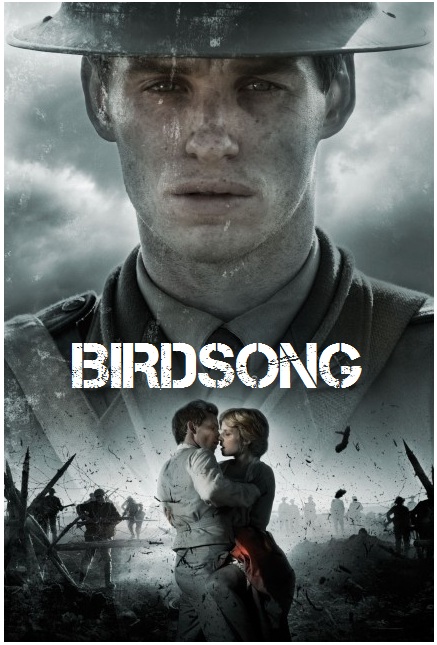
I finally managed to watch Part I of Birdsong, the BBC One TV drama based on Sebastian Faulk’s excellent eponymous novel. They chose to tell the story moving back and forth between 1910 and 1916.
Stephen is fighting in the trenches and thinking back on how he meet Isabelle, in France, in 1910. He stayed at her house and helped her husband, a factory owner, develop new machines. Those machines were going to make a lot of the workers lose their jobs. The marriage is an odd one. The children are from a former wife, Isabelle and her husband have no children together. At night Stephen hears her cry, during the day he watches her sneak around. She tells him later that she brings bread to the worker’s families.
Isabelle is clearly what the French call a “mal-mariée” – a woman unhappy in her marriage. Stephen is much younger than her husband. He is kind, caring and very attentive. We can’t blame her for falling in love.
All this is shown in flashbacks while Stephen is fighting in the trenches. He is a Lieutenant and has the reputation of being very quiet and superstitious. He seems to have no family, friends or a sweetheart. The trench they are in is above a tunnel system dug out to lead under the German trenches where they could be blown up. The diggers hear that the Germans are digging on the other side as well and are quickly approaching. Usually miners were sent down, not infantry men, but the commanding officer decides that Stephen and his men have to go down as well. Stephen had a problem with one of the miners before and now he is sent down with him.
I’m looking forward to part II as I have forgotten the rest of the story. Or at least the rest of the love story. When I read the book I was much more impressed with the parts on WWI. Although the movie starts in the trenches, it still is much more of a love than a war movie and can’t even be called a war romance as I would only call a movie “war romance” when the romance is set during the war.
I didn’t mind watching it, I even liked it, but it isn’t great, it’s just very watchable. I’ll tell you my final impressions once I have watched part II.
The African Queen is one of those classics that many people like. Surprisingly I’ve never even seen it on TV although Hollywood classics are regularly shown on Sunday afternoons. I didn’t expect anything because other than that it’s set in Africa during WWI I knew nothing about it. After having seen it, I know that it is rather a screwball comedy than a war movie as such. Nevertheless I enjoyed watching it. It is entertaining and the actors are excellent. Being a bit of a Humphrey Bogart fan I had to watch it sooner or later.
September 1914, German Eastern Africa. Missionary Reverend Samuel Sayer and his prudish sister Rose (Katharine Hepburn) live on a farm isolated from any other colonists. They are regularly visited by Charlie Allnut who owns a crummy boat, the “African Queen” and travels up and down the river, bringing the mail and other things. He is boorish and has very obviously an alcohol problem.
When the war in Europe breaks out, the colonies are drawn into it as well. German troops burn down the mission and the Reverend dies soon afterwards. Allnut passes by on his boat and helps Rose to bury her brother and takes her with him on the African Queen. They face a very long, difficult and dangerous journey down the river and on top of that Rose is determined to help the war effort. She suggests, Allnut should construct a torpedo and that they should then attempt to sink a German warship, the Luisa.
As is to be expected their trip down the river is more than adventurous. Torrential rains, rapids, mosquitoes and German posts make the journey very daunting. What is worse for Allnut is the fact that Rose supervises him and throws away his brandy. She wants him to behave and at first they bicker and quarrel constantly. After several days on the boat and many dangerous adventures they get closer and end up falling in love.
What an unlikely couple they make. What I liked is the fact that Rose is the inventive and courageous one. Although she doesn’t exactly look like an adventurer, in her long skirts, hat and with her prissy little manners, she is quite gutsy after all. Something else that makes this movie memorable is the fact that it reminds us that the Germans used to have a few colonies as well. One tends to forget that as they lost them all during WWI.
It’s an adventure story and a very amusing tale in which two very different people on a shabby little boat, fall in love and successfully fight a whole crew of a warship. It certainly is an early version of adventure romances like Romancing the Stone.
Finally the long-awaited BBC TV adaptation of Sebastian Faulk’s WWI novel Birdsong is shown on British TV. It’s a two-part adaptation that got a lot of rave preview reviews.
I’m sure all those who loved the novel, would want to watch this and all those who are interested in WWI as well.
I missed part I but they will air it again shortly. As soon as I’ve seen part I and II will post my review.
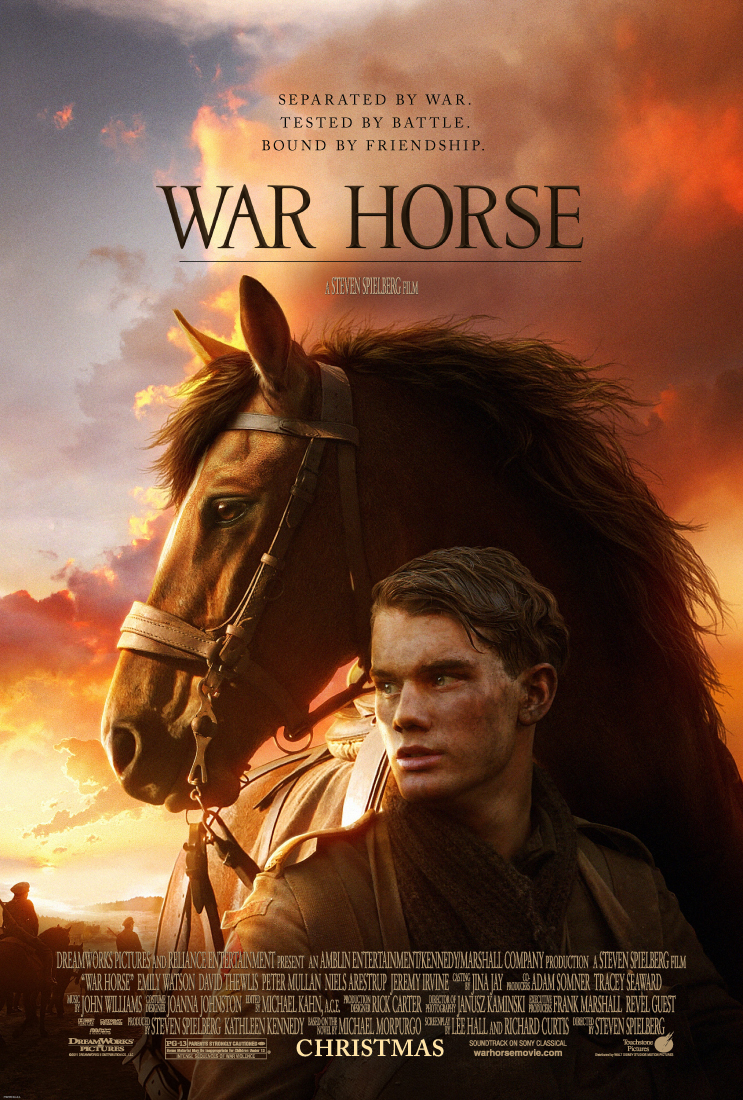
I find it much harder to watch anything depicting cruelty to animals than to humans. I can’t help it. And despite the fact that Steven Spielberg’s War Horse is decidedly tacky at times, it really upset me. Not so much the movie – things are toned down to make it suitable for all ages, I guess, – as to think about what those horses went through in WWI.
Based on Michael Morpurgo’s eponymous novel, War Horse tells of the friendship of a farm boy with a horse. It’s very Black Beauty in the beginning. Out of sheer folly Albert’s father buys an expensive race horse that he can neither afford nor use. Albert manages to save his father’s farm and the horse and trains the animal until it is able to perform the duties of a workhorse. He also teaches him to come when he whistles and many other tricks.
When the war breaks out, Albert’s father sells Joey to a British officer who takes the horse to France. This almost breaks Albert’s heart but the officer, a kind man, promises to take care of Joey. Sadly he is killed in a reckless cavalry attack that goes very wrong. The horse, one of the rare that survives, can escape but is captured by the Germans. After this an odessey begins in which Joey changes hands more than once and more than once faces death.
Albert who has sworn to find his horse wherever it is (a bit of a Last of the Mohicans moment), has heard of the death of the officer and signed up. Soon he finds himself in the trenches in France.
The movie isn’t too graphic, we don’t see wounds and atrocities that you would normally see in a war movie, still it manages to convey the horror. It just does it by focussing on other elements. We see how many horses died in cavalry attacks and how thousands were overworked until they died from exhaustion.
The parts related to the war were, in my opinion, well done. Without being too graphic they illustrated a lot that was typical for WWI like the trenches, the mud, the gas. What was tacky was how the story was told at times and the end which didn’t seem very realistic. On the other hand the scene of Joey who runs down No Man’s Land and gets caught in barbed wire, manages to convey a better anti-war statement than many other movies.
The acting is quite good and in the case of Benedict Cumberbatch, in a very short but effective role as British Major, and Emily Watson, as the mother of Albert, even excellent.
Apart from showing the harrowing destinies of horses in WWI the movie captures the beauty of the bond that can exist between a human being and an animal.
Have you seen Capitaine Conan? You haven’t? Well then I’d like to know why you are sitting here, reading this blog when what you should really do, is chase a copy of this unique and brilliant movie? This is one of the best war movies I have seen in a while. I’m doing pretty bad with movies these days and have found my attention span is quite short but this movie had me glued to the screen. WWI movies tend to be a bit repetitive, it’s either the atrocity of the trenches, facial wounds, the analysis of the shortcomings of the high command or the incredible amount of dead and lost soldiers. All of it worthy themes but done a few times and quite brilliantly too. That’s why it was such a surprise that there is hardly any of this in Capitaine Conan.
Capitaine Conan is based on the largely autobiographical novel Captain Conan by Roger Vercel who won the prestigious Prix Goncourt for the book. Vercel based the main character on one of his comrades.
The most interesting aspect is that the movie (and the book) takes place on the Bulgarian border where French and English troops fought a guerrilla like war against Germans and Bulgarians. There are trenches but a lot of the combat is hand-to-hand combat, man against man.
The lieutenant Capt Conan is an insubordinate, extremely wild and brutal soldier. But also someone who cherishes camaraderie. Instead of eating with the fellow officers, he rather sits somewhere with the men. He leads a group of 50 men that he calls his wolves. They are all equally fearless, brutal and, as it seems, addicted to violence but also a tight-knit group, ready to do anything for each other. There is nothing they like more than fighting man against man and mostly with knives. Because Conan is highly efficient and can turn around the course of hopeless battles, his superiors let him do as he pleases but when the war ends, things go wrong. His bloodthirsty men are too easily bored. They start to commit one crime after the other. Pillaging, raping, robbery. Conan who calls himself a warrior, as opposed to a soldier, isn’t any better and let’s his men get away with everything. Conan has long-lost his sense of right and wrong and all that he cares about are his men. War has turned him into a brute.
Among this violent crowd is a more gentle lieutenant, who wants to become a school teacher in peace time. If it wasn’t for him, who is appointed as prosecutor, Conan and his men would be court-martialled. The friendship between these two men grows slowly but once it’s established, it is indestructible.
It’s quite difficult to do this movie justice as it is very complex and quite fast-paced. Conan is a fascinating character and the way Tavernier depicts him we can’t help but admire him. In the world of WWI, in which there are so many officers who never dirty their hands but make the most important decisions without having a clue, someone like Conan, with a sense of honour and dignity, despite the brutality, becomes admirable. He is ruthless but he has a sense of loyalty and justice. The problem is, that men like him cannot go back to a normal life, once the war is over. They have gone too far.
After the war has ended, they are boarding a train and sent around without really knowing where they go. They stop in Sofia for a long time and are finally sent to the Russian border to fight the Bolsheviks. The scene in which the general informs them of the Armistice is one of the greatest scenes in any war movie ever. It’s so absurd. We see the guy talk about victory and glory, while the rain is pouring down, half of the men are running away because of diarrhea and the highly decimated band plays an off-key Marseillaise and looks like a bunch of flea-infested hobos.
I really hope I could give a halfway good impression of this wonderful movie and how rich it is. It’s very witty with super fast dialogue that I hope is well captured in the subtitles. I have a French DVD so I turned them off. It’s one of the huge problems of French cinema in translation. French cinema does live to a large extent from the dialogue which is usually fast and a lot of it isn’t translated. This isn’t a comedy but it has a lot of funny elements because it shows how absurd war is and because it juxtaposes many different levels of French society and different French regions.
As I said, the movie is available with English subtitles but the only trailer I found is a French one with Spanish subtitles. It still gives a good impression of the movie.



 All About War Movies