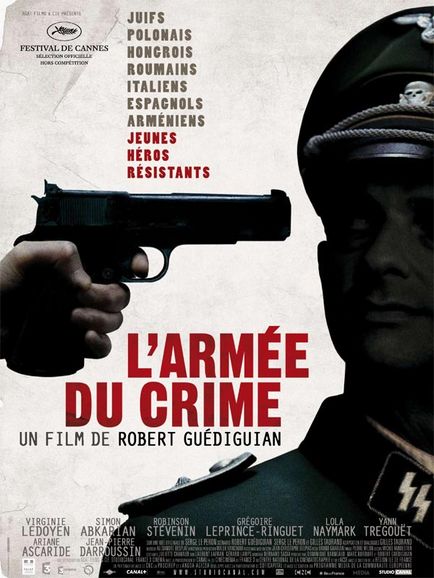
The Army of Crime aka L’Armée du Crime (2009) The Latest Addition to my Top 10 War Movies or A Gut-wrenching Movie on the French Resistance

Robert Guédiguian‘s movie L’armée du Crime or The Army of Crime is one of the best war movies I have ever seen. I already said that it entered my Top 10 immediately. The question that remains: which one I am going to kick out? I’ll have to think about this later. For now let me tell you why I think The Army of Crime is such a brilliant piece of filmmaking. Apart from being based on actual events and being historically very accurate it is beautifully filmed. The actors are outstanding. The protagonists are heroical like not many but at the same time the movie doesn’t shy away to point its fingers not only at the Germans but also at the extremely shameful role the French government played during WWII. We had the heroism of the Resistance and Partisan groups on one side and the cowardly collaborators in the government, the police and among normal people on the other side. Shame on all of them. The movie shows all these aspects, nothing is hidden.  This is the third French movie I have seen in a short period, L’armée des ombres aka The Army of Shadows being the first, The Officers’ Ward aka La chambre des officiers the second.  I must say these movies manage something that not many others achieve. They get under your skin. You don’t only watch these movies, you live them. They don’t let you indifferent. Especially not this one.

1943, Paris, the Armenian poet Missak Manouchian (Simon Abkarian) becomes the leader of a special unit of the French Resistance. His people, men and women, are all very young immigrants. They are Hungarian, Polish and Romanian Jews and Spanish, Italian and Armenian Communists. They decide to form a group and fight for France, the country of the Human Rights, to free and to defend her. They are determined and well-organized and soon will be declared enemies number one. The German occupiers and the French police strike back savagely. They hunt them and use every possible way to capture and destroy them, be it bribery, torture or coercion. In the end they are betrayed and all of them are shot.

The movie tells not only the story of the group and their actions as a whole but shows many intimate portraits of all the individual members. I have hardly ever seen a movie displaying so much diversity. This is underlined by a brilliant score with influences of the music of all the different countries that came together in this fight.

The torture scenes are very graphic. We are not spared anything. The most incredible is that with the exception of one person none betrayed the others. Not even under the worst of torture I have ever herad of. While they were operating in the underground most of their families were being deported to camps. Manouchian is an exemplary man. A larger than life character. He does not use arms lightly unlike some of the other reckless young people. He is a poet, an orphan, a gentle man, married to a beautiful French wife, Melinée (Virginie Ledoyen), whom he loves dearly.

I would like to urge each and every reader to watch this movie as my words will never really manage to convey its utter beauty. It is also worth mentioning that we see a lot of Paris.  The Army of Crime is one of those very rare movies that are, simply put, masterpieces in which every element is perfect.

The following people died for France: (AR = found on the Red Poster or Affiche Rouge):
Celestino Alfonso (AR), Spanish, 27
Olga Bancic, Romanian, 31
Joseph Boczov [József Boczor; Wolff Ferenc] (AR), Hungarian, 38
Georges Cloarec, French, 20
Rino Della Negra, Italian, 19
Thomas Elek [Elek Tamás] (AR), Hungarian, 18
Maurice Fingercwajg (AR), Polish, 19
Spartaco Fontano (AR), Italian, 22
Jonas Geduldig, Polish, 26
Emeric Glasz [Békés (Glass) Imre], Hungarian, 42
Léon Goldberg, Polish, 19
Szlama Grzywacz (AR), Polish, 34
Stanislas Kubacki, Polish, 36
Césare Luccarini, Italian, 22
Missak Manouchian (AR), Armenian, 37
Armenak Arpen Manoukian, Armenian, 44
Marcel Rayman (AR), Polish, 21
Roger Rouxel, French, 18
Antoine Salvadori, Italian, 43
Willy Szapiro, Polish, 29
Amédéo Usséglio, Italian, 32
Wolf Wajsbrot (AR), Polish, 18
Robert Witchitz (AR), French, 19

The Great Escape (1963) Tells Actually the Story of a War Crime

Maybe 90% of my readers are yawning now. I am very sorry but since I have seen The Great Escape for the first time only recently I had no clue. I thought it was basically the story of an escape, which it is, of course. The scene of Steve McQueen on a bike was very familiar as well (one of those memorable movie scenes), but apart from that: zero. I never heard it mentioned anywhere that it is based on the true story of a war crime. Are there any others out there like me who haven’t seen it yet? Maybe. For their sake I am not going to reveal why it is the story of a war crime. Just telling you, that it is.

Apart from that? Did I like it? Obviously when everybody tells you how great a movie is you start to expect something and if that is not what you get then you are slightly disappointed. So I was slightly disappointed. I didn’t expect such a summer camp like joyousness in the beginning. I rather expected something in the vein of The Colditz Story. Something a tad bleaker and grimmer. The feel of The Great Escape is much more adventure story than war movie. Plus English actors who play Englishmen  who pretend to be Germans and get away with it despite their heavy accents are not the height of realism.

What is my final conclusion? No, you are wrong, I don’t write it off but I will have to watch it again without the weird expectations that are never going to be fulfilled. A proper review will be due by the time I have watched it for the second time. After all its a classic, with a fabulous all-star cast and it’s just bad luck  I never watched it as a kid when it was on TV cause everyone who watched it then has the fondest memories. It’s definitely nice to have fond childhood movie memories. My only childhood war movie memory is A Bridge Too Far. Yeah well, not a bad one either, right?

Why Saving Private Ryan (1998) is not in my Top 10 of Favourite War Movies but in my Top 5 of most Influential War Movies

I have seen Saving Private Ryan for the first time in cinema when in came out. At the time it was like a fist in the gut. The Omaha Beach landing was nothing I had ever seen before and this was very probably the beginning of my fascination with war movies. Since then I have seen many more but when I ended up doing my Top 10 it wasn’t in it. I watched it again, like it a lot but didn’t want to add it to the list. Still it is important to say in advance, no matter what my personal reasons are,  the genre has been marked by Saving Private Ryan to a very large extent. There really is a time before and a time after Saving Private Ryan. Especially when it comes to WWII movies. The depiction of war has fundamentally changed with and through Saving Private Ryan. Never before did those who watched get the feeling they were in the battle like in Saving Private Ryan. Therefore, if I should make a Top 10 of most influential War Films, Saving Private Ryan would even be among the top 5.

I guess the second viewing was a distracted so I felt I had to re-watch it. I am sorry to say but this third viewing has made it clear to me. Saving Private Ryan is never going to be among my top ten unless I would have to choose movie scenes. It has some of the very best scenes that you can find in any war movie but unfortunately it has way too many really corny moments. As a matter of fact I hadn’t even remembered such a lot of corny moments. Maybe that is why I love Band of Brothers which is certainly the closest you can get to Saving Private Ryan. To me this is like a purified version of it. But still, it is excellent.

For those who have never watched it I’ll summarize the story. An old man stands at the grave of someone and looks back on his life. Rewind some 50 years. D-Day. We are in the middle of the Omaha Beach landing. Horrible scenes are shown. All filmed with a shaky hand-held camera to heighten the authentic feel. People’s guts spilling out. Bodies ripped apart. Heads blown off. Arms ripped out. Men crying, screaming and praying until the worst is over, the noise dies down and the only thing that stays is a beach full of dead bodies and body parts. After this horror Capt. Miller gets a new assignment. We will follow him and his group well into France and behind enemy lines. He has to look for one James Francis Ryan. All three of his brothers were killed in action so people in Washington decided to get him out and back to the States. The group around Capt. Miller are reluctant to go on such a seemingly futile mission. They don’t understand why they have to endanger their lives for the sake of one soldier. This is a very tight-knit group of soldiers and that is part of the appeal of this movie. The sense of camaraderie and friendship has rarely been depicted this touchingly. There are very moving moments especially between Miller and Horvath. There is one in which they talk to each other in an empty church at night. Their closeness is palpable. Strangely it almost makes you want to be there. There are much more tragic moments however. One after the other of the men gets killed until they find James Ryan. When finally discovering him they face the biggest problem. He doesn’t want to leave. He feels he owes it to his comrades to stay. His highly decimated group must defend a bridge against a majority of Germans. This is one of the many famous bridge scenes that we encounter in war movies. Bridges being strategically as relevant as hills, it is a frequent theme. As I don’t know if every reader knows the story I will stop here.

Saving Private Ryan has some of the most memorable war movie characters. I like Capt. Miller as much as Sgt. Horvath, the Privates Reiben, Jackson, Caparzo and Mellish and of course the Medic Wade. As we follow the little group for a long time we get to know them very well. It has also one of the most annoying war movie characters in it. Upham is a revolting person. And there is of course a very mean German. In any case, kudos to the actors. Tom Hanks, Tom Sizemore, Edward Burns, Matt Damon.

Saving Private Ryan is infantry combat at its best. A lot of intense fighting. Incredible settings. Unfortunately it has moments that are way too sentimental for my taste. I will always prefer Band of Brothers.

Now it’s your turn to rank it. 1. In your Top Favourite List 2. In a Best of List and  3. Most Influential ones.

Another of my posts on Saving Private Ryan: Mean Old Private Ryan

10 German War Movies You Must See Before You Die

In the last years Germany has made quite a few very good war movies but there are also some older ones that have stood the test of time. I am sure I have forgotten some and left out many that are co-productions with the exception of Joyeux Noël aka Merry Christmas because it is one of my Top 10. I will very probably mention it again when I will make a post on 10 French war movies you must see before you die.

Let´s stick to Germany for the time being.

Die Brücke aka The Bridge (1959): WWII, Germany. One of the best anti-war films ever. Shows how senseless some orders are. Young people fight for a bridge although the war can´t be won anymore. It is one of the movies on my list Children in War Movies.

Hunde, wollt ihr ewig leben aka Dogs, do you want to live forever – Stalingrad (1959): WWII, Russia. A German classic. A grim look at the battle in Stalingrad.

Das Boot (1981): THE U-Boot movie. Conveys brilliantly what it is like to be helpless under water. Claustrophobic feel. Superb acting. Marvellous cast. Especially noteworthy the singer Herbert Grönemeyer.

Stalingrad (1993): WWII, grim infantry combat. German POV. One of the best war movies  ever, one of my Top 10 as well. The setting, the character portraits, the acting, the combat, the snow, the cold, the despair. A fabulous movie that gives an insight in one of the worst chapters of WWII. Another marvellous cast. Thomas Kretschmann (King Kong, Resident Evil, The Downfall, The Young Victoria) is in it. He is one of those German actors that are known far beyond Germany and Europe. (see my post on Stalingrad)

NaPolA aka Before the Fall (2004): WWII, Germany. Interesting look at the Hitler Youth. How they recruited their elite, how they brainwashed them. Poisonous Pedagogy. See my review for more details. This movie is also on the Children in War Movies list.

Der Untergang aka The Downfall (2004): WWII, Berlin. The final days of Hitler. Astonishing acting from the very great Bruno Ganz. A fascinating portrait. Eerie. Creepy.  An outstanding movie and a must see even for those who don’t watch war movies. (see my post on The Downfall)

Joyeux Noël aka Merry Christmas (2005): WWI, France. Especially noteworthy as it is about WWI. The movie depicts the so-called “Little peace”. It is Christmas and something strange is happening. The war stands still. The enemy soldiers prefer football over fighting and get to know and like each other. Based on a true story. You get a good feel for the differences of the trenches and the characteristics of the parties involved.

Sophie Scholl – Die letzten Tage aka Sophie Scholl (2005): WWII, Germany. German Resistance. One of the leaders of The White Rose, Sophie Scholl´s final days. I have hardly ever seen a movie like this. After watching it I did solemnly swear to become a better person (I am not too successful yet. It is an ongoing process. A work in progress). No, honestly, this woman or girl´s guts… So much selfless idealism and courage. I was awed.

Anonyma – Eine Frau n Berlin aka Anonyma – The Downfall of Berlin (2008) : WWII, Berlin. One of the movies I reviewed recently. I included it as it tackles a lesser known and very painful subject. The mass rape of German women by the Red Army. See my post of Anonyma.

Der rote Baron aka The Red Baron (2008): WWI, Germany. The romanticized story of Baron von Richthofen the famous German fighter pilot. Beautifully filmed, good-looking cast, very intense air combat. See my post of the Red Baron.

Any movies you would add?

As I think Sophie Scholl is not known enough I added the trailer for you.

La vita è bella aka Life is Beautiful (1997) A Thought-Provoking Italian Holocaust Movie

, w

La vita è bella is a very unusual movie that you will hardly ever forget should you watch it. It is touching, at times funny, tragic and sentimental. It shows one man’s attempt to protect his child from the horrors of the concentration camp and how he fails in the end. It is one of the movies on my Children in War Movies List.

Roberto Benigni, the Italian main actor, writer  and director of La vita è bella is mainly known as a comedian. People were quite surprised when they heard he had done a movie on the Holocaust. I remember that I had mixed feelings but was really surprised how well this combination works. Other critics however felt offended as they stated it was in poor taste to attempt to combine a comedy with the topic of the Holocaust. But the comedy pretty much stops when the war begins. The movie has really two parts that are strikingly different which was obviously wanted. The beautiful before and the horrible after.

The Jewish man Guido Orefice (Roberto Benigni) is not a good-looking guy. He is not even very intelligent. He is clumsy and silly but also very funny and charming and has an eye for poetical and beautiful things. This is how he wins the heart of the attractive Dora even though she is already engaged to a future fascist leader.

The second part starts a few years after their marriage. They have a little boy named Guisoué. Anti-Jewish laws have been implemented in Italy and Guido tries to hide their meaning from his son by turning them into a game. When they know they will be deported, Dora, even though she is not Jewish, accompanies them to the concentration camp. Once arrived Guido pretends that this is all a game, some sort of summer camp for children and grown-ups alike. He makes his son believe that they have to follow all the orders strictly if they want to win.

I must admit that I did not totally approve of Benigni’s approach, but it is not a movie that is easily forgotten. And it is thought-provoking and will give ample material for discussion of various questions. Are we allowed to tell the Holocaust through comedy? Should a movie about the Holocaust be this sentimental? Wouldn’t it be better to tell it in a more sober manner? La vita è bella is also problematic when it comes to the historical facts. Children were not kept alive in the camps. Still the first part is a touching and funny story of an impossible courtship while the second is the story of a fathers attempt at keeping the horror at bay.

Did you see it? Did it work for you? And if you haven’t, would you want to watch it? Do you mind a Holocaust comedy?