The Pacific versus Band of Brothers: Should we compare?

I finally got to watch the last episode of The Pacific. Even though I had an entry on it a while back I didn´t feel like writing about it before I had seen the whole series. It proved to be  a good decision since I couldn´t really appreciate it at first. I couldn´t help myself, like so many others, and compare it constantly to Band of Brothers. Apart from being a HBO miniseries produced by Spielberg and Tom Hanks, opening with men who were there talking about their experiences, those two series have nothing in common. Sure they both show a lot of very intense and gruesome infantry combat scenes but that is that.

Band of Brothers, as the title eloquently indicates, was about a close-knit group of men, one Army Infantry Company. This is not the case in The Pacific. The Pacific focuses on three main characters, the three marines Sgt. John Basilone, PFC Robert Leckie and Eugene B. Sledge. The last two wrote books about their experiences. The first episodes focus on Leckie, whereas the last ones tell Eugene aka Sledgehammer´s story. This last detail is based on the fact that Eugene went to war much later than the others. He missed Guadalcanal and Cape Gloucester, one main battle and one major experience of the war in the Pacific.

The mini series shows a lot of off the battle ground episodes. Soldiers on leave in Australia, Leckie´s stay at different hospitals and later we see Sledge back home. Many of this off the battleground parts look at the symptoms of post-traumatic stress of which both Leckie (in a very physical way-peeing himself-) and Sledge (more psychological-he´s depressed and has endless nightmares) suffer intensely.

The series has  many crucial moments. Truly gory battle scenes.  Endless rain on Cape Gloucester that grinds down the morale. The realization that all they learn is “killing Japs”.

There is one key scene, the moment when the two friends Sidney and Sledge meet as one leaves and the other arrives in the Pacific. Sledge wants to know from Sidney how it is to be fighting but he doesn´t get an answer. This is actually a recurring theme in war movies (there is a scene like that in The Deer Hunter and in many others): the inability of those who have experienced it to tell those who are about to experience it what it is like to be in combat. Or maybe it is not so much an inability as a refusal. They have been there, they know it´s no use. You cannot talk about something that is so completely different from anything you imagine. No one who hasn´t been there will ever know what it is like and there are no words to really convey this, nothing that equals the experience. All you have got in the face of the innocent and ignorant is silence. The Pacific shows this very well.

I would like  to point out specifically one further scene. It is related to one of my major points of interest namely Death. In The Pacific we see one of the most touching deaths in the history of war movies. I don´t want to spoil anything so I´m not going to tell you who is dying. What makes this scene so different is the way it is shown. We do not see the actual dying, we hear that the person died and then the corpse is being carried  by some soldiers and transported through the lines of men standing there paying tribute and crying. This is a genuinely heartfelt and sad moment. A display of utter futility.

Something else is very different from Band of Brothers. Even though it was WWII, this wasn´t the same war. This is not about a bunch of soldiers freeing occupied countries and captives. We have no rewarding moments like the one in Band of Brothers when they liberate people in a concentration camp. The war in the Pacific seems much more futile at moments. And senseless. And it lasted longer. The war in Europe was already over, Germany had surrendered but Japan had not. Only after Little Boy and Fat Man did this war stop. This must have been some sort of an anticlimax. By the time those soldiers came home, the whole world had already been celebrating the end of the war. The party was over and they had missed it.

Needless to say that this influences the tone of the movie.

For all these reasons I do not think it is doing The Pacific any justice to compare it to its older brother.  It really has its moments this series.

One last thing needs mentioning though and it is something I did not enjoy much. The Japanese are never ever shown in a positive light. You truly get the impression that they were a bunch of murderous automatons. If anyone wants to see a more honest depiction I suggest you watch Tora Tora Tora (1970) or Letters from Iwo Jima (2006). They both try to and  succeed in doing the Japanese justice.

amazon.com

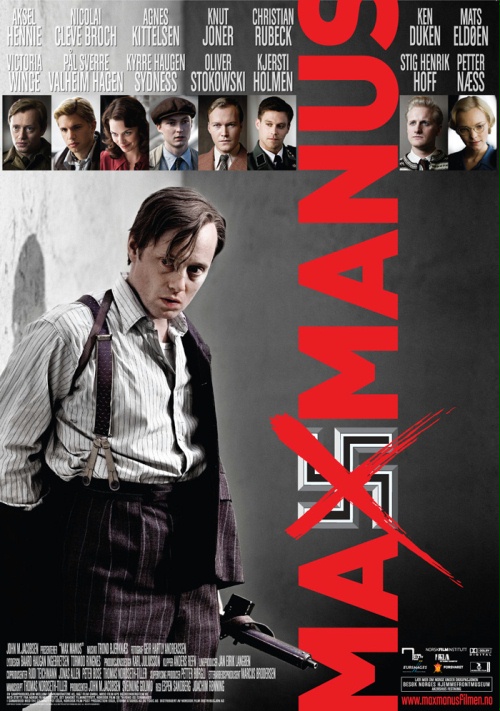
Two Movies on Nordic Resistance: Flame & Citron (2008) and Max Manus (2008)

Two movies on the same theme, Nordic Resistance, yet how different their tone. While Max Manus (aka  Frihedskæmperen Max Manus) is a hero story with tragic and uplifting moments, Flame & Citron (aka Flammen & Citronen) is depressing and full of angst. Both movies are based on true stories and illustrate aspects of lesser known WWII history.

Max Manus tells the story of the Norwegian saboteur Max Manus and his resistance group. After having fought in Finland against the Communists he joins the norwegian resistance. They fight the Nazis very effectively by blowing up supply ships, stealing documents and shooting people. They are hunted down by the Germans and many lose their lives, only Max escapes miraculously every time which fills him with survivor’s guilt but at the same time gives him an aura of invulnerability.

Flame & Citron is the story of two very famous Danish Nazi assassins. Where Max attacks mostly buildings and objects, they shoot Nazis and their allies, mostly execution style up-close.Early on it is evident that this weighs heavily on their conscience. Especially Citron has a hard time to kill.

At one time Flame says: “I almost forgot we are not shooting people but Nazis” as if to take the humanity away from the enemy makes the deed easier. Here lies their problem and this is very obviously the source for the depressing heaviness of this film. We watch two good people doing very bad things although for a just cause. After a while they really doubt that what they do is right. But worst of all they can´t trust anyone and see themselves surrounded by double agents and traitors.

Like the more famous Black Book (aka Zwart Boek 2006) these movies show that there was very effective resistance in the Northern European countries, like the Netherlands, Denmark and Norway. It seems as if it took those countries quite a long time to tell their own story. All three movies are in original language with subtitles. They are all convincing.

Black Book ist the most entertaining, Max Manus is thoughtful and uplifting but I liked Flame & Citron best. I found it the most honest. The pictures are very beautiful and apart from that the acting is great. Mads Mikkelsen (King Arthur) as Citron is just brilliant and so is Thure Lindhardt as Flame.

A Soldier´s Story (1984) or Racism in the Military

The worst thing you can do, in this part of the country, is pay too much attention to the death of a negro under mysterious circumstances. (Colonel Nivens)

Norman Jewison´s movie A Soldier´s Story (1984) shows you what great acting can be.

It is one of Denzel Washigton´s first movies. Although he is not the leading actor you can already tell what he´s capable of. What is very obvious, that´he´s not only a movie actor but one hell of a good theater actor as well. The story is based on a theater play and almost the whole cast is from the original ensemble.

The movie takes place in a base in Louisiana during WWII.

Sgt. Waters, a black sergeant, is found dead and an army attorney is sent from Washington to investigate the murder. What no one suspects, least the white commanding officers, is the fact that the attorney is also Afro-American. The base which consists to a great extent of black Americans has never seen a black decorated officer before. They are awed whereas the white officers are outraged. It´s one of the best moments in this movie.

Soon it is obvious what a contradictory character the victim was. However the investigation is hindered by uncooperative officers and fearful soldiers. Bit by bit,shown through flashbacks, the victims true character and the actual events are revealed. The shocking truth is that the killed sergeant though African-American himself was a racist at heart and punished every act that he deemed unworthy of other black people, notably singing and dancing.In his own words:

You know the damage one ignorant Negro can do? We were in France in the first war; we’d won decorations. But the white boys had told all them French gals that we had tails. Then they found this ignorant colored soldier, paid him to tie a tail to his ass and run around half-naked, making monkey sounds. Put him on the big round table in the Cafe Napoleon, put a reed in his hand, crown on his head, blanket on his shoulders, and made him eat *bananas* in front of all them Frenchies. Oh, how the white boys danced that night… passed out leaflets with that boy’s picture on it. Called him Moonshine, King of the Monkeys. And when we slit his throat, you know that fool asked us what he had done wrong?

He was cruel, unjust and unfair. He wasn´t liked by neither white nor black soldiers and officers and really had it coming.

The character portraits in this movie are all extremely convincing, the acting is outstanding, the tale is gripping and it really doesn´t leave you untouched. This is a 100% convincing anti-racism movie and one of the few movies about racism in the military. A must-see.

Dresden (2006) or Was the Bombing of Dresden a War Crime?

Dresden is a quite controversial German movie that has been criticised a lot. Shot for TV it is basically a very corny love story between a German nurse and an English fighter pilot.

I´m not going into any plot details since they are quite boring but still I do think this movie achieved something.

The love story takes place during the days before the bombing of Dresden starting February 13 1945 and ends with a depiction of the bombing.

This end part as well as  all the parts in the English Head Quarters from where the bombing was organised had me glued to the TV screen. The moral conflicts of the British to bomb what they knew to be one of the most beautiful European cities was shown very well. The atrocity of what is still called a war crime nowadays, is symbolised in the collapse of the famous Frauenkirche, one of the town´s landmarks  (reconstructed in 2008 as a symbol of hope and peace). The church withstood two days of bombing and finally collapsed on the second day.

The damage the bombing caused, the heatwaves, the firy wind… I think it is shown rather well however varnished with a lot of corny elements.

The end of the film shows actual footage, the re-inauguration of  the rebuilt Frauenkirche.

This movie, as flawed as it is, offers a lot of food for thought. How justified was it to systematically bomb a city like that, to kill so many and to destroy century old  architectural treasures? How is this different from the bombing of other cities?

Was it unavoidable? Was it a war crime? How did the pilots feel?

Further questions circle around the film makers´ choice to mix a corny romance with historical facts.