Lone Survivor (2013)

Lone Survivor

I decided to watch Lone Survivor after having read a positive review on The War Movie Buff’s blog (here). I did not regret it, although I have some reservations.

Talk about a doomed operation. Lone Survivor is based on a true story – Operation Red Wing – which went horribly wrong. Given how the movie starts and its title, it’s not a spoiler to mention that the operation only had one survivor played by Mark Wahlberg. 

The movie is set in Afghanistan in 2005. Marcus Luttrell (Mark Wahlberg) and three other Navy Seals are sent on a mission to capture or kill al Qaeda leader Ahmad Shahd. While hiding in the mountains goatherds literally stumble over them. The four men have a heated discussion about what they should do with them. Two want them dead, one wants to tie them and only Luttrell wants to let them go. Unfortunately their communication systems don’t work and they cannot reach their commander (Eric Bana) and ask for advice. Finally they let them go as that is in line with their rules of engagement. It’s clear that while this is the right thing to do, nothing good can come of it. And indeed, one of the herders runs down to the village and alerts the men surrounding Ahmad Shadh. What follows is an intense two hours of flight and fight.

First I’d like to say that the movie is well done. The pacing is good, there is some nice cinematography (stunning sunsets), the music works well, the action scenes are extremely realistic. The characters aren’t fully rounded, but that would be absurd in a movie like this. Last, but not least it’s very suspenseful, although we know there’s only one survivor.

I thought that in choosing this title and beginning of the film, which clearly shows that only Wahlberg’s character survived, the director stayed away from sentimentality and melodrama, which is so often annoying in movies of this type.

I’ve seen this compared to Black Hawk Down but I can’t see any similarity. I was reminded of Bravo Two Zero, in which the failing communication also played a major role. Lone Survivor has elements of both Act of Valor and the French Forces Spécilales, but I would say it’s better.

I’ve seen a lot of very harsh reviews of this movie. I think it’s not as bad as some say, but as is often the case with movies, which also find the approval of the military, there’s a mix up in the reception. One thing is the movie as such, and one can really not find a lot of flaws in that, the other thing is the reason that this movie was made in the first place. It depicts a true story and if you are against the way the US handle their war against terrorism, then you are probably inclined to be against this film. But that’s really mixing up two things. I thought that this movie stayed away from a lot of the glorifying we usually see in movies like this. It depicts  highly trained men on a mission that goes wrong. Sure, the characters want to kill as many Afghanis as they can, and they don’t try to apply a lot of empathy, but I’d like to see what all the liberal thinkers who criticized this film would do in a similar situation. Would they still try to understand and speak in a politically correct way about people who are trying to kill them?

I liked this film and the way it was done. I’m not keen on the US strategies against terrorism, but there is no denying that they exist. And there is no denying that the US military has some admirably well-trained soldiers who would do anything for each other.

Watch it if you like watching an action-driven movie inspired by a true story, leave it out if you expect criticism of the US military.

The Best Years of Our Lives (1946)

The Best Years of Our Lives

I’m actually a bit surprised that I really liked this melodramatic movie, despite the fact that the gender roles and the messages about family and marriage are cringe-worthy. While I felt it’s dated, I could still understand why this won 7 Oscars when it came out.

The Best Years of Our Lives shows three WWII veterans returning home to small-town America. The three men meet on the plane home. Homer is a young marine, Fred is an equally young airforce captain and war hero, while Al is a fortysomething Infantry Sgt. The three men go back to very different lives. Homer who has lost both arms is scared that people will react badly, especially his childhood love Wilma. Fred returns to his wife to whom he’d been married for only 20 days before going abroad. He used to work in a drugstore before the war and hopes that becuase he is a highly decorated officer now, he will find a better job. Al, the oldest of the trio, has been married for twenty years and has two grown-up children. He used to work in a prominent position in a bank and is pretty sure to return to an equally good position.

On the rather lengthy trip they share some of their fears and hopes, and before parting they decide they will meet some day at a bar that belongs to Homer’s uncle.

The three men soon find out that returning is very difficult. They have changed, society has changed and people don’t react with a lot of empathy. By the time they meet at the bar for the first time, all three of them are disillusioned about their home and, even more about themselves.

The first part of the film is really good, but then it turns too melodramatic for my taste, although I liked the love story between Fred and Al’s daughter. The movie is worthwhile for many reasons. Some of the scenes are really gopd, the acting is great and the cinematography was convincing too. Some critics found the end too corny. While I wouldn’t exactly deny that, I liked the scene set at the aircraft graveyard, which takes place towards the end. I think it is one of my favourite war movie scenes (see below).

What is worth mentioning is that Howard Russell who plays Homer had lost both of his hands in 1944. I think you can easily imagine how authentic that makes Homer.

A trailer

http://www.youtube.com/watch?v=IELMoOcSKf8

And here’s the aircraft graveyard scene

http://www.youtube.com/watch?v=tU0d3DVcKoY

Miklós Jancsó’s The Round-Up – Szegénylegények (1966)

The Round-Up

I suppose when you’ve seen quite a lot of the well-known prisoner of war films and are fond of the genre, you’ll come across Miklós Jancsó’s The Round-Up aka Szegénylegények sooner or later. Not only is it an unusual example of a POW movie, but it’s considered to be a masterpiece of European filmmaking and was highly influential.

Miklós Jancsó is a Hungarian film maker. He started out with documentaries before he moved on to movies. He’s made a few famous films – The Red and the White – My Way Home and many others. The Round-Up was the movie that made him famous and is still considered to be his most important film.

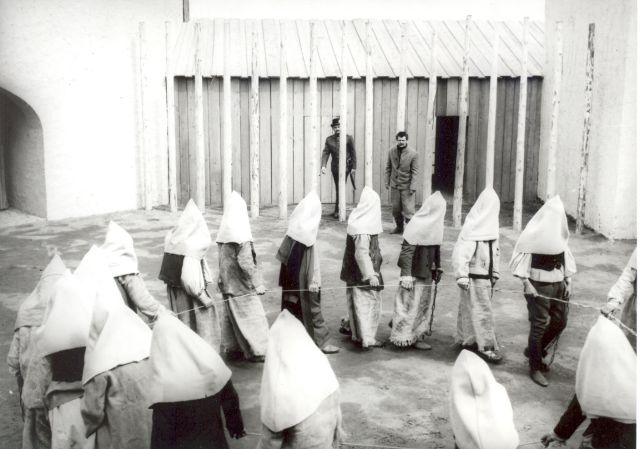
The Round-Up is set in a prison camp, on some God-forsaken stretch of land on the Hungarian Plain (Puszta). It’s the mid 19th century and the Austrian hegemony has just been re-established after the unsuccessful revolution of 1848. The men who are held in this prison camp are suspected to be followers of the leader of the revolution Lajos Kossuth. There is still a lot of guerilla activity going on and the Austrians, helped by their Hungarian counterparts, try to find out who are the guerilla leaders. Most of them are suspected to be among the prisoners and the guards use perfidious and sadistic techniques to find out who they are. 

What we see applied in this film is psychological torture. People are promised not to be executed if they can find others who killed more people than they did. Or the guards pretend that a guerilla leader will be pardoned which makes his followers cheer. Of course they have been set up and that was a means to find out who they are.

Humiliation is part of the tactics used. We see how one officer is stripped of his rank, how the guards rip all the insignia from his uniform and while they do not harm him, it feels extremely violent. We later realize that this was foreshadowing as other suspects undergo a fate that’s similar but even worse. One girl is stripped and whipped until she dies. Watching the whipping of the girl triggers a flood of suicides. Later men are stripped too.

Torture is always humiliating but this subtle use of psychological torture is, although less violent, just as effective in that regard.

I have to be honest, I personally didn’t like this film, although it has a lot of poignant scenes, which I’m not likely to forget, but overall this isn’t my type of movie. It’s visually expressive but there isn’t much plot and hardly any dialogue. I don’t need action or plot but I like more atmosphere and dialogue. The Round-Up is all about forms, shapes, space and minimal movement. Plus it’s set in the type of flat landscape I’m really not keen on. That doesn’t mean I didn’t appreciate the film, I just couldn’t relate to it much. But it’s an important movie if you are either a cinephile or a war movie completist. I’ll watch The Red and the White and My Way Home next.

You can watch the whole movie on YouTube

https://www.youtube.com/watch?v=96osyWNblwU

Top 10 War Movies – The Guardian List

where-eagles-dare-LST065899

This year I want to move back to what this blog was initially meant to be. A place where I would write about war movies and related themes, and not so much a blog, which is limited to reviews. As you may have noticed I was less and less present, not only because I was not so lucky with my movie choices  but also because I didn’t feel like writing as many reviews as before.

So, in order to kick off the new year, I’d thought I’d share with you this top 10 war movies list that I found on The Guardian website. It was published on October 28, 2013.

The top 10 war movies are

10. Where Eagles Dare

9. Rome, Open City

8. La Grande Illusion

7. The Deer Hunter

6. Three Kings

5. Come and See

4. Ran

3. The Thin Red Line

2. Paths of Glory

1. Apocalypse Now

It’s an interesting list and I’d say, they are all worthy movies, however there is only one among these that also makes my personal Top 10. Guess which one.

How about you? What do you think about this list?

The Desert Fox (1951) Biopic on Field Marshal Rommel’s Final Years

The Desert Fox

The Desert Fox, starring James Mason as Field Marshal Rommel, is based on the biography of Rommel by Desmond Young. The movie opens with British commandos trying to assassinate Rommel in 1941 and then forwards to 1943 showing Rommel at El Alamein.  Rommel, who is of poor health, is just back on the front line and faces a pretty desperate situation. The German troops are far outnumbered and any reasonable commander would give the order to withdraw. Not so Hitler whose consultants all encourage him to give orders to either win or die. For the first time, the movie tells us, Rommel starts to doubt the Führer’s sanity. It will not be the last time. On the very contrary. The movie tries to show a Rommel who goes from doubt to open criticism and even knows the group around von Stauffenberg will attempt to assassinate Hitler. While not tied to the assassination he’s still found guilty of treason and given a chance to either get a fake trial or to commit suicide in order to assure the future of his wife and son.

I must admit I expected this movie to be far better than it was. The story is interesting, of course, but the way this was filmed was not much better than a B-movie. Mason is good, I wouldn’t say he’s great but he’s good. There is just one problem. He doesn’t look like Rommel. What didn’t work is that most of the movie is either composed of real footage or scenes filmed in the studio which makes the whole movie look like a theater play broken up by documentary material.

The other problem is that we don’t really get to know Rommel. Given that the title of the movie is The Desert Fox and not “Rommel’s Downfall” or some such thing, I expected that we will learn why Rommel was considered to be such a great general. Although he was their enemy, the Allies admired and feared him. The movie only shows us a Rommel who is very realistic, who knows when a battle can’t be won, who makes great suggestions, but isn’t heard. The movie also fals in showing Rommels’ humanity. It seems he was never accused of war crimes. He refused to kill Jewish soldiers, civilians and prisoners.

The best part is that the movie shows how Rommel first doubts the people who consult Hitler before he doubts the man himself. Once he’s understood that his Führer is nothing but a maniac, he speaks his mind openly and confronts him.

I watched the movie Patton two years ago and thought it was outstanding. If anyone knows of a biopic of Rommel which is equally good, please let me know.

I didn’t mind watching The Desert Fox, but it’s certainly not the ultimate movie on Rommel.

Rommel’s son Manfred died last month. It’s interesting to know that he formed a friendship with Patton’s and Montgomer’y sons.

Here’s one of the best scenes in which Rommel confronts Hitler