Women in War Movies

War movies are a genre in which women will rarely if ever play major roles.

However there are a few that come to mind immediately.

Nurses

Mothers

Wives

Girl friends

Resistance fighters

Soldiers

Officers

Victims

The nurse is by far the most common role. In many movies they are very prominent. Especially in the sub genre of the war romance they get more than just small roles. (Yes, Pearl Harbor (2001) comes to mind, but…)

Some fine examples of nurses can be found in The Lighthorsemen (1987), In Love and War (1996), The English Patient (1996).

Mothers, wives, fiancées are often found at the very beginning of a movie, when the soldiers leave their homes like in Dark Blue World aka Tmavomodry svet (2001). We often see them again, reading a letter arriving from the field as in The Thin Red Line (1998).  They serve as a sort of counterpoint to make the contrast between those who fight and those who stayed home even bigger. Then, you may find them once more at the very end, when the soldiers return home. One of the most poignant and touching wives is Madeleine Stowe in We Were Soldiers (2002). The story moves back and forth between the battle field and the home front depicting the agony the soldier´s wives went through when the telegrams arrived telling them one of their husbands had been killed.

Nurses become very often soldiers’ girl-friends which makes the two roles blend into each other. But many of the classic girl friends in movies depicting the second WW are the girls the men encounter in the countries they are shipped to. The American soldiers in The Pacific for example have Australian girl friends.

The role of the resistance fighter is quite a noble one. Not very frequent but appealing. Cate Blanchett as Charlotte Gray (2001) comes to mind. Or the women in Uprising (2001). And definitely Sophie Scholl (2005). The latest example of this kind is Carice van Houten as the jewish woman Rachel Stein who joins the Dutch resistance after having survived a massacre in the brilliant Black Book aka Zwartboek (2006).

Female soldiers that are even involved in combat are not very frequent. The most remarkable one I remember is the Vietnamese sniper in Full Metal Jacket (1987). A further female soldier  is played by Demi Moore in G.I. Jane (1997) where she is said to be the first woman  to have  been granted access to the navy SEALS.

Women as officers is by far more common. Again Demi Moore played a role in the excellent legal drama A Few Good Men (1992). And then there is Meg Ryan as medevac chopper pilot Capt. Karen Walden in Courage under Fire (1996).

Unfortunately some of the above mentioned portraits of women in war movies are quite questionable and have been criticised repeatedly (especially G.I. Jane).

I almost forgot the victims. Inexcusable. There are as innumerable female victims in real wars as there are high numbers in movies. One of the saddest are the victims in Vietnam war movies. I think of  Platoon (1986) and Casualties of War (1989). They are not the only ones. Of course not.

My favourite heroines are Cate Blanchett as Charlotte Gray, the wonderful Juliette Binoche as nurse  in The English Patient and, another nurse, Sandra Bullock in In Love and War, and the outstanding Julia Jentsch as Sophie Scholl. The first two are based on novels, the other two on historical facts. Sandra Bullock plays the nurse Ernest Hemingway fell in love with when he fought in Italy during WWI.

Christ and The War Movie Hero

Don’t get alarmed! I’m not going to be blasphemous here. I have just been wondering about this coincidence/symmetry for quite a while and would like to give you something to ponder.

In 1986 Oliver Stone did Platoon starring Willem Dafoe as one of the main characters whose death has written film history and is also depicted on the movie’s poster. The hero who sacrifices himself.

1988 Willem Dafoe played the role of Christ in Scorsese’s The Last Temptation of the Christ.

1998 one of the main characters in  A Thin Red Line, the most pensive one, is played by James Caviezel.

2004 Mel Gibson, who had  major roles in many a war movie, chose James Caviezel as Christ in The Passion of the Christ.

With regards to The Passion of the Christ one must add that there aren’t many movies out there that are more graphic, gory and bloody. One of the longest agonies in film history.

It’ s about death and dying again.

The Pacific 4 (2010): Rain on Cape Gloucester or The Weather in War Movies

Since I saw Stalingrad in which soldiers die in the snow or the episode Bastogne in Band of Brothers I consider the weather to be one of the key elements not only in the actual war but also in transmitting a sense of reality to the audience of war movies.

I have only seen five episodes of  The Pacific so far. Episode 4 was the first to really grip me. It’s raining and raining endlessly. The morale of the soldiers gets lower and lower. There is no escaping this torrential downpour. Whoever has been in the tropics knows that this is not the kind of rain we Europeans or Americans are used to. There is the humidity, the violence and the noise. Yes, this kind of rain is as noisy as a constant shower open at full blast and as violent. If you are in a solid house maybe you could ignore it but in a hut or a tent…No way.

Incredible somehow that after all the heavy fighting the soldiers have been through at Guadalcanal it is the rain that finishes some of them off.

Rain on Cape Gloucester

With all the natural disasters and extreme weather conditions that have always been taking their toll  it is amazing we humans are not more humble. Or is this one of our well-kept secrets that fighting each other and subduing one another helps us fool ourselves into believing we are stronger than we are.

Stop-Loss (2008): The End of Denial or The War that Takes Place in Living rooms

Stop-Loss

“Sand, fleas, flies, heat, boredom. Or you can get shot at. Or blown up. That’s pretty much it. There are sheep on the highway”, says SSgt. Brandon King (a remarkable Ryan Philippe) in Stop-Loss after Steve’s girlfriend tells him that Steve doesn’t talk much about being over there. Brandon doesn’t go into details, he sums it up and turns it into a joke. It’s difficult to talk about it. And not even wanted as his father tells Brandon when he is getting too graphic. There is denial in both camps. Those who stay home do not want to know because they want to believe in their sons/lovers/friends/brothers doing the right thing. To be invulnerable heroes and return as such. Nothing really bad happens over there, right? Soldiers like Steve do not want to talk about it because they simply do not want to think about it. As soon as they start thinking, like Brandon does, the only thing they want is: getting out! And that’s when the trouble begins

Brandon has seen it all. His people dying, being terribly wounded and crippled for life. Dead civilians. The war taking  place in living rooms. He’s done his job. He returns from a completed tour of duty in Iraq a hero and now he wants out. Unfortunately he is stop-lossed. In times of war, when there is no draft and not enough volunteers, the government can stop-loss soldiers, meaning send them back even if they want out.

What begins as a war movie with heavy fighting, interspersed with grunt-video like elements, turns now into a road movie. Brandon wants out and goes AWOL.

He and his best buddies girlfriend Michelle are taking a trip to… A new life with a fake identity or back to where his friends are?

Watch it and you will find out. It should suffice to say that this movie is a character study, a very critical look at what is going on “over there” and a way out of the speechlessness of those involved and those waiting for them. The young men, depicted in this movie are of the kind who rather hit you in the face than voice their uneasiness. They drink, they fight, they like to shoot guns and listen to heavy music. They are self-destructive but loyal friends. They do not have much other professional options but join the army.

The movie’s strength is not only to be highly watchable but to convey a deep feeling of  sadness. Sadness about many things: the loss of naivety,  the governments cheating, the waste of lives and ultimately hope.

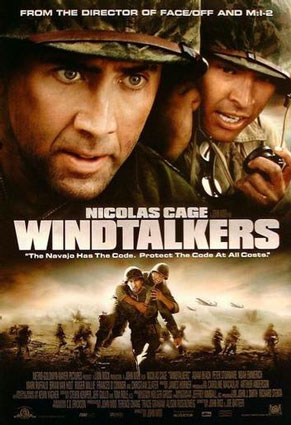
Is There Such A Thing as a Bad War Movie? Windtalkers (2002)


This is one of my worst war movie experiences and probably even one of the worst movies in general. Already under normal circumstances (meaning when he does some decent acting of which he is capable) I’m not really a Nicolas Cage fan but in this movie his acting is frankly ridiculous. This is a parody of suffering and you don’t believe one second that his character is in pain. Definitely not from shell shock. Maybe one would believe it if someone informed you he had a bad case of piles. I had been told that this is not a good movie, although it has his followers, but I didn’t imagine it could be this flawed. There’s bad acting, a lot of explosions that seem to happen for no reason and a stupid plot twist when the Indian code talker plays a Japanese and enters the Japanese  dugout with Nicolas Cage’s character in tow. Unconvincing? Embarrassing!

Enough slagging off. What is it about and why did I not listen to the ones who told me? Purely because I’m interested in the history of the North American Indians. Apparently they had successfully been used as code talkers during WWII. A valuable asset to the American Army. Codes and code breakers  are a vital element in any war (nicely shown in Enigma). Windtalkers tells the story of two Indian code talkers and their counterparts or body guards so to say during the battle of Saipan in the Pacific. But this is only what the Indians are told they are. On a deeper level those two men (one the insufferable Nicolas Cage and the other the convincing  – as always- Christian Slater) are not only guardians  but ultimately they could become executors. Since it would be fatal should the code get into the hands of the enemy,  the men must see that those Indians are not taken prisoners under any circumstances and are  killed in the event of  imminent capture.  This creates a lot of moral tensions. Would they really do it?

The only good bit was the rites you see the Indians perform. What a pity. Had John Woo  managed to tell us something like Glory does about the African-American soldiers’ participation in the Civil War… What a movie this would have been…well…he didn’t.