Spike Lee’s Miracle at St.Anna (2008) The Story of the Buffalo Soldiers and the Massacre at St. Anna

I would say that Miracle at St.Anna is one of the best American war movies and the best American WWII movie of the last ten years. I was surprised to see how good it is, as critics and public have been equally harsh. I assume they are biased because of its director. The end is corny but overall it is absolutely excellent and tells a lesser known story in a very engaging way.

The movie starts somewhat surprisingly in 1982 New York. A modest post-office worker kills a man who buys stamps from him. He shoots him with a German Luger. The incident attracts a lot of attention, even more so when they discover the head of an Italian Renaissance statue in his apartment.

Next we are in Italy, in 1944. The 92nd company, the so-called Buffalo soldiers, a company consisting almost only of African-American soldiers gets under heavy German fire. A small group is separated from the rest and makes their way to a little mountain village that is surrounded by Germans.

One of the soldiers, a huge man, saves a little boy who seems to be ill and slightly crazy. He takes the disturbed little kid with him, all together they find refuge in the house of some Italians, one of them a Fascist. The Germans aren’t really looking for the Buffalo soldiers, they are hunting Italian partisans. And the partisans are hunting them. The Italians know, and so it seems does the little boy, that there is a traitor among them.

While they stay at the village, some of the soldiers realize that the Italians treat them much better than the white people back home. And they also treat them better than some of the white American civilians living in Italy. There is a particularly infuriating scene with an American bar owner who doesn’t want to serve black people. They fight for their country but their country doesn’t appreciate them.

The core scene of the movie is the massacre at St. Anna, a true story, in which hundreds of Italian civilians got killed by the Nazis because the Partisans have killed some of the Germans. The Germans have been told by their command that they have to shoot 10 Italians for one dead German.

Miracle at St. Anna is very rich. It combines a multitude of elements and many stories that circle around different relationships but still feels like a whole. It’s sad, it’s moving and it is very suspenseful as it also works like a thriller. We really want to know why the guy killed the other one. There aren’t many good WWII movies showing the African-American participation and there aren’t many good ones on Italy during WWII. This covers both. And there is also some fighting, for those who want this from their war movies.

Miracle at St. Anna is also part of the Children in War Movies List and African-American Soldiers in war movies.

For those of you who like to watch TV series, the actor who played Shane in The Shield and the guy called “Omar” in The Wire are in this movie.

This is a highly watchable and very original movie that can be named together with other great WWII movies like Saving Private Ryan or The Thin Red Line. 5/5

Roma, Città Aperta aka Rome, Open City (1945) Roberto Rossellini’s Neorealist Masterpiece

Rome, Open City, which is part of Roberto Rossellini’s War Trilogy, was first meant to be a documentary. It eventually  became a movie which incorporated a lot of original footage, in part due to the shortage of film. The black and white movie Rome, Open City is one of the most important movies of the Italian Neorealist movement. Apart from a famous cast, including Aldo Fabrizi and the great and talented Anna Magnani in one of her best roles, Rossellini hired many people from the streets to enhance the authentic feel.

It’s a fantastic movie and one of the most important movies of European film making. Furthermore it’s another one on my list Children in War Movies as children play an important role.

Roma, città aperta takes place towards the end off WWII. At the core of the story are the Priest Don Pietro Pellegrini, the widow Pina who is about to get married to Franceso, her little son Marcello and Giorgio Manfredi, the head of the resistance. Because Giorgio almost gets caught he hides and the priest and his friend Francesco try to help him and organize his escape. Francesco has a girlfriend, Marina, but he keeps her at arm’s length knowing very well that he is about to leave. Marina, a vain and weak woman, gives away his hiding place to the Gestapo. On the one hand she wants to take revenge, on the other she is venal. Since the war began she regularly sells her body to all sorts of people, also Germans. When bribed by a sleek German commander and his lesbian assistant she gives in. In exchange she gets drugs.

When the Gestapo arrests Giorgio, Pina runs after him into the street and is shot by the Germans. This is an extremely famous scene, one that stays with you for a long time. What follows Giorgio’s and his friends’ arrest is similar to all the other Resistance movies I have seen. The men are tortured. The priest isn’t tortured but also questioned and when he doesn’t say anything, he is executed. The children of the street, among them Pina’s little son, witness the execution of the beloved gentle priest with horror.

Rome, Open City is gritty and realistic. It shows many details of the life in Rome during WWII. How the people lived in close quarters, how they struggled to provide themselves with food. It also shows how many people were active in the Resistance. All the main characters are part of it, also the priest which is an important detail that wants to show how unified the Italians were in their fight against the Germans.

Rome, Open City is a classic. It has many memorable scenes and dialogues. It also analyses the deeper meaning of war and guilt. The priest states more than once that maybe the war happened for a reason. With a central character being a Catholic priest it’s obvious that the movie is saturated by Catholicism. The church  takes an active part in fighting evil.

This movie is a must for cinephiles and people interested in war movies alike. If you need the subtitles it will be a bit difficult to follow this movie. Although I speak Italian I had to watch with subtitles as they can’t be turned off and noticed that far over 50% of the dialogue, which is very fas,t is missing.

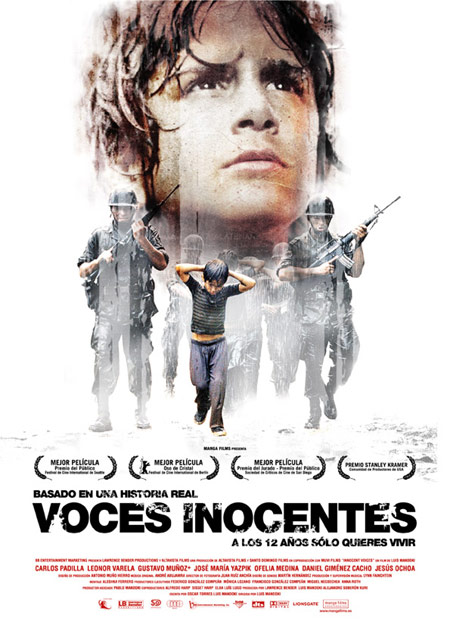
Voces Inocentes aka Innocent Voices (2004) Children as Soldiers in the Civil War in El Salvador

Based on a true story, Luis Mandoki’s Voces Inocentes aka Innocent Voices is going directly on my list of all time favourites, regardless of the genre. This Mexico/US/Puerto Rico co-production is an astonishingly beautiful movie despite the atrocities it depicts. It is simply awesome and as good as Army of Crime about which I raved last year. It is one of the movies on my Children in War Movies List and a s such worth watching in any case.

What makes this movie so incredible is the fact that it works on many levels. It is as much the story of a childhood and a little boy, as an in-depth look at a way of life we are less than familiar with and a civil war we have almost forgotten about. Last but not least it shows the portrait of a mother (Leonor Varela) whose spirited fight and love for her children makes her one of the most memorable and dignified characters I have seen in any movie.

The war, that started in 1980 and lasted 12 years, was initially a conflict between the army and the campesinos, the land owners, over land rights. When they didn’t come to an arrangement the campesinos formed a guerilla, the FMLN, to defend their rights. The war escalated into a bloody civil war. On top of that the US felt the urge to provide the Army with weapons and heir assisstance, fearing that the guerrilleros would be supported by the USSR. The war cost 75’000 lives and over 1 Mio people fled the country. Lacking men, the Army recruited young boys who were barely 12 years old. Oscar Torres, who wrote the script, is the model for Chava, the little boy, whose story we see.

The movie starts with soldiers escorting little boys holding their hands over their heads, to an execution place. They walk in the pouring rain and we hear Chava’s voice in the off. It’s a beautifully filmed scene that immediately sets the tone for the whole movie. We will see many scenes that take place in the pouring rain and are of great beauty despite the fact that they show horrors.

Chava (Carlos Padilla) lives alone with his mother and his little brother and sister. The father has fled the country and gone to the US. Chava’s young and beautiful mother, Kella, is truly a memorable character. Tender and fierce at the same time, she defends her children and fights for their survival. These are the poorest of the poor, their houses are only shacks with cardboard roofs. Kella tries to make a living as a seamstress. Imagine living in a shack when at night there is fighting in the roads. Bullets easily enter the walls of the houses and come flying past your head, there is hardly any cover apart from mattresses that are build up against those thinnest of walls. It is hard to imagine that people not only lived in such poverty but had to endure a war like this that threatened their lives on a daily basis. Many got killed like this, in their own house.

Young Chava is a cheerful and funny little boy. Despite the war, he plays with his friends, falls in love with a little girl, fights with his mother, finds a means to earn money. Even though they have nothing, live precariously, his childhood seems almost enchanted. The tiniest things amuse him, he lives with great intensity, knows no boredom.

The main theme of the movie is the threat that the soldiers will come and get Chava and his friends. We see many scenes in which little boys are recruited by force. The procedures are quite upsetting. Some of the boys around Chava finally decide to join the guerilla in order to avoid the military. And that is what little Chava does in the end as well. The final scene of the movie brings us back to the beginning. Chava and his friends have joined the guerilla and were caught by the Army. Unless they get help, they will most probably be executed.

The actors are amazing, especially the children. They are really awesome. The movie is full of beautiful scenes that allow us to have a look at these precarious lives in poverty. They convey a melancholic beauty that is quite special. There are a few songs that are important in the movie. They had been forbidden by the army but were listened to anyway.

The movie manages to mix a lot of different tones. At times it is sad and melancholic, at times it is thoughtful almost meditative, then again it’s funny or just downright tragic. Innocent voices is a gem, a must-see.

One final word: the people from El Salvador were apparently not entirely happy about this movie because none of the actors is from El Salvador and it has been filmed in Mexico.

Full Metal Jacket (1987) One of the Most Important But Ambiguous Vietnam Movies

In the hand of another filmmaker than Stanley Kubrick this wouldn’t have become the breathtakingly awesome movie this is. Full Metal Jacket is a visceral experience if there ever was one, a movie whose images will burn themselves into your memory forever. Not an unworthy beginning to a new year of blogging. But also a very controversial one.

As probably most of you know, Full Metal Jacket is like two movies in one. The first part, is the boot camp part, the second the combat part.

During the boot camp part the new recruits are transformed into killers, men who belong to a brotherhood. The drill instructor Gunnery Sgt Hartmann (R. Lee Ermey) is by far one of the most obnoxious war movie characters. But what a performance. Try saying one of the numerous bits he utters without stammering. This part also introduces us to Private Joker (Matthew Modine), an aspiring, cynical journalist. Private Joker symbolizes the controversies around this war. We will see him later, in combat, wearing a peace button and simultaneously a “Born to Kill” slogan on his helmet. Another of this movies memorable characters has his major part in this sequence, Gomer Pyle (Vincent d’Onofrio), a fat and clumsy recruit who winds everybody up because they are punished for his failures that are endless. His final scenes bear all the traces of other Kubrick movies like A Clockwork Orange and The Shining.

Once in the combat zone in Vietnam, we meet other colorful characters, one of them Animal Mother (Adam Baldwin), a pure killing machine. At the beginning of his stay Joker is bored like hell. He is a journalist with Stars and Stripes. The guys basically hang around and wait for something to happen and instructions on what they have to report. The Vietnamese they see are either hookers or Vietcong. Any others don’t seem to pass their radar.

The last part is an intense combat part in the cit of Hue. They come under fire and some of them are killed by a sniper hiding in one of the bombed out buildings. As there may still be many people who have never seen Full Metal Jacket I will stop here. It should suffice to say that the last part is intense and not easy to watch.

What struck me most in this movie are the pictures and the colours. Smoke and fire, burning red heaven, bombed out buildings  and palm trees. Apparently the parts in the buildings were filmed in the docklands of London. I don’t know about the rest of the movie. The music is interesting as well. There is a mix between songs of the era and original score that would do any horror movie justice.

I have left out many important, visually powerful and interesting moments. I just wanted to give a short introduction to one of the most extreme and most important war movies that has ever been made. If you haven’t seen it yet, you should watch it.

Full Metal Jacket is also one of those movies that is focussing on the themes War and Journalism and Women in War Movies. Believe me, if you haven’t seen it, we got some interesting elements on both in this movie. If you have seen it, you know what I mean.

I don’t think it is the best Vietnam movie. At least not for me. Of the combat Vietnam movies I consider Platoon, Hamburger Hill, and maybe even We Were Soldiers to be superior. Why? I think, it is fantastic from a cinematographic point of view, but as an anti-war statement I always found it a tad ambiguous. Pretty much like Apocalypse Now.

What do you think?

Silent Night (2002) Christmas in War Movies I

This review is part of a sequence of reviews of war movies that have Christmas as their main theme. There are many war movies in which a part takes place during Christmas or in which it is evoked but that are not the ones I’d like to focus on. I want to focus on those that really center on it.

The first one I’m reviewing is, as you can see, Silent Night, A  Midnight Clear, Joyeux Noël and maybe one or two older ones will follow.

The TV drama Silent Night is based on true facts. It is set on Christmas Eve 1944, just after the Battle of the Bulge. A mother and her young son are seeking refuge in the family’s hunting lodge in the middle of the Ardennes Forest. They walk through the war-torn woods, approach the front line and pass dead bodies, troops of soldiers and tanks.

They have just arrived at the lodge when two American soldiers arrive, carrying one of their wounded. The woman lets them stay reluctantly but makes them leave their weapons in front of the house. Elisabeth Vincken (Linda Hamilton) is not what you would call a patriot. She has lost her eldest son at Stalingrad, her husband is probably dead as well and the youngest, Fritz, would like to join the Hitler Youth which she wants to prevent at all costs.

While they are looking after the badly wounded soldier, a group of three German soldiers arrives at the hut and the encounter almost ends in mutual shooting. Elisabeth is a very strong woman, very determined and persuasive. After some initial discussions and negotiations they agree to leave their weapons behind, enter the house and spend the night there in peace.

I don’t think that anyone present during this Christmas dinner was likely to ever forget it. It would certainly be the most memorable Christmas of their lives. They sit around the table, share their food and stories, talk about the way in which this and the former war affected them. Still,  tensions do not subside completely. The German lieutenant has a particularly hard time to stay peaceful. He is bitter and aggressive, however, after a moment of escalation, he starts to see how absurd this all is and gives in as well. There is a final test that will show if these men have truly become friends in one evening. And if so, will they stay friends later on?

One  thing, as often, that truly bothered me were the bad accents. Americans speaking German with heavy American accents and then fake English accents. But cheer up, I have been assured that it doesn’t bother you if you don’t speak German.

The movie has a few very sentimental moments but it is overall not bad at all, no it is quite a pleasant movie that achieves to capture the spirit of Christmas. Recommended Sunday afternoon viewing with loads of snow, drama and some genuinely heartfelt moments.

I also included Silent Night in my update Children in War Movies List.