I just came across this documentary on YouTube and thought I must share this.
I hadn’t heard of it before and certainly wasn’t aware of such a lot of original footage in color. I only watched the beginning so far and can already tell it really gets to you so much more in color.
I knew I couldn’t go wrong with Hannah Arendt. It can’t get much better than Barbara Sukowa starring in a movie by Margarethe von Trotta. Just recently I have watched another movie they’ve made together – Vision, which was amazing – and I was looking forward to watch Hannah Arendt. The movie is, as I expected, very good, but the title is badly chosen. It would have been much better to call it Arendt on Eichmann or some such thing. With her name as the sole title we’re led to believe it’s about her life while it’s only about her controversial book on Adolf Eichmann and the extreme hostility she experienced after writing it.
Philosopher and political theorist Hannah Arendt emigrated to France in 1933 and, after having spent some time at Camp Gurs, emigrated to the US in 1941 where she stayed until her death in 1975. She lived in New York.
The movie takes place in 1961. Eichmann had been captured in Argentina by the Israeli Intelligence Agency and brought to Israel to be tried. The New York Times sent Hannah Arendt to Jerusalem to report on the trial. The movie uses a lot of original footage of the trial; we see and hear Eichmann answer questions. And we witness Arendt’s fascination and shock. When she travels to Israel, like so many, she’s prepared to see a “monster”, an extraordinarily evil man, but what she witnesses is, what she later coins “the banality of evil”. What the film shows nicely is how Arendt came to understand that Eichmann was not extraordinary at all. On the very contrary. He was just a man who followed orders without ever thinking or questioning anything. People didn’t react kindly to her interpretation. Surely a mass murderer like Eichmann couldn’t be such a banal creature. But Arendt went one step further saying that without the support of the Jewish leaders the mass extermination would not have been as successful as it was.
Of course I knew her position of Eichmann’s banality but I didn’t know she had blamed the Jewish leaders. The uproar and outrage were incredible and for a long time her book Eichmann in Jerusalem was not translated into Hebrew.
The movie also touches briefly on her relationship with the philosopher Martin Heidegger, with whom she had an affair when she was his student. Heidegger is a controversial figure because he was affiliated with Nazism prior to 1934.
According to the film, Arendt was not only blamed for her positions but for being very cold. The victims felt that in saying Eichmann wasn’t a monster, they were blamed as well. I agree that some of the interpretation of her findings must have sounded harsh and brutal to the victims, but I think the movie also manages to show that wasn’t what it was about. In saying Eichmann was banal, Arendt warned us. She meant to show that it didn’t take extraordinary people for a totalitarian systems to work; ordinary people who follow orders and refuse to think are all it needs.
The original footage showing Eichmann is chilling, but without Sukowa’s stellar performance this would only have been half as good.
Not a lot of people stood by her side once her articles were published. But she always had Mary McCarthy (wonderfully played by Janet McTeer) and her husband Heinrich Blücher and some of her friends.
Hannah Arendt is one of the best biopics I’ve seen in recent years. I highly recommend it.
For those who don’t like subtitles: a large part of the movie is spoken in English.
I suppose when you’ve seen quite a lot of the well-known prisoner of war films and are fond of the genre, you’ll come across Miklós Jancsó’s The Round-Up aka Szegénylegények sooner or later. Not only is it an unusual example of a POW movie, but it’s considered to be a masterpiece of European filmmaking and was highly influential.
Miklós Jancsó is a Hungarian film maker. He started out with documentaries before he moved on to movies. He’s made a few famous films – The Red and the White – My Way Home and many others. The Round-Up was the movie that made him famous and is still considered to be his most important film.
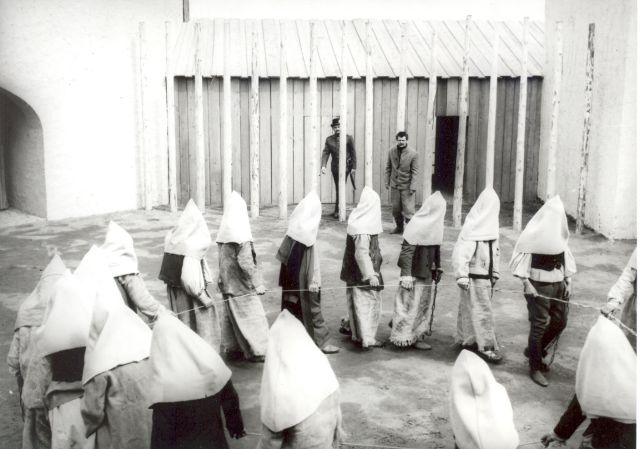
The Round-Up is set in a prison camp, on some God-forsaken stretch of land on the Hungarian Plain (Puszta). It’s the mid 19th century and the Austrian hegemony has just been re-established after the unsuccessful revolution of 1848. The men who are held in this prison camp are suspected to be followers of the leader of the revolution Lajos Kossuth. There is still a lot of guerilla activity going on and the Austrians, helped by their Hungarian counterparts, try to find out who are the guerilla leaders. Most of them are suspected to be among the prisoners and the guards use perfidious and sadistic techniques to find out who they are.
What we see applied in this film is psychological torture. People are promised not to be executed if they can find others who killed more people than they did. Or the guards pretend that a guerilla leader will be pardoned which makes his followers cheer. Of course they have been set up and that was a means to find out who they are.
Humiliation is part of the tactics used. We see how one officer is stripped of his rank, how the guards rip all the insignia from his uniform and while they do not harm him, it feels extremely violent. We later realize that this was foreshadowing as other suspects undergo a fate that’s similar but even worse. One girl is stripped and whipped until she dies. Watching the whipping of the girl triggers a flood of suicides. Later men are stripped too.
Torture is always humiliating but this subtle use of psychological torture is, although less violent, just as effective in that regard.
I have to be honest, I personally didn’t like this film, although it has a lot of poignant scenes, which I’m not likely to forget, but overall this isn’t my type of movie. It’s visually expressive but there isn’t much plot and hardly any dialogue. I don’t need action or plot but I like more atmosphere and dialogue. The Round-Up is all about forms, shapes, space and minimal movement. Plus it’s set in the type of flat landscape I’m really not keen on. That doesn’t mean I didn’t appreciate the film, I just couldn’t relate to it much. But it’s an important movie if you are either a cinephile or a war movie completist. I’ll watch The Red and the White and My Way Home next.
The Desert Fox, starring James Mason as Field Marshal Rommel, is based on the biography of Rommel by Desmond Young. The movie opens with British commandos trying to assassinate Rommel in 1941 and then forwards to 1943 showing Rommel at El Alamein. Rommel, who is of poor health, is just back on the front line and faces a pretty desperate situation. The German troops are far outnumbered and any reasonable commander would give the order to withdraw. Not so Hitler whose consultants all encourage him to give orders to either win or die. For the first time, the movie tells us, Rommel starts to doubt the Führer’s sanity. It will not be the last time. On the very contrary. The movie tries to show a Rommel who goes from doubt to open criticism and even knows the group around von Stauffenberg will attempt to assassinate Hitler. While not tied to the assassination he’s still found guilty of treason and given a chance to either get a fake trial or to commit suicide in order to assure the future of his wife and son.
I must admit I expected this movie to be far better than it was. The story is interesting, of course, but the way this was filmed was not much better than a B-movie. Mason is good, I wouldn’t say he’s great but he’s good. There is just one problem. He doesn’t look like Rommel. What didn’t work is that most of the movie is either composed of real footage or scenes filmed in the studio which makes the whole movie look like a theater play broken up by documentary material.
The other problem is that we don’t really get to know Rommel. Given that the title of the movie is The Desert Fox and not “Rommel’s Downfall” or some such thing, I expected that we will learn why Rommel was considered to be such a great general. Although he was their enemy, the Allies admired and feared him. The movie only shows us a Rommel who is very realistic, who knows when a battle can’t be won, who makes great suggestions, but isn’t heard. The movie also fals in showing Rommels’ humanity. It seems he was never accused of war crimes. He refused to kill Jewish soldiers, civilians and prisoners.
The best part is that the movie shows how Rommel first doubts the people who consult Hitler before he doubts the man himself. Once he’s understood that his Führer is nothing but a maniac, he speaks his mind openly and confronts him.
I watched the movie Patton two years ago and thought it was outstanding. If anyone knows of a biopic of Rommel which is equally good, please let me know.
I didn’t mind watching The Desert Fox, but it’s certainly not the ultimate movie on Rommel.
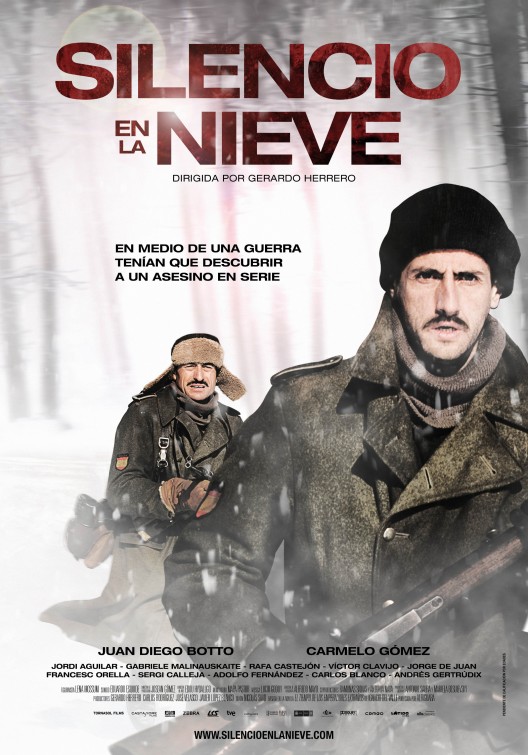
Set on the Russian front in 1943, this thriller shows a lesser known aspect of WWII, namely Spain’s participation on the Russian front. I may not be the history buff I should be to write a blog like this, so, in all honesty, I have to admit, I had no clue the Spanish were fighting on the Russian front alongside the Germans. The Blue Division or División Azul (also called División Española de voluntarios, meaning Division of volunteers) was a division of Spanish volunteers, the 250th Division of the German army. Franco had allowed these volunteers to join up. Most of these men were right-wing, falangists, only a very few were communists.
I knew this was a thriller, therefore I didn’t expect to see all that much about the war as such. The 250th Division must have seen some heavy fighting, but we only get a taste of it. Nevertheless I liked this film a great deal. It works as a gripping thriller, but it also conveys a feeling for what it must have been like for the Spanish to fight with the Germans. There was a lot of hostility, and the Germans made them feel their superiority constantly.
The story starts with a chilling image. A frozen lake full of dead horses. When the soldiers of the Spanish division approach they find a dead man among these horses. His throat has been cut and an inscription has been carved into his skin “God Sees Everything”. The Spanish commander appoints a former police officer, Andrade, to investigate the case.
Arturo Andrade goes about this investigation with great care. At first it looks las if the victim was a pro-Soviet agent, later when there are further murders a possible lead points towards freemasons.
There is a longer sequence towards the end of the movie which is reminiscent of the Deer Hunter Russian Roulette scene, only this one here is even more chilling. I wonder if this is truth or fiction. Did they really play Russian Roulette to the extent it’s shown here?
I liked the mood and the atmosphere of this beautifully filmed movie. It has a lot of great scenes. I enjoyed the characters and the story as well and I’m glad it made me aware of the Spanish participation in WWII. I think this is fascinating material and well-worth a “proper” war movie. I’m afraid though that not many Spanish film makers would want to portray the División Azul. After all they were falangists and, as it seems, quite heroic. Depicting their heroism could be interpreted as pro-Franco, I guess.
The movie is based on a novely by Ignacio del Valle.
I found the Spanish trailer but none with subtitles and another trailer below in which nobody talks.


 All About War Movies