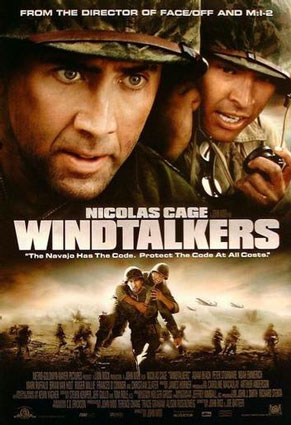
Is There Such A Thing as a Bad War Movie? Windtalkers (2002)


This is one of my worst war movie experiences and probably even one of the worst movies in general. Already under normal circumstances (meaning when he does some decent acting of which he is capable) I’m not really a Nicolas Cage fan but in this movie his acting is frankly ridiculous. This is a parody of suffering and you don’t believe one second that his character is in pain. Definitely not from shell shock. Maybe one would believe it if someone informed you he had a bad case of piles. I had been told that this is not a good movie, although it has his followers, but I didn’t imagine it could be this flawed. There’s bad acting, a lot of explosions that seem to happen for no reason and a stupid plot twist when the Indian code talker plays a Japanese and enters the Japanese  dugout with Nicolas Cage’s character in tow. Unconvincing? Embarrassing!

Enough slagging off. What is it about and why did I not listen to the ones who told me? Purely because I’m interested in the history of the North American Indians. Apparently they had successfully been used as code talkers during WWII. A valuable asset to the American Army. Codes and code breakers  are a vital element in any war (nicely shown in Enigma). Windtalkers tells the story of two Indian code talkers and their counterparts or body guards so to say during the battle of Saipan in the Pacific. But this is only what the Indians are told they are. On a deeper level those two men (one the insufferable Nicolas Cage and the other the convincing  – as always- Christian Slater) are not only guardians  but ultimately they could become executors. Since it would be fatal should the code get into the hands of the enemy,  the men must see that those Indians are not taken prisoners under any circumstances and are  killed in the event of  imminent capture.  This creates a lot of moral tensions. Would they really do it?

The only good bit was the rites you see the Indians perform. What a pity. Had John Woo  managed to tell us something like Glory does about the African-American soldiers’ participation in the Civil War… What a movie this would have been…well…he didn’t.
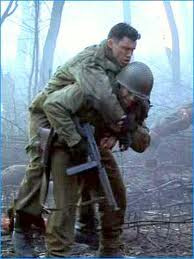
When Trumpets Fade (1998)

Eerily beautiful is what comes to mind when speaking about this overlooked war movie gem. I discovered it thanks to Gary Freitas’ book on war movies.

The movie starts with black and white original footage and a voice telling us that it is 1944, just after Paris has been liberated.

After this introduction we are thrown into action and see one soldier, private Manning (Ron Eldard),  carrying his mortally wounded comrade whom he finally must abandon. All through watching this movie I was reminded of Goethe’s ballad the Erlkoenig in which a father rides with his son through the woods at night. The child keeps on saying it sees the Erlkoenig in the darkness who tries to tempt him and take him away. A very spooky ballad. When the father finally arrives at his destination he finds out that his little son has died in his arms.

Maybe John Irvin, the director, did think of this ballad when he shot this movie. The woods always had a special place in German mythology and references to this can be found in many a movie or book about WWII.

The soldiers in this movie are fighting a senseless battle, one that cost a horribly high amount of lives. The battle of Hurtgen forest is only not spoken about so often since it was shortly followed by the more famous Battle of the Bulge.

When Trumpets Fade tells the story of private Manning the only survivor of his company who is – due to his ability to survive under such circumstances – promoted to sergeant and gets to lead a group of replacements. In a bloody battle where they are to secure a bridge he is again one of the only survivors and gets promoted to lieutenant. Both times he protests. All he wants is to survive and  get out. He’s not the only unhappy soldier. The battle seems sense- and fruitless, casualties are high, soldiers and officers complain and rebel.

Manning is a very interesting character and his development makes this movie one of the rare psychologically interesting of its kind. This and the eerie scenes in the woods where the fog is thick, Germans lurking everywhere and naked, burning trees stand lonely and dark against the background,  makes this a haunting experience to watch.

The final credits are shown over endless rows of dragon’s teeth that are slowly covered in snow to  Bing Crosby singing White Christmas.