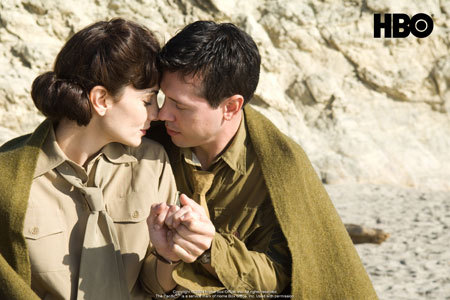
Rescue Dawn (2006) or One Man´s Ordeal in a Vietcong Prison Camp

Dieter Dengler, a young American fighter pilot of German origins, is shot down over Laos, in 1965, just when the Vietnam war is about to start. Naïve and enthusiastic he doesn’t think that much harm could come his way but when he is captured by Vietcong he learns otherwise. Thanks to his astonishing resourcefulness, his unabashed optimism and his sense for camaraderie he survives the worst imaginable circumstances. He endures torture, hunger, pain and humiliations by sadistic guards, petty accusations and nagging by fellow prisoners. He carefully plans their escape and finally succeeds, only to find his ordeal is not over.

Werner Herzog is known for movies that often have lush jungle vegetation as a backdrop. No difference here. The same cinematographic language that I knew from movies like Aguirre, Fitzcarraldo, Cobra Verde and Grizzly Man that have made Herzog famous. The beauty of the forest, the plants and giant insects are captured here as well, but  then the comparison to other movies stops. Rescue Dawn was one of the most revolting films I have ever seen. Probably it is shockingly true to the events that Dieter Dengler had to endure, nevertheless I found it hard to watch. Seeing people eat handfuls of larvae and maggots was not my cup of tea. Sure it is well done and all but yuk, yuk, yuk.

Apart from being disgusted I am also awed. It´s incredible what some people can endure and how they manage to survive the worst.

Christian Bale is very good although  he acts quite badly at the beginning. Steve Zahn and Jeremy Davis are outstanding.

Required viewing for Werner Herzog fans, POW movie fans and every one like me mad enough to think they have to see every decent war movie no matter what´s at stake for the stomach nerves.
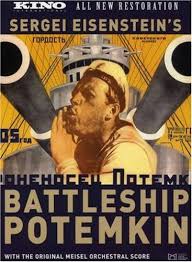
Sergei Eisenstein’s Battleship Potemkin aka Bronenosets Potyomkin (1925): A Painful Movie Experience

Eisenstein’s Battleship Potemkin is one of the great cinema classics and the first time a movie was dedicated to a Revolutionary act. It tells the story of a mutiny that took place in 1905 and was followed by a street massacre. The crew of the Battleship rebelled against their officers.

Some of the scenes, like the one posted below, dubbed “Odessa Steps”, have written film history.

Be it as it may, I suffered all through the viewing of this film. I found it agonizingly boring. Maybe I am just not a silent movie person although I seem to remember I have seen a few that I liked.

Still, I quite like the Odessa steps scene but the parts on the ship with the long takes on machines and guns are excruciating.

We have to bear in mind that this movie is also an eloquent piece of propaganda.

The Guns of Navarone (1961): A Great War Adventure Movie

Some movies age well. Others don´t. The Guns of Navarone,  a splendid UK/US co-production, is one of the first kind. Almost 50 years old but still fresh like on the day it came out. This is thanks to a  lot of things. A gripping story, a great cast (Gregory Peck, David Niven, Anthony Quinn, Irene Papas, Stanley Baker, Anthony Quayle), wonderful cinematography, a nice score. What more do you want from a good war adventure yarn? I hadn’t  seen it before (yes, yes, shame on me) and was really surprised how good it is. And very esthetic. It is one of the most esthetic movies I have ever seen.

The year is 1943. Greece is occupied by Germany.  The Germans who feel they are losing on the Eastern Front try to force Turkey to join them. The Guns of Navarone tells us how a group of men tries to secretly enter a Greek island, meet with the Greek resistance and with their help sneak into a fortress to destroy two powerful German guns that threaten British soldiers who are marooned on another island. The mission is extremely dangerous and no one actually thinks they might accomplish it.

The story, from the beginning to the end, is one gripping sequence after the other. Each one of them could almost stand alone like some sort of short story. First they fight the elements on a boat during a storm. Then they have to climb an impossibly steep rock. Every place they find themselves in is swarming with Germans so they have to hide often.  In one episode one of them gets wounded and they need to decide if they take him along or shoot him. One of them betrays them and they need to decide whether or not to shoot the person. They get captured by the Germans but escape. Many things go wrong and not all of them make it. The best scenes for me are in the fortress. We hear a German song in the background and see this bunker with its typical Nazi esthetics.

It is also a funny movie at times as the German´s really get their asses kicked. In one scene the group is hiding and a German guard hears them. To distract  him they throw something and he runs off like a dog.

There is also some humorous dialogue mostly coming from the stiff-upperlipped British major played by David Niven.

The characters are well drawn, interesting and complex. Major Mallory (Peck) is a mountaineer whose expertise is needed for the mission. Miller (Niven) is an expert in explosives. Stanley Barker plays a trained killer who has problems with his conscience. I was quite surprised to see Irene Papas, the Greek singer, in one of the roles. I didn’t even know she acted. She plays a Greek resistance fighter. Quite a fierce character. Gia Scala´s role Anna is interesting and what happened to her illustrates once more the idea of the absurdity of war.

This movie made me quite nostalgic. You don’t find many movies like this anymore. And no actors like these either.

Do Women prefer The Pacific to Band of Brothers?

In an interview Dale Dye, a military advisor for many war  movies, was asked why The Pacific had many female viewers and here is his explanation for that fact.

“By telling a story that reflects the thousands of whirlwind wartime romances that happened during World War II. There’s this great desperation element—I might get killed in the next six weeks, we’ve got to get married now—and females really identify with that. They get it.” (Dale Dye in The Atlantic)

He also believes that the love story between the two soldiers John Basilone and Lena Riggi made women like it.

Aha? So it is only the romance that makes women appreciate The Pacific? Could it not be that it has more to do with the fact that there are simply more women in The Pacific than in Band of Brothers?And that there is a whole psychological dimension in The Pacific, with all its tales of post-traumatic stress, that might appeal to women?

I would love some comments. Do women like The Pacific? Do they prefer it to Band of  Brothers? Or did they even like both?

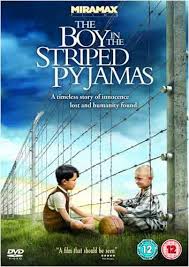
The Boy in the Striped Pyjamas (2008) or An unusual look at the Holocaust

The movie The Boy in the Striped Pyjamas is based on a novel by John Boyne.

The movie tells the story of Bruno, an eight year old boy, whose father is a high ranking Nazi officer newly appointed to be in charge of a concentration camp.

The family leaves Berlin (shot in Budapest, by the way) for a place somewhere in the country, near a concentration camp. The story is purely seen through the eyes of the little boy which creates some very uneasy moments.

I believe that the major theme of this movie is knowing and knowledge. We do know what happened during the third Reich. We know what Endlösung – The Final Solution – means. We know about concentration camps and extermination camps. Watching this movie with all this background information makes for a lot of discomforting moments. All the signs, the chimneys and the smoke, the people in the striped pyjamas… We know what to make of them. Bruno does not. And neither does his mother as it would seem.

The crucial moment is when Bruno meets the boy behind the barbed wire, the boy in the striped pyjamas, Shmuel. An impossible friendship begins. Bruno understands after a while that this boy is a Jew; at the same time he is taught by a fanatic private tutor that Jews are vermin.

Boyne says in an interview that he wanted to tell a different story, add something new to a topic that has been taken up so many times. He is very successful. One thing is for sure, no one who watches The Boy in the Striped Pyjamas is going to forget it easily. The whole way it is told plus the more than atrocious end is by far too unusual to be forgotten.

I am sure it is one of the best movies to teach children the Holocaust.

To be honest, I am still a bit speechless. The whole film and especially the ending are like being kicked in the gut. I am quite awed by the little actors. Asa Butterfield, who plays Bruno, is amazing. This little kid has a way of talking with his eyes that is rarely found in grown up actors. To cut a long story short: Watch it!

See also Children in War Movies: A List