African American Soldiers in War Movies

It is a fact that until recently African American actors were almost nonexistent in war movies. This is quite unfair since they were also fighting for their country. Even though they are not omnipresent in today´s war movies, they seem to get a fairer share.

The makers of Generation Kill faced quite some questioning as to the reasons why there was no African American cast in the series. As fishy as this may have seemed initially there was a very good explanation for this. Generation Kill is based on the true story of the First Recon Company, a highly specialized troop, in which there were actually no African American soldiers, or only one, as we can deduce from the group photo in Evan Wright´s book.

The questioning however was very justified since there is really no war movie on contemporary conflict in which there are no African American actors. Be it Battle for Haditha, Redacted, The Hurt Locker, Stop-Loss, Home of the Brave and many more. There are always African American actors and this is highly justified since many of the troops are of said origin.

How does the situation look regarding other wars? For example Vietnam? When it comes to combat movies – with the exception of We Were Soldiers – black soldiers are very often present. The best example is certainly Hamburger Hill that has a big African American cast. But they are not absent from Platoon or Full Metal Jacket either. Now what about We Were Soldiers? I honestly don´t know. Since it is based on a true story it might be possible that there were no African American soldiers in that company. If anyone knows the reason, tell me please.

WWII is another story altogether. Looking at the massive production of WWII movies it is incredible how absent African American actors are. Sure there are a few exceptions. A Soldier’s Story that I reviewed a while back is a good example. And then we have the Tuskegee Airmen based on the true story of the African-American 332nd Fighter Group of the Army Aircorps (see my movie review). This fine movie illustrates how unjustified the belief was that Blacks were not capable of flying modern fighters. But apart from these two examples? And what about Flags of our Fathers? It´sad to say that there were 900 black troops participating in the battle of Iwo Jima but not one of them is represented in Eastwood´s movie. He has been questioned many times and asked to clarify but he did not reply. This infuriated many people, among them the film director Spike Lee. I think his Miracle at St. Anna might be a direct response to Eastwood´s omission. It is actually incredible but the absence of African American actors in Flags of our Fathers makes Pearl Harbor look good in comparison. At least  Cuba Gooding Jr had quite an important role. Spike Lee´s just mentioned Miracle at St. Anna focuses on the 92nd Infantry Division that fought in Italy. This division was the result of the segregation of the times. It was a purely African-American division, also called Buffalo soldiers  (I must admit that I have not seen Miracle at St. Anna but read many reviews that did NOT appreciate it). I think we are still waiting for a truly good depiction of African American participation in WWII.

And WWI? I am lost. Have no clue if there ever was  a WWI movie with African Americans in it.

Let´s rewind some more: The Civil War. And yes here we finally find an outstanding movie with a largely African American cast. One of my Top 10. Yes, I am talking about Glory. If you haven´t seen it yet, watch it.

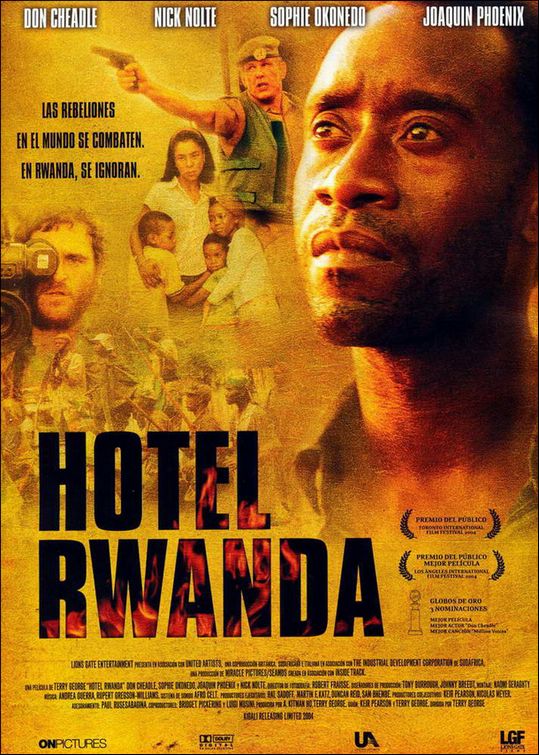
Looking at the whole picture again we can say, it is getting somewhat better, but a contemporary movie, based on a conflict younger than the civil war, with an African American main actor is still outstanding. Now, don´t mention Hotel Rwanda (Don Cheadle was actually also in Hamburger Hill). Although it is an impressive movie  there was really no chosing a white main actor. Not even Clint Eastwood would have had the insipidity to do so.
History versus Story or Platoon versus Hamburger Hill

I named both these infantry combat movies among my Top 10 favourite war movies (of course, since this list ist out there for everybody to see I doubt its content. Typical.). Apart from thinking that these are great representatives of the genre I think they illustrate wonderfully the topic “history versus story” and why critics often rate the second as the better movie, whereas the general public will be more likely to prefer the first one.

Hamburger Hill is foremost based on a historical event, namely one squad´s  battle for Hill 937 in the A Shau Valley of Vietnam from May 11- 20, 1969. The squad consisted of 14  U.S. Army soldiers of B Company, 3rd Battalion, 187th Infantry Regiment, 101st Airborne Division. The battle was later called Hamburger Hill since the losses were so high and the American soldiers literally shredded to minced meat.

You can not be more precise than this when chosing to tell a story in a movie. That is the theme, and that is what is shown. No niceties, no made up story, no sugar coating to make the bitter pill go down any better. War movies don´t get any more visceral than that.

And then there is Platoon. We know the year and that some events resemble other events that happened but apart from that this is purely fictional. Especially the whole good and bad officers theme and a young soldier´s loss of innocence. All these roles are played by famous actors which is not the case for Hamburger Hill.

As I said before many critics rate Hamburger Hill higher than Platoon and from an intellectual point of view I can´t blame them. But I don´t agree. They think it is more realistic. Somehow morally superior. There is not a tiny spark of beauty in that movie. OK, I agree. But… If we really wanted pure unadulated realism, authenticity, moral education, unambiguity, shouldn´t we stick to documentaries? (And even those can show us whatever  they want to make us believe has happened. But this is not the subject here).

I´m afraid but I like a  bit of symbolism and an interesting story. And I also judge movies by the criterion whether their pictures stay in my memory or not.

For many of these reasons  if been considering lately to kick out Hamburger Hill of my Top 10 list and integrate one of the most artistic Vietnam war movies ever: Full Metal Jacket.

Yes, right, why wouldn´t I?

Women in War Movies

War movies are a genre in which women will rarely if ever play major roles.

However there are a few that come to mind immediately.

Nurses

Mothers

Wives

Girl friends

Resistance fighters

Soldiers

Officers

Victims

The nurse is by far the most common role. In many movies they are very prominent. Especially in the sub genre of the war romance they get more than just small roles. (Yes, Pearl Harbor (2001) comes to mind, but…)

Some fine examples of nurses can be found in The Lighthorsemen (1987), In Love and War (1996), The English Patient (1996).

Mothers, wives, fiancées are often found at the very beginning of a movie, when the soldiers leave their homes like in Dark Blue World aka Tmavomodry svet (2001). We often see them again, reading a letter arriving from the field as in The Thin Red Line (1998).  They serve as a sort of counterpoint to make the contrast between those who fight and those who stayed home even bigger. Then, you may find them once more at the very end, when the soldiers return home. One of the most poignant and touching wives is Madeleine Stowe in We Were Soldiers (2002). The story moves back and forth between the battle field and the home front depicting the agony the soldier´s wives went through when the telegrams arrived telling them one of their husbands had been killed.

Nurses become very often soldiers’ girl-friends which makes the two roles blend into each other. But many of the classic girl friends in movies depicting the second WW are the girls the men encounter in the countries they are shipped to. The American soldiers in The Pacific for example have Australian girl friends.

The role of the resistance fighter is quite a noble one. Not very frequent but appealing. Cate Blanchett as Charlotte Gray (2001) comes to mind. Or the women in Uprising (2001). And definitely Sophie Scholl (2005). The latest example of this kind is Carice van Houten as the jewish woman Rachel Stein who joins the Dutch resistance after having survived a massacre in the brilliant Black Book aka Zwartboek (2006).

Female soldiers that are even involved in combat are not very frequent. The most remarkable one I remember is the Vietnamese sniper in Full Metal Jacket (1987). A further female soldier  is played by Demi Moore in G.I. Jane (1997) where she is said to be the first woman  to have  been granted access to the navy SEALS.

Women as officers is by far more common. Again Demi Moore played a role in the excellent legal drama A Few Good Men (1992). And then there is Meg Ryan as medevac chopper pilot Capt. Karen Walden in Courage under Fire (1996).

Unfortunately some of the above mentioned portraits of women in war movies are quite questionable and have been criticised repeatedly (especially G.I. Jane).

I almost forgot the victims. Inexcusable. There are as innumerable female victims in real wars as there are high numbers in movies. One of the saddest are the victims in Vietnam war movies. I think of  Platoon (1986) and Casualties of War (1989). They are not the only ones. Of course not.

My favourite heroines are Cate Blanchett as Charlotte Gray, the wonderful Juliette Binoche as nurse  in The English Patient and, another nurse, Sandra Bullock in In Love and War, and the outstanding Julia Jentsch as Sophie Scholl. The first two are based on novels, the other two on historical facts. Sandra Bullock plays the nurse Ernest Hemingway fell in love with when he fought in Italy during WWI.

The Pacific 4 (2010): Rain on Cape Gloucester or The Weather in War Movies

Since I saw Stalingrad in which soldiers die in the snow or the episode Bastogne in Band of Brothers I consider the weather to be one of the key elements not only in the actual war but also in transmitting a sense of reality to the audience of war movies.

I have only seen five episodes of  The Pacific so far. Episode 4 was the first to really grip me. It’s raining and raining endlessly. The morale of the soldiers gets lower and lower. There is no escaping this torrential downpour. Whoever has been in the tropics knows that this is not the kind of rain we Europeans or Americans are used to. There is the humidity, the violence and the noise. Yes, this kind of rain is as noisy as a constant shower open at full blast and as violent. If you are in a solid house maybe you could ignore it but in a hut or a tent…No way.

Incredible somehow that after all the heavy fighting the soldiers have been through at Guadalcanal it is the rain that finishes some of them off.

Rain on Cape Gloucester

With all the natural disasters and extreme weather conditions that have always been taking their toll  it is amazing we humans are not more humble. Or is this one of our well-kept secrets that fighting each other and subduing one another helps us fool ourselves into believing we are stronger than we are.

Hooked

Which war movie was it that did it? Which was the first to catch my interest to such an extent that it would become a passion? Is it the same that I would call my all time favourite war movie or has it meanwhile become one amongst many?

Which one is it for you? Or is it more than just one, maybe a whole category? Was it the day you discovered that there is actually more than just one Vietnam movie but a whole bunch of them?  Or do you go for combat movies in general and the actual war isn’t even that important to you?  It could also be about the camaraderie. Or the weapons. Or machines. You could love sniper movies or those with subs in them. Maybe you are obsessed with panzers.

See? A lot of things could get you hooked.

In my case it was a very specific movie. The war: Second world war. Location: The Pacific. Genre: Infantry combat. You know which one? Take a guess.

Yes, the other one, the one that didn’t get all the credit it deserved cause Saving Private Ryan was out there at the same time.  Yeah, I’m talking the Thin Red Line here.

That was the first one that moved me so much it got me thinking. And looking back. There had been others before and there would be many more afterwards but this one  was the first that got me hooked. Followed closely by Stalingrad, Black Hawk Down and Band of Brothers. Ok, I admit, it is not a very old passion but notwithstanding it is a profound one. These  movies convinced me that there was more about war movies than the general public would ever see,it showed me a huge terrain full of astonishingly original, moving, interesting and fascinating movies.    A world full of variety. There are so many war movies out there and so many different genres and subgenres that probably no one, and I mean it, absolutely no one would not name the one or the other among some of their all time favourites (it just depends on how inclusive the borders of the category are to you.  Combat movies are just a genre among many and even though, admittedly, it might be what I prefer, they are not to everybody’s liking. But think: Last of the Mohicans, Enigma, The Pianist…..  There’s quite a wide range.)