Finally the long-awaited BBC TV adaptation of Sebastian Faulk’s WWI novel Birdsong is shown on British TV. It’s a two-part adaptation that got a lot of rave preview reviews.
I’m sure all those who loved the novel, would want to watch this and all those who are interested in WWI as well.
I missed part I but they will air it again shortly. As soon as I’ve seen part I and II will post my review.
I find it surprising that this movie, although not a “real war movie”, didn’t even get the tag “war” despite the fact that civil war is a major topic. I had meant to watch Agora a long time ago although I read many mixed reviews. Now that I have finally seen it I can see why. It is a flawed movie, it is the victim of silly marketing as well as the victim of what I think is a bad and misleading title. All this said I still think it is excellent and how many times do I have nightmares after having watched a movie? And, yes, Agora, woke me, it woke me because the story it tells – and which is a true story – is deeply upsetting for many reasons.
391 A.D. Alexandria. The Roman Empire is in decline. The philosopher, astronomer and mathematician Hypatia is an influential figure in the city. She teaches and does research. One of her main topics is the movement of the planets. She wonders whether the sun is really moving around the earth. Her lectures are lively and interactive. She doesn’t mind being contradicted but she wants to hear reasons, well formulated thoughts. It seems she was an attractive woman and some of her pupils are in love with her. She doesn’t want to get married, her life is dedicated to philosophy and research.
The city of Alexandria is composed of different people, Jews and Christians and of course, the so-called heathens, like Hypatia herself. The Christian movement which is not more than a sect is becoming more and more influential and finally a civil war breaks out during which the famous library of Alexandria is burned down and the Christians, led by their bishops, take over the city.
Hypatia is tolerated but not allowed to teach anymore. The longer the Christians are in charge and when they finally also start to persecute the Jews, she is in danger as well. It isn’t liked that she insists upon the fact that the earth circles around the sun and not the other way around. And worse than that, it’s not tolerated anymore that a woman occupies an influential position. Her end is famous and extremely gruesome. The trailer and some of the movie posters make us believe that we will watch a romance. While there are men in love with Hypatia we do not see any love stories but in order to make her ending more acceptable for sensitive movie goers this aspect plays into it.
Before she is killed, Hypatia is accused of witchcraft and the bishops insist that women are to be subjugated by men. All the reasons for this are taken from the bible and the fact that Jesus had 12 male apostles but no woman serves as another proof.
After having watched this and done a bit of research on Hypatia I must say that she was a truly amazing woman. She had found out with very primitive methods (nicely shown in the movie), that the earth isn’t the center of the universe. We know how long it took until this was rediscovered and how long the Catholic Church fought this discovery.
I think it would have been justified to call this movie Hypatia and not Agora. Yes, it’s about the end of an era but more than that it is about a woman and the war against women that still rages in many countries.
Religious fanaticism, no matter the origin, is something that upsets me and one group of people oppressing another group does upset me as well. The combination of topics in this movie make it topical and many elements are as explosive today as they were then.
I’m not much of a Rachel Weisz fan but she is convincing in this role. I have only seen one other of Amenabár’s movies The Others which I liked but I haven’t seen his highly acclaimed Mar adentro – The Sea Inside. After having watched Agora, I’m keen on watching other movies by him.
I am fascinated by this story and would love to read a book about this period and Hypatia. Does anyone have a suggestion?
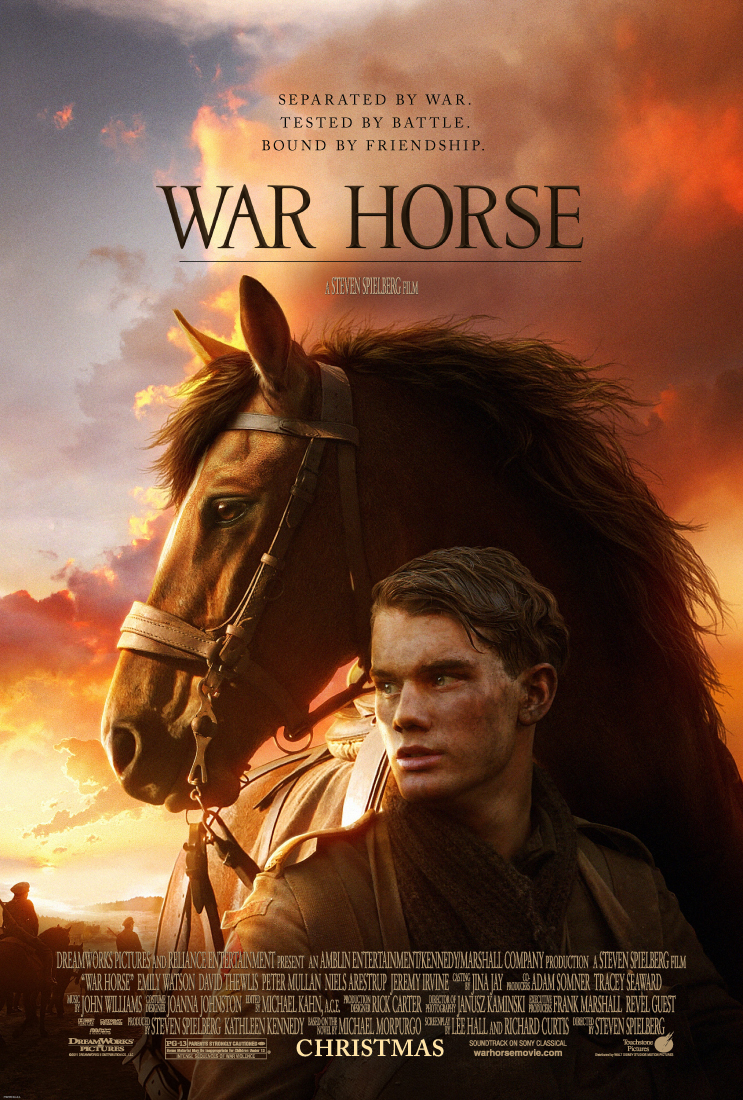
I find it much harder to watch anything depicting cruelty to animals than to humans. I can’t help it. And despite the fact that Steven Spielberg’s War Horse is decidedly tacky at times, it really upset me. Not so much the movie – things are toned down to make it suitable for all ages, I guess, – as to think about what those horses went through in WWI.
Based on Michael Morpurgo’s eponymous novel, War Horse tells of the friendship of a farm boy with a horse. It’s very Black Beauty in the beginning. Out of sheer folly Albert’s father buys an expensive race horse that he can neither afford nor use. Albert manages to save his father’s farm and the horse and trains the animal until it is able to perform the duties of a workhorse. He also teaches him to come when he whistles and many other tricks.
When the war breaks out, Albert’s father sells Joey to a British officer who takes the horse to France. This almost breaks Albert’s heart but the officer, a kind man, promises to take care of Joey. Sadly he is killed in a reckless cavalry attack that goes very wrong. The horse, one of the rare that survives, can escape but is captured by the Germans. After this an odessey begins in which Joey changes hands more than once and more than once faces death.
Albert who has sworn to find his horse wherever it is (a bit of a Last of the Mohicans moment), has heard of the death of the officer and signed up. Soon he finds himself in the trenches in France.
The movie isn’t too graphic, we don’t see wounds and atrocities that you would normally see in a war movie, still it manages to convey the horror. It just does it by focussing on other elements. We see how many horses died in cavalry attacks and how thousands were overworked until they died from exhaustion.
The parts related to the war were, in my opinion, well done. Without being too graphic they illustrated a lot that was typical for WWI like the trenches, the mud, the gas. What was tacky was how the story was told at times and the end which didn’t seem very realistic. On the other hand the scene of Joey who runs down No Man’s Land and gets caught in barbed wire, manages to convey a better anti-war statement than many other movies.
The acting is quite good and in the case of Benedict Cumberbatch, in a very short but effective role as British Major, and Emily Watson, as the mother of Albert, even excellent.
Apart from showing the harrowing destinies of horses in WWI the movie captures the beauty of the bond that can exist between a human being and an animal.
I read that John Ford’s They Were Expendable was liked by the critics but not by the public when it was released. The public thought it was too patriotic and since people were tired of the war, they didn’t care for the movie all that much.
While I often share the critics’ view, I must say, not in this case. It isn’t a bad movie, it has quite a few scenes that are good but it didn’t work for me as a whole.
At the center of the story are Commander Lt Brickley (Robert Motgomery) and his friend and second in command Lt Ryan Rusty (John Wayne). Brickley is the squadron leader of a crew of PT Boats who are to defend the Philippines just after the Japanese have attacked Pearl Harbor.
Although Brickley is the commanding officer, Rusty is still the main character, he is also the one with a love interest (Donna Reed). For once I didn’t mind John Wayne, I would even say this is one of his better movies. Maybe because he isn’t the commanding officer.
There is a lot of emphasis on duty and honor and “getting the job done” no matter whether you will come back or not. All that is rather on the annoying side of things but what I truly liked is the battle with the speed boats. These are such neat little boats. Although it is said by an Admiral at the beginning of the movie that these boats were not likely to achieve much, their speed and agility makes them a dangerous opponent for the Japanese fleet and they manage to sink a few very big boats. Their losses are high anyway as they are not only attacked by the Japanese boats but by their planes as well.
They Were Expendable was very important for John Ford who was one of those directors (like Capra, Huston and Wyler) who had served during WWII where he also filmed the documentary on the Battle of Midway (1942). He was chief of the Field Photographic Branch of the US Navy and also present during the Normandy invasion in 44 where he met the man who served as model for Lt. Brickley.
Funny enough what works best in this movie, apart from the speed boats, is the love story as it underlines how much the people fighting in the Pacific are in danger. The scenes with Donna Reed are quite languorous, I particularly liked the many shots with light falling through blinds. That always creates a nice atmosphere.
Something else that I appreciated is the fact that the Japanese are not demonized. They are only present through their planes and boats, we don’t see them.
While this is certainly not one of my favourites, I think it is worth watching for those who are interested in the development of the war movie genre. Despite its flaws, John Ford manages to tell the story in a very unique way with a lot of emphasis on all the individual people involved. Last but not least, I think it is a must-see for John Wayne fans as he is more interesting when he gets to play second in command.
Uprising is a made for TV movie based on the true account of the rebellion in the Warsaw Ghetto in 1943. A group of young and very determined Jewish people managed to do what some of the biggest armies weren’t capable of doing, namely fighting back the Nazi’s for a few weeks. It’s not a flawless production, some of the dialogue is a bit “What-the-Heck”, including the fact that all the actors talk with a heavy accent, but apart from that I found it very interesting. The actors are mostly good and it focuses on a few historical facts I hadn’t known too much about and that I found very interesting. I can only hope it’s accurate. At least it felt so.
The movie begins with the Germans entering Poland and Warsaw and forcing all the Jews to live in the ghetto. They endure famine, illness, daily abuse. The conditions in the ghetto are harrowing. The most controversial role is played by Donald Sutherland as Adam Czerniakow, head of the Jewish council. He thought that by collaborating with the Germans he could save the Jews from being deported. When he realized his error and the daily transports to Treblinka started, he committed suicide.
The rebellion is led by Mordeachai Anielewicz (Hank Azaria), Yitzhak Zuckerman (David Schwimmer), Kazik Rotem (Stephen Moyer) Tosia Altman (Leelee Sobieski) and Mira Fruchner (Radha Mitchell). The danger to smuggle out information from the ghetto to the Polish side and weapons back in, is shown in great detail. Those people were incredibly courageous. Still they had to fight at lot of internal opposition. The Jewish Council didn’t want to support them as nobody wanted to believe that the camps were extermination camps. When they finally coudln’t doubt this anymore and Czerniakow had committed suicide, more and more people joined them. At first they planned little terror attacks until the Nazi’s seent tanks to erase them. The Nazi leader Stroop is played by Jon Voight, accompanied by filmmaker Dr.Hippler (Cary Elwes), who was responsible for propaganda. In Goebbel’s name he films The Eternal Jew – Der Ewige Jude, a horrible piece of shit that should help make Germans hate the Jews, as – according to Goebbels – they were not sufficiently anti-Semitic.
The movie can’t be compared to The Pianist, that’s for sure, but it’s well worth watching and quite informative too. David Schwimmer is surprisingly good in this and so are most of the other actors. Many, I’m sure, will be delighted to see Stephen Moyer in his pre True Blood days.
It’s often been said that it was hard to understand that the Jews didn’t fight back. This movie shows why they didn’t or couldn’t and what happened when they did and how incredibly difficult it was to organize a rebellion. Most of these young people didn’t make it but some did. Their story is a testimony of how courageous people can be.



 All About War Movies