Platoon (1986) Oliver Stone’s Iconic Vietnam Movie

Platoon-PosterArt

Platoon is one of those war movies I have seen quite a few times and every time I discover something new. It’s one of those which has stayed among my Top 10 after each viewing, I never even considered to remove it like I did with some of the others.

It’s a powerful anti-war and anti-Vietnam movie. There is no doubt about Oliver Stone’s position. Stone is a veteran of the Vietnam war, Platoon was the first in his Vietnam trilogy, Born on the 4th of July and Heaven and Earth were the other two.

Reviewing it seems odd as I have a feeling it’s one of the most famous war movies and almost everybody who likes war movies knows the story to some degree. I will therefore only give a very short summary.

Chris (Charlie Sheen) volunteers to go to Vietnam. He is a college student unlike most of the others who are in his company and wouldn’t have had to join up but since his father fought in WWII and his grandfather in WWI he felt it was his duty. He is the typical naive recruit, one of those who usually get killed in the first week but he survives. He learns a few things which will help him to survive and looses a lot of his illusions.

The main story is certainly Chris’ transformation only I never saw it as that before. It’s only now that I’ve watched it for the third time that I realize how important it is. Until now, the story that I was most interested in was the story between the morally good Stg Elias (Willem Dafoe) and the bad Sgt Barnes (Tom Berenger). Barnes represents everything I hate in a character while Elias is – together with Lt David Manning from When Trumpets Fade – my favourite war movie character. Barnes shows the worst aspects of the war in Vietnam while Elias shows the best. The fight and hatred between the two makes for intense viewing.

Barnes and Elias never get along and after a massacre in a village they become open enemies. Based on a true event (My Lay Massacre), the massacre is one of the most sickening scenes I have seen in any war movie.  

Elias is a saviour figure or sacrificial hero and, as I have written elsewhere (see below), it’s not surprising he was cast as Jesus in The Last Temptation of Christ, just like Caviezel was cast as Christ after having been in The Thin Red Line in a similar saviour role.

Many elements speak for the comparison of Elias and Christ. The most obvious is the iconic poster showing him with his arms outstretched. In the movie there are different instances which emphasize this further. One person says that he thinks Elias is Christ, Barnes says of him that Elias is one of those who think they can walk on water. And there are more.

What I had forgotten is the character of Chris who is at first naive and then gets swept away by the collective acts of violence. This shocks him, it shocks him to see that he is capable of such violence at all. I think that at the end, Chris is the most important character as he is neither black nor white but just an “ordinary good” guy who becomes violent under certain circumstances. What is interesting is the fact that the movie shows that he cannot go back to the state he was in before he acted brutally. This seems crucial too and is exemplified by his final actions.

Platoon is certainly a must-see war movie and will always be one of my favourites.

Platoon is a war movie to which I return frequently and I’ve written a bout it quite a few times before:

Is Platoon a War Movie?

History versus Story or Platoon versus Hamburger Hill

Obnoxious and Unlikable War Movie Characters

My Favourite War Movie Character

Christ and the War Movie Hero

http://www.youtube.com/watch?v=daN61E2JO3c

Twelve O’Clock High (1949)

3A1ijr6gqT6zkfOoG3WUyGVBWd3

I wanted to finish the year in style and a review of the black and white movie Twelve O’Clock High seemed fitting. This is one of the most highly acclaimed war movies and while I wouldn’t exactly give it a five-star rating, like so many critics did, I still think it’s a very important movie and the acting is superb.

Most air combat movies I have seen so far, with very few exceptions, showed the point of view of the British or the Germans. This is one of the rare depicting the American side.

In 1942 the US Air Force conducted daylight bombing raids. They thought that the precision of daylight bombing would speed up things and end the war earlier. However this put the pilots under a lot of additional pressure. 918th Bombardment Group was one that took much higher casualties than others. Their morale was pretty low, their squadron leader on the brink of a breakdown. Their explanation for their losses was “bad luck”.

Brigadier General Frank Savage (Gregory Peck) doesn’t want to hear any of this. He believes that leadership or rather the lack thereof is the main reason. The squadron leader is too attached to his men, identifies with them which clouds his judgement.

When Savage takes over the command he faces open resistance. The men don’t want such a hard and seemingly unfeeling leader and want to be transferred. Savage won’t let go. He works on their morale, assigns new leaders, regroups the men, even has the change their sleeping quarters. While they are hostile in the beginning, the first raids show, what he teaches makes sense as there are fewer casualties. On top of that he flies every mission with them.

Outstanding leadership, unflinching command, show results and soon the morale is high again and the men start to admire and even like Savage. Unfortunately the intensity of his assignment comes at a high cost.

While the beginning of the movie is extremely wordy, the second half is perfect. A lot of original footage heightens the authenticity and Savage’s character is one of the most interesting in any war movie. As said before, I wouldn’t exactly give this 5 stars (I found the beginning too slow) but it’s certainly a very good movie and Gregory Peck’s acting is outstanding.

Don’t let the poster fool you, by the way, Twelve O’Clock High is a black and white movie.

The Haunted Airman (2006) BBC TV Drama

The Haunted Airman, starring Julian Sands, Robert Pattison and Rachel Stirling is a 70 minutes BBC TV production based on a novel by Dennis Wheatley (The Haunting of Toby Jugg). I thought it was a great choice for this time of the year as it is quite eerie; a mix between psychological drama and horror story.

A young RAF bomber pilot is shot down. His wounds are considerable and he becomes a paraplegic in a wheel chair. His aunt Julia, a widow, decides to bring him to an asylum where the mysterious Dr. Hal Burns treats soldiers with post-traumatic stress disorder. The asylum is located in one of those huge English country houses.

Toby suffers from different symptoms of post-traumatic stress. Nightmares, hallucinations, visions, phobias. He sees burning cities and dead civilians, relives the night in which he is shot down, imagines being attacked by giant spiders.

Julia is his aunt by marriage. She is gentle and beautiful and Toby is clearly very much in love with her and dreams of marrying her. He writes to her frequently but she never replies. One day he finds out that the sinister doctor has kept back all the letters.

From then on tragic and dramatic things happen. The end is a bit weird and mysterious.

I didn’t mind watching this, it had a gothic, haunted house feel, the images were quite beautiful and Pattison and Sands act quite well. Still, I didn’t really know what to make of it all and didn’t get the end. I went to IMDb and saw that the reviews were extremely mixed. Either 8-10 or 1-2 stars.

I’d say it’s a movie you either love or hate. Being a Robert Pattison fan would certainly influence the reaction.

I don’t like rating movies this much, but in this case, I’ll try to. I’d give it 4 stars for the actors and the cinematography and 1.5 stars for the story. Whether it is OK to turn PTSD into entertainment…

Senso (1954) – A Guest Post by nem baj

https://i0.wp.com/static.omdb.si/posters/active/298217.jpg

Let’s face it, my self-imposed “One Month of Watching German War Movies” was a bit of a failure. The problem was, I wasn’t in the mood for the movies I had here. Instead of watching other war movies I stayed clear of the genre altogether and that’s why – once again – I’m grateful that nem baj stepped in with a review of a Visconti movie. I’ve seen a lot of Visconti’s movies, he used to be one of my favourite directors. However I haven’t seen Senso yet but I think I should watch it. I have a feeling I would like ti very much. 

In a nutshell: on the eve of the third Italian war of independence, in the Austrian-occupied city of Venice, the Contessa Serpieri (Alida Valli), a married Italian aristocrat, falls hopelessely in love with a younger Austrian lieutenant (Farley Granger), a notorious seducer. For him, she will betray both her social position and her beliefs in Italian independence, while he will exploit her love, and in turn betray his own career and country, up to a tragic ending.

Had it not been for the censorship, Luchino Visconti’s movie would have been called Custoza, after the second battle of Custoza, near Verona, where the Italian independence army was defeated by the Austro-Hungarian forces in 1866. Fortunately for the Italians, their opponent’s defeat at Königgrätz against Prussia prevented them for pushing their advantage and keep the Venetia region. However, in spite of its name reverting to that of its (loosely adpted) source short story, Senso certainly remains a war movie.

Of course, it is also a melodrama, an operatic portrait of the desperate, nefarious, masochistic love of an educated woman for an adventurer. I will not insist upon this aspect here. Yet, although there isn’t much combat to be seen, in part due to the censors, war is everywhere. War, in Senso, is at the same time the driving force of its protagonists’ lives, and the telltale device which reveals their character. And on a historical level, war is at the same time the developing bath and the accelerator of global changes.

As Renoir’s Grand Illusion demonstrated, a war movie isn’t always about those who fight. In this case, it’s about those who choose not to – those who, confronted with a crisis which reveals that their world is crumbling down (a theme dear to Visconti), choose not to join either side, and instead pursue their self-centered interests, their passions. Here, the battle of Custoza is a defeat for both sides. For Italy, it is the defeat of idealists betrayed by the aristocracy. For Austria, it is the beginning of the end of a decaying empire.

Visconti’s images of the battle of Custoza remind me a lot of the way many cinematographers chose to render the American Civil War. There’s a strongly suggested state of confusion, which brings the idea that the opponents belong to the same culture. It’s not so much a war beetween foreign and domestic as it is a conflict beetween the old and the new. Here, the new is a nation-state in the making, forged by ideals: Italy. While the old is a multi-cultural empire held by social allegiances, bent for dissolve: Austria-Hungary.

Senso might not be as achieved as The Leopard, as it is sometimes difficult for the viewer not to give priority to one of its two main streams (the love story and the historical statement) over the other. However, the narrative use of tracking shots is wellesian. The settings, composition and costumes are magnificent, well in line with what we know of the director’s personal background, knowledge, and career in the opera and theatre. Yet the camera never indulges in sheer production show-off: these elements constantly add meaning to what’s going on – and in the interior scenes, the games with the mirrors, paintings and doors are quite devilish. Last but not least for European music lovers, the double use of Verdi (for politics) and Brückner (for love) should make for an unforgettable experience.

PS: Blu-Ray restored edition recommended. You may have a peek at the results here

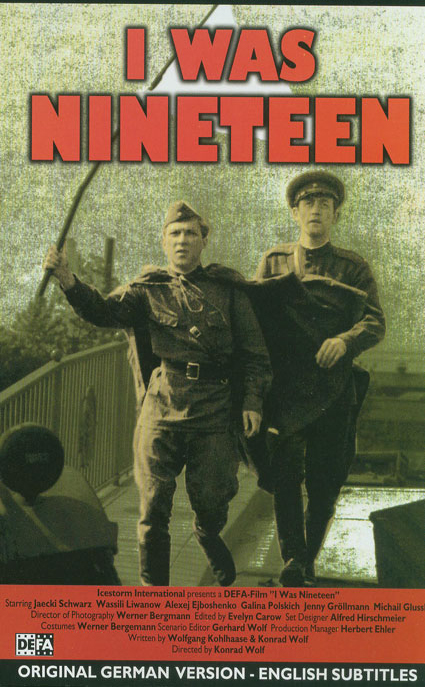
I Was Nineteen – Ich war neunzehn (1968) East German WWII Movie

The East German movie I Was Nineteen – Ich war neunzehn is based on the film director Konrad Wolf’s war diaries. Set in April 1945, it is an episodic movie which tells the story of 19 year-old Gregor Hecker who moves with a Red Army  scouting team towards Berlin.

Hecker is of German origin, he left Germany with his parents at the age of 8 and has lived in Russia ever since. Returning to his home country is peculiar for him. He speaks fluently German and Russian but feels much closer to the Russians.

The movie shows a vast panorama of German society. People who have lost everything and despair, those who believe the war can still be won, some who are afraid of the Russians, others who threaten them. Gregor and his group try to persuade all the German soldiers and officers they meet to surrender; some follow the suggestions, some keep on fighting although the war is almost over.

As I said, the movie is episodic, more than a coherent story line we have a lot of short stories which illustrate the different reactions to the end of the war.

The Russians are also depicted in their variety, peasants and people with higher education, people from all sorts of social and ethnic backgrounds are shown.

I liked the movie, the characters are likable and the approach was interesting however I don’t think it’s a very realistic movie. Sure, it accurately depicts how estranged someone like Gregor would have felt, how different he was from the other Germans but that’s how far realism goes. What I didn’t find realistic is how peacefully they behaved. The Russians in this movie were all good-natured, mostly gentle, protective of women and children. I don’t think that was the case, there are too many horrible stories which tell otherwise.

The movie isn’t a German but an East German movie which may explain why the Russians were depicted in such a positive light.

There is only one instance in which it is shown how much they must have hated the Germans for what they had done to them. When a German woman asks Gregor whether she can sleep in the house he and his fellow soldiers have occupied a female soldier shouts at her in Russian and Gregor translates. She tells her that it serves her right to be afraid and that what the Germans did to the Russians was so horrible and painful that it deserved punishment.

Despite these reservations I’m very glad I watched this. The movie is available with English subtitles I just couldn’t find a corresponding trailer.