For various reasons I am not watching a lot of movies these days but finally I had a bit of time this weekend and what do I pick? Iron Sky. I hardly got through the first half hour.
A brief look at the IMDb user reviews tell me that people “laughed all the way through this movie”, “enjoyed it incredibly”, thought it was “the best sci-fi” movie ever. What the heck?
I found the humour heavy-handed, from the Nazi to the Sarah Palin parody. And I couldn’t shake off the feeling that the producers liked the paraphernalia, symbolism and imagery of the Nazis a bit too much for my taste. Plus Laibach made the music? Hmmmm.
Maybe this is the new Starship Troopers, another one I found insufferable and couldn’t finish. If so, then this is simply not a movie for me. Or maybe it is really crap. I can’t finish it just to find that out.
In line with another event I’m planning on watching only German war movies and mini-series during November and to some extent maybe already during October. I’ve seen a lot of the best but haven’t reviewed them all so that should be a good opportunity to catch up.
These are the movies I’m planning on watching and rewatching.
I’ve seen a few depressing war movies and the one or the other that affected me a lot, still I’d say the prize for most depressing war movie has to go to Johnny Got His Gun (1971 US). What a nightmare. If there ever was a movie which was completely unambiguous in its anti-war message, that’s it.
Dalton Trumbo’s novel Johnny Got His Gun was quite a success when it came out still no film director wanted to make it into a movie until Trumbo himself decided to do so. The result is unsettling.
Joe is a young man of 21 years when the US enter WWI in 1917. Patriotism and a feeling of duty, the wish to serve his country and democracy make him sing up. Once in France he is severely wounded, loses both of his arms and legs and his face as well. They put him in a utility room in the hospital, his head covered with cloth. The doctor who is in charge declares that he is brain-dead. According to him he doesn’t feel or sense anything and isn’t much more than a vegetable really.
The scenes showing Joe in the hospital are black and white and they alternate with color scenes representing either dreams and hallucinations or memories. As the spectators soon realize, Joe isn’t brain-dead. He has a feeling for himself and slowly discovers the horrific state he is in. Together with him we realize at first that his arms are missing, then that his legs are missing too and later that there is only the top of his head and the brain left.
In the flashbacks we see his life before he signs up and in his dreams and hallucinations show how he tries to make sense, tries to find a meaning and some reason to live.
If it wasn’t for one nurse who is so shaken by compassion his live would be even more miserable than it is. She sees more than just a rump in him, moves his bed into the sunlight, touches him and tries to communicate with him.
The end is absolutely horrible. Joe finds a way to communicate with the people around him in using morse code. He tells them to expose him. As a warning, for people to learn. When the doctors see their mistake, that he isn’t brain-dead but knows what is happening to him, they lock him up, and deprive him of what little he had. He ends up as a secret and one can not even imagine what that means. Alone, abandoned and without the possibility to end his own life.
Johnny Got His Gun may be one of the most forceful anti-war movies ever but it’s really a very depressing movie. Not one I’m likely to watch again.
This was part of a watch along and I’m curious to hear other impressions or read other reviews.
One aim of this blog is to raise awareness of all the many conflicts that have been fought on this planet and another one to introduce people to movies from many different countries. My war movie lists are one of the means to achieve this. I’ve done a few lists on movies from different countries like Australia, France and Russia and thought it would be interesting to make such a list for Canada. Canadian soldiers are often depicted in WWI and WWII movies but I couldn’t think of a lot of Canadian movies.
I have been looking really hard but all I came up with are three movies, two of which I have reviewed. I haven’t seen the third, War Witch aka Rebelle, as it’s from 2012 but it looks interesting.
Additionally I found two War Romances for which Canada is one of several co-producing countries. I’ve seen Closing the Ring and as far as War Romances go it’s not bad at all. It’s a Richard Attenborough movie starring Shirley Mac Laine and Christopher Plummer and some other interesting actors. I might review it one of these days.
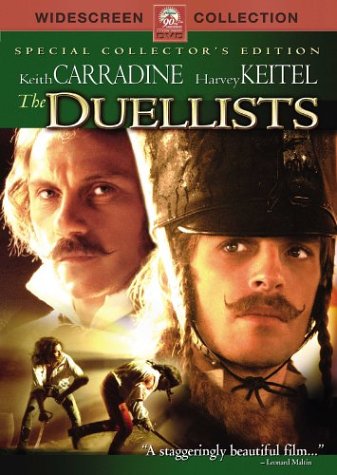
More than anything else Ridley Scott’s directing debut, The Duellists, tells the story of an obsession. I’m glad Guy (Phoenix Cinema) suggested it as I wasn’t aware of the movie and found it oddly captivating and very beautiful too. Plus I find duels fascinating. I can’t really say why.
Based on the short story The Duel by Joseph Conrad The Duellists tells the story of a lifelong enmity. Two officers of Napoleon’s army, d’Hubert (Keith Carradine) and Feraud (Harvey Keitel), pursue each other for years and fight one duel after the other. While the first duel might have made some sense, at least at the time, the following duels are less and less understandable. Although d’Hubert tries to reason with Feraud, the latter becomes more and more obsessed as the years pass by.
The movie has a lot more to offer than a fascinating story and two interesting characters. It’s visually stunning and brilliantly acted. I couldn’t even say which of the two actors I liked better. Carradine as d’Hubert who seems more complex, more humane or Keitel as Feraud who is relentless in his pursuit of d’Hubert. If you like sword fighting you will adore The Duellists anyway as the choreography of the fights, as many reviewers have commented, is excellent.
The movie starts in 1800 and ends around 1815. After almost every duel the men lose sight of each other for a few months or even years as they are often posted in other places. They sometimes meet under quite improbable circumstances, once for example while retreating from Moscow where they fight a group of Cossacks together.
The code of duels was quite complex, I suppose every country had its own set of rules. I felt we learned quite a lot about the rules in France at the time. What made it especially dramatic was the fact that if one of them had been promoted but not the other one it would have become impossible to go on fighting. So every time d’Hubert is promoted he hopes the folly is about to end, only to find out later that Feraud meanwhile has been promoted to the same rank.
The Duellists has been compared to Barry Lyndon but I don’t think they are that similar. Be it as it may, I’ feel more inclined to rewatch The Duellists, I thought it was more captivating. And I really must read the novella soon.


 All About War Movies