La Grande Illusion aka Grand Illusion (1937) The Classic French WWI Movie

What took me so long to watch La grande illusion one of the greatest masterpieces of French cinema?  Jean Renoir’s black and white movie is simply one of the best movies I have ever seen, regardless of any genre. It combines so many elements, to enumerate them all would make a long list. Compared to La grande illusion every other POW movie seems to be just a remake. Every element of later films is already there but the message is a different one. This is a movie that probably wouldn’t have been possible with the same core message after WWII. When Renoir shot his movie, there was still ample room for positive German figures. We don’t see any nasty or cruel guards.  La grande illusion is a work of poetical realism. The two points of view go hand in hand.

The central story is the story of two officers Maréchal (Jean Gabin), a simple mechanic, and de Boeldieu (Pierre Fresnay), an aristocrat, shot down together over Germany. They are brought to a prison camp where, thanks to the food parcels of one of their rich Jewish fellow officers, they live relatively luxuriously while the German guards eat cabbage day in and day out. The people they are sharing a room with have been digging a tunnel for weeks. While waiting for the tunnel to be finished, they spend their days rehearsing for a theater play, dreaming of women and civilian life. When Maréchal announces that Douaumont has fallen, they all sing the Marseillaise together. Maréchal is locked up for this act of instigation and almost goes mad in isolation.

Before they can put the tunnel to use, they are all sent to another camp. After different attempts to escape, Maréchal and Boeldieu are brought to burg Wintersheim. Officer von Rauffenstein (Erich von Stroheim) whom they have met before is in charge of the burg. Von Stroheim as Rauffenstein is one of the most memorable war movie characters. He has fairytale like, fantastic aspects. Von Rauffenstein has been badly wounded, his spine has twice been broken, he has silver plates in his body and wears a corset. He looks like an artificial being. He is an aristocrat through and through and recognizing the same background and upbringing in Boeldieu he takes an intense liking to him. Boeldieu, even though, stiff and formal as Maréchal often says, feels closer to the simple officers and wants to transcend the class differences. Even though he likes von Rauffenstein a lot, he still helps the other prisoners in their attempt to flee. Maréchal and Rosenthal make it and find refuge on the farm of a German widow (Dita Parlo). They cannot stay but Maréchal and Elsa still dream of meeting again after the war.

Renoir chose deliberately to show no violence. The war is spoken of, we never see it. His aim was to show a world that transcends differences. This is socialism of the purest kind, the one, that unfortunately only ever existed as an idea. Renoir wanted to show in how many ways people of different classes and nationalities are alike. The French prisoners make fun of the Germans’ constant repeating “Das ist strengstens verboten (strictly forbidden)”. It’s like a running gag all through the movie. A ritual. The Germans try to coerce the French and the French in excahnge make fun of them. Contrasting the attitudes of France and Germany towards obedience is one that we find in many older movies. It is also symbolised in all the interdictions that we see in the movie and in the barbed wire and fences. It’s a very funny movie at times. Fun that stems from the contrasts of the different classes and their use of language. The late, great Jean Gabin was always an outstanding actor, but here, as Maréchal, the simple mechanic, born in the 20th arrondissement of Paris (pure working class), he surpasses himself.  I really don’t know how they did the subtitles for this movie as they speak rapidly (I did watch the French version). Judging from the trailer, parts of the dialogues have been left out, nuances have been flattened. That is a pity. The use of dialogue and languages throughout the movie is a very realistic one. Germans speak German, French speak French, English speak English. Working class people speak like working class people, and the aristocrats like aristocrats.

As I said before, I don’t think a movie like this would have been possible after WWII. The illusion that everybody is the same at heart was shattered by then.

The illusion in the title apparently refers to the illusion of the class system. But I think there is another interpretation. Towards the end Maréchal says “We have to finish this war and hope that it was the last one” upon which Rosenthal utters something like “That is just an illusion, old man”. In 1937 is was already obvious that peace wouldn’t last forever.

La Grande Illusion is a movie that every cinephile needs to watch and possibly re-watch as it is multilayered and full of symbolism. Truly a work of art.

Joyeux Noël aka Merry Christmas (2005) Christmas in War Movies III

This is not only the best of the three movies on the theme Christmas in War Movies that I have reviewed but it is one of my Top 10 favourite war movies. And definitely the one, with L’armée du crime aka Army of Crime, that is closest to my heart.

Merry Christmas aka Joyeux Noël is based on a true event, the so-called “Little Peace during the Great War”. It’s a multinational co-prodcution, in three languages, English, French and German, filmed by the French writer and film director Christian Carion. One of the most European movies of all time. It portrays cultural differences of the involved parties in a truly amazing way. It is one of the most outstanding anti-war movies and achieves to make a profound pacifist and humanist statement.

Pretty much like Stalingrad, Joyeux Noël focuses on very few people. At the heart of the movie are the soldiers in the German, French and Scottish trenches. The central figures are the three lieutenants of the respective trenches, and one or two of their soldiers.

After endless days of shelling, Christmas 1914 arrives. The soldiers in the three enemy trenches are having their Christmas meals. A simple meal, accompanied by a lot of whisky, in the Scottish trench, hundreds of Christmas trees and a frugal meal in the German trench and nicely laid tables, candles, wine and a sophisticated meal in the French trenches. Towards the end of the meal, the Scots start to sing and play the bagpipes. The German’s are startled at first and finally join in. Amongst their ranks is a soldier who was a famous opera singer (Benno Fürmann) in his civilian life. He leaves the German trench with a Christmas tree and walks singing into no man’s land until his angered lieutenant follows him. Meanwhile, the Scottish lieutetnant has also left the trench and approaches them. For the sake of the evening and their men, they discuss a ceasefire. All this time the French look at this with wonder and utter puzzlement, until their lieutenant joins in as well and they all agree on the ceasefire. The evening is spent with a mass (Gary Lewis is fantastic as the priest) and the fiancée (the very beautiful Diane Kruger) of the opera singe,r who has been there for this evening, sings for them. They also share food, drinks and get to know each other.

The next day they have a hard time going back to the normal routine of shooting at each other. They first agree on letting each other bury their dead and then start playing football until the shelling starts again. The Germans start first and so all the soldiers are allowed to seek refuge in the German trench.

The commanders of the three armies hear of this and all the involved parties are severely punished. If they hadn’t been so numerous they would have been shot.

What I liked the most about this movie is how emotional it is. Carion says in an interview that he wanted to remind us of this little miracle and to really experience it. He states that he is a pacifist and a humanist, in the sense of believing in human values. The choice of the three lieutenants was extremely important in conveying this. If I ever do a post on the most likable commanding officers in war movies, those three are all going to be on it. My personal favourite is the French lieutenant Audebert, played by Guillaume Canet. The choice of such a sensitive and fragile actor was a stroke of genius. The German Daniel Brühl is very good too, and so is the Scottish actor Alex Ferns, but they do not have the versatility of Canet. Lieutenant Audebert is a very determined but just and utterly emotional commander. He throws up at the beginning of the battle but still manges to give strength to his people, to guide them. Apart from Platoon’s Sgt Elias, Audebert is the most touching soldier I have ever seen. Brühl as Horstmayer is the most complex of the three, the only one who speaks all three languages and changes considerably during the movie. Ferns as Gordon is the one that men would want as their mate.

An absolutely outstanding aspect of the movie is the way it renders the differences of the trenches that do mirror the differences of the mentalities of the parties involved. This might seem clichéd for an outsider but if you are familiar with the cultures of those countries and know something about the life in the trenches you will notice how highly accurate it is.

The British trenches had the reputation of being very shoddy and muddy, whereas the Germans transformed theirs into real homes. The French on their side had the best food and coffee. The trench system is very complicated and the narrow steep walls didn’t allow outside orientation, that’s why they had a system of signs that showed them where which enemy was. We see the sign “Rosbif land” in the French and “Froggy trench” in the Scottish trench which is very accurate and funny.

It is after all also a humorous movie, especially in the French and the Scottish parts. The Germans are shown as more sober. One of the nicest touches of the movie is the story of the trench cat. Each trench believes the ginger tom is theirs. At the end of the movie the cat is caught with a bit of cardboard around the neck. He has become a messenger between the trenches and is duly  arrested for high treason.

If someone wanted to get familiar with war movies or never has seen one,  Merry Christmas is the war movie I would recommend he or she should watch. There is everything in it: tears and laughter, despair and hope, misery and joy, combat and trench life, criticism of the high command, class differences and a love story thrown in for good measure. 5/5

I couldn’t find an English trailer and attached a scene instead.

And the original trailer.

All Quiet on the Western Front (1930) A Timeless Anti-War Movie Classic

All Quiet on the Western Front, based on Erich Maria Remarque’s novel of the same name, is THE classic war movie. One of the best, first and certainly one of the most influential there is.

However we need to bear in mind how old this movie is and that it was one of the first talkies. It was actually even filmed in two versions. The silent-movie feel can’t be denied.

It is very much a movie in scenes. The story as such is easily told. Paul Bäumer, a young student, volunteers, together with his friends, as soon as WWI breaks out. They believe it is noble, honorable and courageous to do so. The teachers and politicians all paint a picture of glory and urge them to enlist and fight for their country. As soon a they arrive in the trenches it becomes obvious that there is nothing glorious in being shelled, ripped to shreds and end as pieces dangling from barbed wire. The older soldiers seem hardened but when the younger ones start to be killed, his first friends die, Paul forms a bond with the old-timer Kat (a great character and superb contrast to the naive Paul), whom he didn’t like at first.

As stated before the movie is told in very distinct scenes that can all be seen like mini-movies themselves.

The one that impressed me most would have to be called “The story of the boots”. One of Paul’s friends is dying and another one would very much like his brand-new, expensive boots. When the friend has died the other one gets the boots. What follows is cinematographic genius. We see the boots, only the boots, from one little scene to the next and how they keep on changing their possessor.

Another memorable scene is the one showing Paul on leave. He lies to his mother and sister about the atrocities of war. This makes his stay very difficult and he is happy to go back as he doesn’t fit in anymore. He can’t stand being with people who don’t know shit about what is going on out there.

A funny scene is when the young soldiers meet a bunch of French girls and spend the night with them. It shows quite well that they were all just humans. The same can be said of the most famous scene. Paul is in a trench with a French soldier and kills him. He spends the night with the dead man. When he finds the pictures of the Frenchman’s wife and kid, he is devastated.

All Quiet on the Western Front is on almost every war movie list. Occasionally in the Top 5, often in the Top 10, always in the Top 100. I guess I will include it in my Top 20. 5/5

It is hard to compare this movie with the outstanding novel. It is probably also one of those movies that has been remade the most. There will soon be another remake starring Daniel Radcliffe (2012). I still haven’t seen the TV production that is said to be quite alright.

What I would really wish for is a German production.

See my post on Remakes and on Daniel Radcliffe.

War Requiem (1989) Derek Jarman’s Impressive Interpretation of Benjamin Britten’s Eponymous Requiem

Futility 

Move him into the sun —
Gently its touch awoke him once,
At home, whispering of fields unsown.
Always it woke him, even in France,
Until this morning and this snow.
If anything might rouse him now
The kind old sun will know.

Think how it wakes the seeds —
Woke, once, the clays of a cold star.
Are limbs so dear-achieved, are sides
Full-nerved, — still warm, — too hard to stir?
Was it for this the clay grew tall?
— O what made fatuous sunbeams toil
To break earth’s sleep at all?


I have never seen anything like the War Requiem before. Although I used to like Derek Jarman‘s movies (especially Caravaggio, Sebastiane and The Tempest) I wasn’t aware that this existed before I saw a review on the War Movie Blog. This is certainly not for everybody. If you don’t like classical music, especially requiem’s you will have a hard time. I tell you this right away. Jarman took Britten’s War Requiem, which consists of a proper requiem and sung versions of Wilfred Owen’s poems, and illustrated it. Wilfred Owen is the young poet we also see in the movie Regeneration. He was killed in action one week before the end of in WWI. As you can see I added two of his poems for you.

War Requiem is actually a silent movie so to speak. We see images, acted scenes and hear Britten’s music. In part it’s a reenactment of Wilfred Owen’s story, in part we see actual footage of different wars. Documentary and art are entwined and the result is extremely rich and interesting. The acting is of course somewhat exaggerated as the actors are miming not acting as they don’t talk (silent movie style). The two main actors are Nathaniel Parker (Owen) and Tilda Swinton (The Nurse): Sean Bean (The German Soldier) and Laurence Olivier (The old Soldier) are in minor roles. There is a bit with Tilda Swinton who plays the nurse that is very annoying (scene 10). But that was the only bit I found hard to take. The rest is impressive. Beautiful images. Colors are very important and highly overdrawn as they are in all of Jarman’s movies. In this one it is the color red that is artificially bright. Colors have a special meaning in Jarman’s work. He wrote a book, Chroma: A Book of Colors, dedicated to color interpretations and his last movie is dedicated solely to the color Blue. The tragedy behind all this is that Jarman was going blind towards the end of his life. He suffered from AIDS related illnesses and finally succumbed to them.

War Requiem is remarkable also because it is not only an anti-war movie but also an “anti war movie movie”. If you watch all of it and don’t give up in the middle you might be astonished to see what kind of actual footage you see towards the end. I have never seen anything like it before and felt very uncomfortable. The footage we see – especially from Vietnam and Angola – is horrible and gruesome. What is even more horrible is that you see the difference between wounds in a war movie and these head wounds and other wounds in these documentary bits. It simply doesn’t look the same. You see immediately that these people are really dead. I think to see something like this would be good for every person who regularly watches war movies. The atrocities of war are so much more horrible in reality. It was extremely sobering to say the least.

This is a really special movie. It is an interesting contribution to cinema history as well as to war movies  in general. But it is not for everybody.

Anthem for Doomed Youth 

What passing-bells for these who die as cattle?
Only the monstrous anger of the guns.
Only the stuttering rifles’ rapid rattle
Can patter out their hasty orisons.
No mockeries for them; no prayers nor bells,
Nor any voice of mourning save the choirs, —
The shrill, demented choirs of wailing shells;
And bugles calling for them from sad shires.

What candles may be held to speed them all?
Not in the hands of boys, but in their eyes
Shall shine the holy glimmers of goodbyes.
The pallor of girls’ brows shall be their pall;
Their flowers the tenderness of patient minds,
And each slow dusk a drawing-down of blinds.


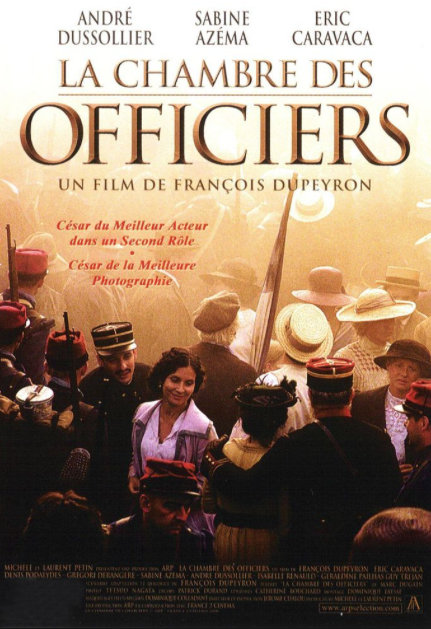
La chambre des officiers aka The Officers’ Ward (2001) France, WWI and the Nightmare of Facial Mutilation

La chambre des officiers

The French movie La chambre des officiers aka The Officers’ Ward may very well be one of the most moving and shocking war movies I have ever seen. I felt sick twice, I cringed endlessly and it made me really sad. It is  a masterpiece. An absolutely brilliant anti-war movie. If you thought Born on the 4th of July was horrible then you haven’t seen this one.

The movie is based on Marc Dugain’s novel La chambre des officiers aka The officers’ ward and tells the story of the young lieutenant Adrien. At the beginning of WWI Adrien is a very handsome young officer. A piece of shrapnel rips half his jaw off. He will spend the rest of the war, a full five years, at the Val-de-Grâce Hospital in Paris. At this hospital they only cure men with facial wounds, burns etc. It is like a freak show only these are human beings.

During the beginning of the movie we never see Adrien. We only see the reaction of those around him. The doctors’, nurses’ and patients’. The profound pity in these faces says more than actually seeing him. Since he cannot talk anymore, we hear his thoughts. The moment when he realises that his face is a gaping hole is so awful…

During the five years at the hospital he fights great pain, despair, horror, suicidal thoughts. Together with the other mutilated officers they try to stay alive and become human beings again.

The music is very intense (Arvo Pärt and Wagner, admittedly the second is a bit strange) and underlines the atmosphere of this saddest of war movies. Funny enough there is also beauty. The beauty in the relationships between the wounded. And the beauty between Adrien and a very gentle and loving nurse. There is also a brothel scene towards the end that is not only lighter in tone but even in a melancholic way funny.

This is a very thought-provoking, must-see, 5/5 star movie.

I only found the French trailer, I’m sorry.