We Dive at Dawn (1943) A Very Decent British Submarine Movie

I think Das Boot made every, but absolutely every submarine/U-Boot movie redundant. What’s there to say after a final statement? What is there to add to perfection? Das Boot is one of the best war movies and one of the best movies in general and THE best U-Boot movie there is. Why watch and review any others? Because there was a time before Das Boot. And submarines are not U-Boots, guess you get my drift.

We Dive at Dawn came out during the war so it is not surprising that it is propagandist.

The movie starts aboard the British submarine HMS Sea Tiger just before the crew swarms out on a seven-day leave that is aborted after just a few hours. They are sent on a secret mission after the German battleship Brandenburg heading for the Baltic sea. When finally encountering the battleship they are heavily attacked by the destroyers who flank the Brandenburg. We have the familiar elements like crash diving, torpedoing and being depth-charged. They seem to lose the fight and only a very shrewd trick helps them to escape. However they have no clue if their mission is accomplished and when diving up again realise that they have run out of fuel. What to do next? One of the crew suggests to land in Denmark and try to refuel there. Of course that is occupied territory and we get to see some fighting on land.

Submarine movies are interesting for many reasons. The hardware used as an arm is also the living space of the crew. There is an interesting difference in US and UK movies regarding the crew. Let me quote from Under Fire (p.181)

Whereas the American war film will often feature an ethnic and regional smorgasbord of characters, the british version involves Cockneys, Scots and Yorkshiremen like Eric Portman’s hydrophone operator, Hobson, whose marital difficulties are making him a surly chap.

John Mills who is in an incredible number of British war movies of the time stars as the captain of the Sea Tiger (e.g.Ice Cold in Alex, The Colditz Story (so far one of my favourite POWs), Above us the Waves, Dunkirk). He is a good actor. No doubt about that.

All in all this is a decent movie. Interesting characters and side stories, gripping combat (not that land bit, that is so so). We Dive at Dawn is a black and white movie which enhances the atmosphere.

I haven’t seen all that many submarine movies. Once I have had a chance to watch and review a few more I will be able to give a decent evaluation. For the time being, should you only watch one sub movie in your lifetime, then stick to Das Boot but if you like the genre, don’t miss We Dive at Dawn.

I couldn’t find a trailer but added an excerpt instead.

Der Stellvertreter aka Amen (2002) The Disillusioning Reaction of the Catholic Church to the Holocaust

In the beginning of Costa Gavras´ Der Stellvertreter aka Amen we see how a group of children with special needs is transported to an extermination camp and gassed. When this is being found out people are shocked and taken aback and, together with the Catholic Church, they fight these practices that are ultimately stopped.

This noble reaction of the Church is not repeated however when they are asked for assistance in stopping the extermination of Jews. Nor do the alerted Allies help. Der Stellvertreter explores the shameful failure of the Catholic church and the rest of the world.

The SS officer Kurt Gerstein (Ulrich Tukur), head of the Institute of Hygiene, is a chemist and the developer of the lethal gas Zyklone-B. He thinks that this deadly gas is used to free the concentration camps from vermin and must find out that it is actually used for exterminating Jews. He witnesses this with his own eyes and his outrage and revulsion are so intense that he decides to alarm the Catholic Church. Only one young priest, whose family is of great influence in the Vatican, Riccardo Fontana (Mathieu Kassovitz), feels the urge to support Gerstein, travels to the Vatican and informs the Pope. To no avail. The Church won’t act.

The Church fears many things. They are afraid that communism might spread and are grateful to the Nazis who stopped it. They are afraid that they might not be spared by the Nazis if they oppose too openly. And, as the movie seems to say, they ultimately don’t care too much about the Jews.

Gerstein and Fontana will go on fighting and trying to inform people, to make at least the Allies act. The Allies however don’t want to act as they don’t want to negotiate with criminals. Every time Gerstein and Fontana inform someone about the extent of the atrocities the numbers have risen. From an initial hundred thousand they are soon in the millions. These numbers are symbolized in the numerous takes of riding trains we see during the movie.

As an ultimate sacrifice and because he thinks it is his Christian duty the young priest joins a transport of Italian Jews to one of the concentrations camps.

Kurt Gerstein is a historical figure. After the war all the important figures of Nazi Germany were incarcerate. Gerstein, facing trial and before killing himself, writes a report on everything he has seen. Years later he is found not guilty and rehabilitated.

As interesting as the theme of this movie is I did not find it completely compelling. Maybe because it is based on a theater play (Rolf Hochhut’s Der Stellvertreter aka The Deputy)? I don’t know. I think you will have to find out for yourself. 4/5 stars but still valuable.

Hitler – The Rise of Evil (2003) Hitler´s Childhood, Youth and Early Years

The only thing necessary

for evil to flourish

is for good men

to do nothing.  (Edmund Burke)

Hitler – The Rise of Evil follows Hitler´s early years. First his childhood with an abusive father, then the pursuit of his dream to become a great artist which lack of talent prevented. His participation in WWI,  his rise through the ranks of the German Worker´s Party, his imprisonment that gave him time to write Mein Kampf. Even though this movie ends around the year 1934 with Hitler becoming Reich´s President, I think it is fair to include it on a war movie blog as it permits to see what happened prior to WWII and how the Jews were persecuted long before the war

The Scottish actor Robert Carlyle gives a stunning performance starring as Hitler. The madness of Hitler is creepy and palpable. However exactly this has been criticized. When you watch this movie you can´t help thinking all the time: how did he get away with it? He was so obviously deranged, mad and psychologically disturbed that no one should have been tempted to follow him. I think that in showing Hitler exactly like this, this movie contributes to shed another light on him. Sure, we know he was sick but still we tend to see him as a deranged dictator. I would say it is high time to look at him as some sort of head of a sect. He should be paralleled with people like Charles Manson and Jim Jones. The same psychological dynamics that are at work in people who follow cult leaders were also present in many Germans at the time.

The movie also manages to show how many people just didn´t react or looked the other way. There is only one journalist (played by Matthew Modine) who points out how dangerous Hitler is. The Rise of Evil has a close look at Hitler´s relationship with women (his niece and Eva Braun) where his full-blown madness is maybe as evident as in his hatred of the Jews. A great part of the movie focuses on the American/German couple Hanfstaengel. Their importance seems not historically accurate and it might very well be that their role had been extended for the sake of US viewers. I thought it interesting to see how Helene Hanfstaengel (Julianna Margulies) who was against Hitler at the beginning, all of a sudden changed her mind and became one of his most fervent supporters. Many women fell for him, as odd as this may seem. The role played by Ernst Röhm (Peter Stormare) is also explored with great detail as is the person of Hindenburg (Peter O’ Toole)

Nobody should compare this film to Der Untergang aka The Downfall as hardly any movie is as good as that but it is thought-provoking, interesting and, as already said, Carlyle is amazingly good.

WWII Film Pictures Quiz 8

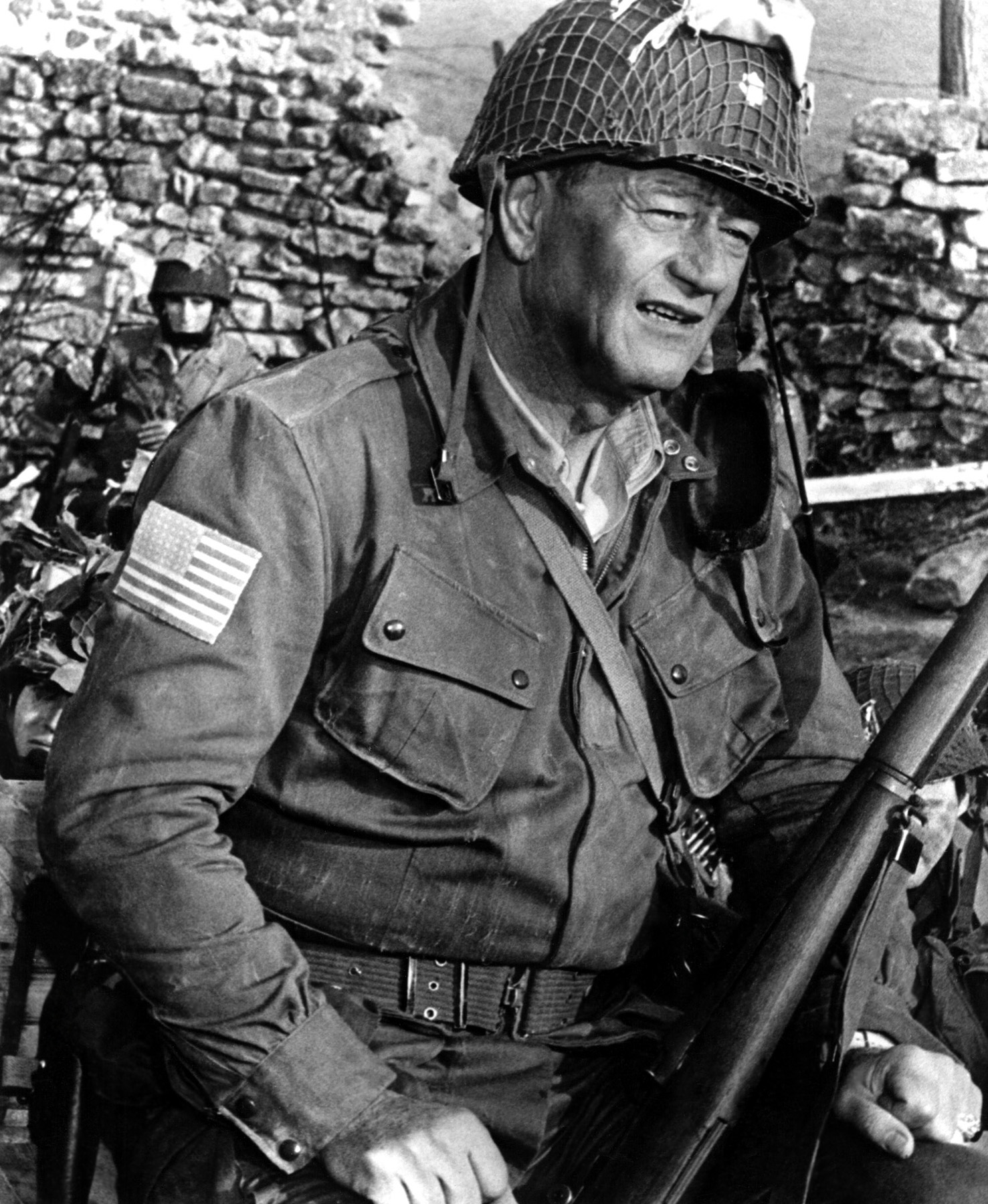
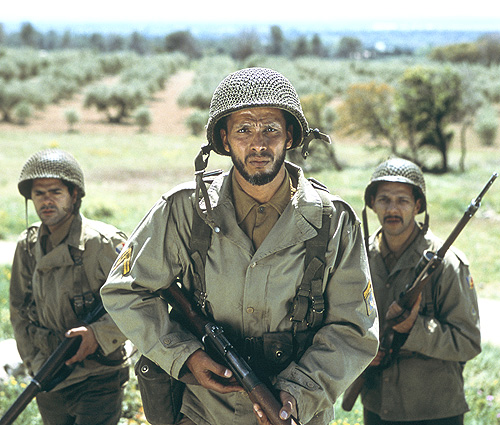
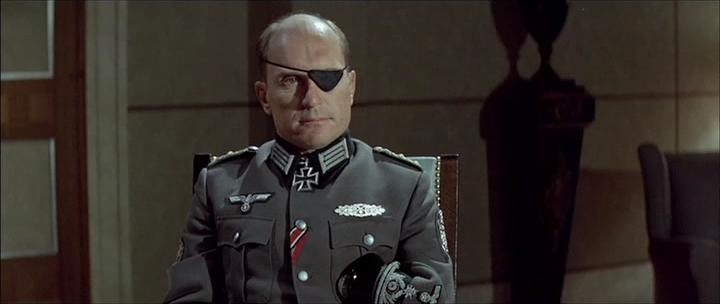
It´s been a while since I posted the last quiz and even longer since I posted the last movie pictures quiz. I am afraid it is not a very difficult one since many of the movies I chose are very well known. That´s why I won´t make a list of all the titles. Just the picture and the solution below. Have fun and don´t cheat. And, yes, the picture above is taken from The Longest Day and is not part of the quiz.

Movie 1

Movie 2

Movie 3

Movie 4

Movie 5

Movie 6

Movie 7

Movie 8

Movie 9

Movie 10

Costa-Gavras’ Music Box (1989) A Court Room Drama About War Criminals

Music Box is not a war movie in the strict sense of the term, especially not since it takes place some 40 years after the war. But it is about what happened to war criminals after the war. The one or the other is still caught today. Many tried to hide in distant countries. Some live in South America but there are certainly also a lot in the US. Since I want to watch Der Stellvertreter aka Amen by Costa-Gavras, I thought it might be interesting to re-watch this one before. I remembered that it moved me quite a bit when I saw it for the first time. I found it totally gripping. As much of the suspense comes from the question whether or not the accused committed the crimes I could concentrate on other elements this time.

Just imagine for one second, someone told you, your mother, or your father was a war criminal. He is said to have left the country shortly after the war and gone to the US where he led an exemplary life as a devoted father, able worker and much liked colleague. Imagine the two of you had a very close relationship. You love the stories your father tells you about his childhood and his youth, the horrors of the war and how he managed to flee to a more welcoming country. Your son adores him, your in-laws respect him. But then, one day, the US government accuses him of being a monster and wants to extradite him to Hungary where he would be judged. That is the story of Music Box. Ann Talbot’s (Jessica Lange) father, Viktor Laszlo, a Hungarian immigrant is accused of having committed war crimes. Ann is a successful lawyer and decides, after some initial reluctance, to defend her father. She doesn’t doubt for one second that he is innocent and soon she is able to prove that there have been wrong accusations before, that the Communist countries often try to get at those who fled from them. She is outraged by the injustice that is done to her father and equally shocked by the crimes, the man who is called Mischka, has committed. Torture, executions and rape. But what is the worst he is accused of is the fact that he showed no mercy, compassion or any other signs of empathy. Mischka enjoyed what he did. Much of it took place on the banks of the Danube in Budapest, near the famous Chain Bridge. One of the last parts of this gripping court-room drama takes place in Budapest. A nice addition to the movie. Budapest is a town I am particularly fond of but when I had seen the movie for the first time, I hadn’t been there yet. I didn’t even remember that part of it was filmed there.

Jessica Lange, Armin Mueller-Stahl and Frederic Forrest, the main actors are fantastic. Armin Mueller-Stahl is one of the very great German actors. I have often problems when actors fake an accent but he does it well.

For one reason or the other, I always compare Music Box to Sophie’s Choice. I find them both equally convincing from a psychlogical point of view. Both have outstanding female actresses in main roles. And they both have this typical 80ies feel.

I was wondering how I would rate this movie. It is interesting and gripping, psychlogically accurate but doesn’t deserve 5/5. It is somewhere between 4 and 4.5 because it is a tad too sentimental.