Katyn (2007) or The Crime and the Lie about a Gruesome Massacre on Polish Officers

This is an outstanding movie. Truly outstanding from every possible point of view. Narrative style, cinematography, actors, story, technical aspects. Absolutely great.

The Polish movie Katyn is about the massacre of some 22000 Polish officers by the Russian army and the subsequent  disposal of their bodies in the Katyn forest in 1940. Once the mass grave is found in 1943 the so-called Katyn list is established.  After having waited anxiously for the return of their fathers, husbands, sons and brothers the families are now informed if or if not their loved ones have been among the victims. However not all the victims are on the list. Many more a still missing and may or may not have been murdered. Many wives still wait for their husbands in 1945.

The movie focuses on two families. One is the family of a Polish General, the other the family of a Polish officer. The story is told in two sequences. The first half tells the story until the massacre, the second tells the story of the lie and ends again with the massacre but this time shown much more explicitly (The way these murders were executed…How can people do this to people?). After the first half we think the story should be over but in reality it only just begins. Seeing it first from the point of view of the victims, we are then guided towards the point of view of the families who wait for them. Their ordeal is a different but very cruel one. Even though everybody knows who killed those officers, officially it is said to have been a massacre committed by the Germans. To say otherwise would be very dangerous. The political climate of the time that made it impossible to even mention a critical view of this incident until 1989 is palpable in all its atrocity.

On my DVD of this movie is an interview with the Polish filmmaker Andrzej Wajda. He tells the interviewer how difficult it was to make this movie. He didn´t know how to tell the story. Should he tell his father´s story, who had been among those officers, or his mother´s who was one of those who did not give up hope until 1945. He decided eventually to tell both stories, juxtapose them, have one mirror the other. This is very skillfully done. Wajda belongs to the so-called Polish Film School and has made many movies, two of his better known earlier ones also deal with WWII:  A Generation aka Pokolenie (1955) and Kanal (1957) about the Uprising in the Warsaw Ghetto.

This film is truly the work of a master, of someone who does not just deliver a story but who weaves it carefully, adding symbolism and criticism alike. And  still it is highly watchable.
10 Reasons Why you should (re) discover Merry Christmas Mr. Lawrence (1983)

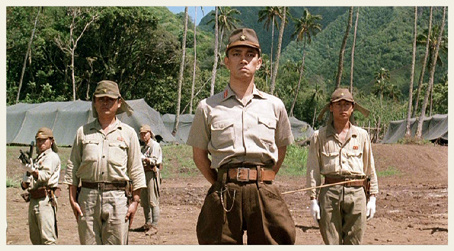
I am probably going to review this movie at length in a few days. It is worth to look into some cultural elements.  Here, as a starter, 10 reasons why you should watch Merry Christmas Mr. Lawrence.

  1. Highly original. Really not your everyday material.
  2. It is not sufficiently known or almost forgotten.
  3. POW movie that is by many people believed to be better than Bridge on the River Kwai.
  4. The main title, Forbidden colors, is very haunting (there are two versions, the instrumental one by Ryuichi Sakamoto and the vocal one by Sakamoto and David Sylvian).
  5. Beautifully filmed.
  6. Japanese culture and esthetics (Samurai, hara-kiri, honor, belief in demons and what not).
  7. Not your average war movie theme. Captain Yonoi is tragically attracted to Maj Celliers.
  8. Nagisha Oshima has directed it (he is famous for his very sensuous and erotic movies, albeit bordering the sadomasochistic. Undertones are clearly present here.)
  9. Great acting. Not only by the two singers Ryuichi Sakamoto and David Bowie but also by Tom Conti and Takeshi Kitano.
  10. Very impressive. Once you have seen it, you will never forget it.

The Pacific versus Band of Brothers: Should we compare?

I finally got to watch the last episode of The Pacific. Even though I had an entry on it a while back I didn´t feel like writing about it before I had seen the whole series. It proved to be  a good decision since I couldn´t really appreciate it at first. I couldn´t help myself, like so many others, and compare it constantly to Band of Brothers. Apart from being a HBO miniseries produced by Spielberg and Tom Hanks, opening with men who were there talking about their experiences, those two series have nothing in common. Sure they both show a lot of very intense and gruesome infantry combat scenes but that is that.

Band of Brothers, as the title eloquently indicates, was about a close-knit group of men, one Army Infantry Company. This is not the case in The Pacific. The Pacific focuses on three main characters, the three marines Sgt. John Basilone, PFC Robert Leckie and Eugene B. Sledge. The last two wrote books about their experiences. The first episodes focus on Leckie, whereas the last ones tell Eugene aka Sledgehammer´s story. This last detail is based on the fact that Eugene went to war much later than the others. He missed Guadalcanal and Cape Gloucester, one main battle and one major experience of the war in the Pacific.

The mini series shows a lot of off the battle ground episodes. Soldiers on leave in Australia, Leckie´s stay at different hospitals and later we see Sledge back home. Many of this off the battleground parts look at the symptoms of post-traumatic stress of which both Leckie (in a very physical way-peeing himself-) and Sledge (more psychological-he´s depressed and has endless nightmares) suffer intensely.

The series has  many crucial moments. Truly gory battle scenes.  Endless rain on Cape Gloucester that grinds down the morale. The realization that all they learn is “killing Japs”.

There is one key scene, the moment when the two friends Sidney and Sledge meet as one leaves and the other arrives in the Pacific. Sledge wants to know from Sidney how it is to be fighting but he doesn´t get an answer. This is actually a recurring theme in war movies (there is a scene like that in The Deer Hunter and in many others): the inability of those who have experienced it to tell those who are about to experience it what it is like to be in combat. Or maybe it is not so much an inability as a refusal. They have been there, they know it´s no use. You cannot talk about something that is so completely different from anything you imagine. No one who hasn´t been there will ever know what it is like and there are no words to really convey this, nothing that equals the experience. All you have got in the face of the innocent and ignorant is silence. The Pacific shows this very well.

I would like  to point out specifically one further scene. It is related to one of my major points of interest namely Death. In The Pacific we see one of the most touching deaths in the history of war movies. I don´t want to spoil anything so I´m not going to tell you who is dying. What makes this scene so different is the way it is shown. We do not see the actual dying, we hear that the person died and then the corpse is being carried  by some soldiers and transported through the lines of men standing there paying tribute and crying. This is a genuinely heartfelt and sad moment. A display of utter futility.

Something else is very different from Band of Brothers. Even though it was WWII, this wasn´t the same war. This is not about a bunch of soldiers freeing occupied countries and captives. We have no rewarding moments like the one in Band of Brothers when they liberate people in a concentration camp. The war in the Pacific seems much more futile at moments. And senseless. And it lasted longer. The war in Europe was already over, Germany had surrendered but Japan had not. Only after Little Boy and Fat Man did this war stop. This must have been some sort of an anticlimax. By the time those soldiers came home, the whole world had already been celebrating the end of the war. The party was over and they had missed it.

Needless to say that this influences the tone of the movie.

For all these reasons I do not think it is doing The Pacific any justice to compare it to its older brother.  It really has its moments this series.

One last thing needs mentioning though and it is something I did not enjoy much. The Japanese are never ever shown in a positive light. You truly get the impression that they were a bunch of murderous automatons. If anyone wants to see a more honest depiction I suggest you watch Tora Tora Tora (1970) or Letters from Iwo Jima (2006). They both try to and  succeed in doing the Japanese justice.

amazon.com

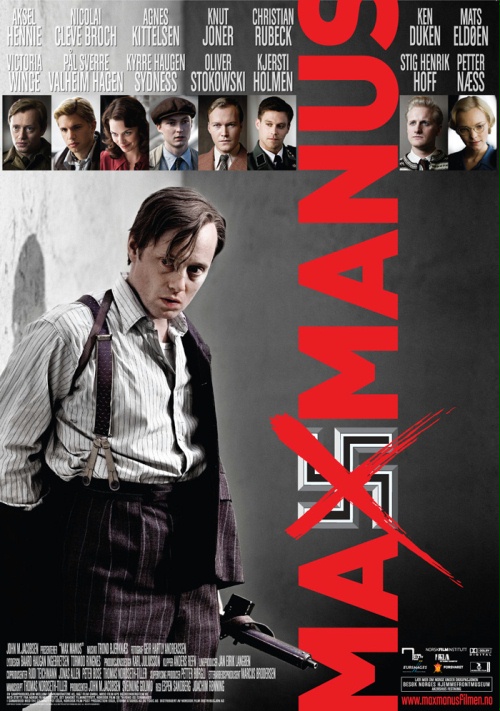
Two Movies on Nordic Resistance: Flame & Citron (2008) and Max Manus (2008)

Two movies on the same theme, Nordic Resistance, yet how different their tone. While Max Manus (aka  Frihedskæmperen Max Manus) is a hero story with tragic and uplifting moments, Flame & Citron (aka Flammen & Citronen) is depressing and full of angst. Both movies are based on true stories and illustrate aspects of lesser known WWII history.

Max Manus tells the story of the Norwegian saboteur Max Manus and his resistance group. After having fought in Finland against the Communists he joins the norwegian resistance. They fight the Nazis very effectively by blowing up supply ships, stealing documents and shooting people. They are hunted down by the Germans and many lose their lives, only Max escapes miraculously every time which fills him with survivor’s guilt but at the same time gives him an aura of invulnerability.

Flame & Citron is the story of two very famous Danish Nazi assassins. Where Max attacks mostly buildings and objects, they shoot Nazis and their allies, mostly execution style up-close.Early on it is evident that this weighs heavily on their conscience. Especially Citron has a hard time to kill.

At one time Flame says: “I almost forgot we are not shooting people but Nazis” as if to take the humanity away from the enemy makes the deed easier. Here lies their problem and this is very obviously the source for the depressing heaviness of this film. We watch two good people doing very bad things although for a just cause. After a while they really doubt that what they do is right. But worst of all they can´t trust anyone and see themselves surrounded by double agents and traitors.

Like the more famous Black Book (aka Zwart Boek 2006) these movies show that there was very effective resistance in the Northern European countries, like the Netherlands, Denmark and Norway. It seems as if it took those countries quite a long time to tell their own story. All three movies are in original language with subtitles. They are all convincing.

Black Book ist the most entertaining, Max Manus is thoughtful and uplifting but I liked Flame & Citron best. I found it the most honest. The pictures are very beautiful and apart from that the acting is great. Mads Mikkelsen (King Arthur) as Citron is just brilliant and so is Thure Lindhardt as Flame.