They Were Not Divided (1950)

THEY WERE NOT DIVIDED

I’m usually quite lucky in my choices of older British movies. Some I’ve watched in the past make my extended best of list. However, They Were Not Divided will not be on that list. It’s not a bad movie but it felt at times as if the director had intended to make a war movie – based on true events (!) – which is suitable for the whole family. The result is a bit too cute for my taste.

At the core of the movie is the friendship between a British, an American and an Irish soldier. Especially the Englishman Philip Hamilton and the American David Morgan are very close. After having undergone intense training which we are shown in a long boot camp sequence, which reminded me a bit of Full Metal Jacket, the three men are promoted and assigned to serve in the tank company of the Welsh Guards.  Two thirds of the film are taken up by the boot camp and further tank training episodes, occasionally interrupted by leaves which they spend at Philip’s home. During one of those leaves, David meets an English girl and falls in love with her.

There is a lot of emphasis on the relationships in the movie. The marriage between Philip and his wife is explored as well as the relationship between David and his future fiancée.

The last part of the film, could finally be called the real war movie part. The three main characters land at Normandy weeks after D-Day as part of the Welsh Guard’s Armoured Division. They quickly see combat and have to cope with fighting a war in another country, far from their wives and girl friends. The film then picks up speed and we see many of the crucial moments of WWII: Operation Market Garden, The Battle of the Bulge. We see how the Welsh Guards join American paratroopers at the Grave bridge before moving to Nijmegen during Operation Market Garden. The film ends with the Ardennes Offensive and the Guards’ unknown operations around the east side of the river Meuse. I suppose it isn’t spoiling the movie too much if I mention that not everyone survives.

I think They Were Not Divided isn’t exactly a must see but I’ve seen far worse. It’s an ok movie, it just doesn’t really have anything that stands out with the exception of some quite humorous scenes during the boot camp sequence. It’s safe to say that even the very squeamish can watch this. If you’re looking for a WWII film to watch with the whole family, this could be your choice.

b00tgdkn_640_360

Twelve O’Clock High (1949)

3A1ijr6gqT6zkfOoG3WUyGVBWd3

I wanted to finish the year in style and a review of the black and white movie Twelve O’Clock High seemed fitting. This is one of the most highly acclaimed war movies and while I wouldn’t exactly give it a five-star rating, like so many critics did, I still think it’s a very important movie and the acting is superb.

Most air combat movies I have seen so far, with very few exceptions, showed the point of view of the British or the Germans. This is one of the rare depicting the American side.

In 1942 the US Air Force conducted daylight bombing raids. They thought that the precision of daylight bombing would speed up things and end the war earlier. However this put the pilots under a lot of additional pressure. 918th Bombardment Group was one that took much higher casualties than others. Their morale was pretty low, their squadron leader on the brink of a breakdown. Their explanation for their losses was “bad luck”.

Brigadier General Frank Savage (Gregory Peck) doesn’t want to hear any of this. He believes that leadership or rather the lack thereof is the main reason. The squadron leader is too attached to his men, identifies with them which clouds his judgement.

When Savage takes over the command he faces open resistance. The men don’t want such a hard and seemingly unfeeling leader and want to be transferred. Savage won’t let go. He works on their morale, assigns new leaders, regroups the men, even has the change their sleeping quarters. While they are hostile in the beginning, the first raids show, what he teaches makes sense as there are fewer casualties. On top of that he flies every mission with them.

Outstanding leadership, unflinching command, show results and soon the morale is high again and the men start to admire and even like Savage. Unfortunately the intensity of his assignment comes at a high cost.

While the beginning of the movie is extremely wordy, the second half is perfect. A lot of original footage heightens the authenticity and Savage’s character is one of the most interesting in any war movie. As said before, I wouldn’t exactly give this 5 stars (I found the beginning too slow) but it’s certainly a very good movie and Gregory Peck’s acting is outstanding.

Don’t let the poster fool you, by the way, Twelve O’Clock High is a black and white movie.

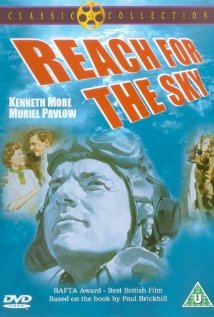
Reach For The Sky (1956) Biopic of a Famous RAF Bomber Pilot

Reach for the Sky

If Reach for the Sky wasn’t a true story it would be one of those movies which you’d just shrug off as way over the top but since it is based on a true story it leaves you astonished.

Reach for The Sky is the story of one man’s love for flying which was so intense that it made him  overcome one of the worst things that can happen to a man and later turned him into a legend.

Douglas Bader is a passionate and reckless young RAF pilot when in 1931, while showing off his talents in front of other pilots, he has a terrible accident which costs him both legs.

Determined and optimistic as he is, he makes the impossible possible and soon learns to walk on tin legs, without help or a crutch. Shortly after leaving the hospital, still on crutches during that time, he meets his future wife and love of his life Thelma.

The only bitter moment comes for him when they don’t accept him as a pilot anymore and he has to do desk duty.

If it wasn’t for WWII he may never have flown again but when war breaks out he undergoes tests and is judged fit for service.

The story which is already quite remarkable until that point, gets truly astonishing now. Not only does he fly one mission after the other, survives the Battle of Britain but he becomes one of the best-loved wing commanders until he is shot down in 1941.

He survives and is captured by the Germans. As a POW he shows the same determination as earlier in his life and escapes several times from different camps until he’s finally sent to Colditz castle where he remains until the end of the war.

Douglas Bader’s story is truly amazing. It would have been so easy to just fall into a deep depression and withdraw from life but Bader was a fighter and nothing, absolutely nothing, could put that man down or stop him. And he was a passionate pilot. As much as he loved his wife, we get the impression that he loved flying even more.

A story like this is quite inspiring but that wouldn’t make this a great movie. What makes it great is the way it is told. While the first half focusses on Bader, his accident and how he learned to walk again, the second half focusses on WWII, the Battle of Britain, the dog fights… It’s quite suspenseful and interesting. It’s not easy for Bader to be accepted at first. The young pilots are a bit taken aback when they find out their wing commander has no legs.

I wasn’t familiar with the main actors Kenneth Moore and the lovely Muriel Pavlow but they were both really good.

It’s certainly a movie I would recommend to anyone interested in WWII, the Battle of Britain and true stories about resilience and overcoming a tragedy.

http://www.youtube.com/watch?v=n9x3r4VWAyE

The Haunted Airman (2006) BBC TV Drama

The Haunted Airman, starring Julian Sands, Robert Pattison and Rachel Stirling is a 70 minutes BBC TV production based on a novel by Dennis Wheatley (The Haunting of Toby Jugg). I thought it was a great choice for this time of the year as it is quite eerie; a mix between psychological drama and horror story.

A young RAF bomber pilot is shot down. His wounds are considerable and he becomes a paraplegic in a wheel chair. His aunt Julia, a widow, decides to bring him to an asylum where the mysterious Dr. Hal Burns treats soldiers with post-traumatic stress disorder. The asylum is located in one of those huge English country houses.

Toby suffers from different symptoms of post-traumatic stress. Nightmares, hallucinations, visions, phobias. He sees burning cities and dead civilians, relives the night in which he is shot down, imagines being attacked by giant spiders.

Julia is his aunt by marriage. She is gentle and beautiful and Toby is clearly very much in love with her and dreams of marrying her. He writes to her frequently but she never replies. One day he finds out that the sinister doctor has kept back all the letters.

From then on tragic and dramatic things happen. The end is a bit weird and mysterious.

I didn’t mind watching this, it had a gothic, haunted house feel, the images were quite beautiful and Pattison and Sands act quite well. Still, I didn’t really know what to make of it all and didn’t get the end. I went to IMDb and saw that the reviews were extremely mixed. Either 8-10 or 1-2 stars.

I’d say it’s a movie you either love or hate. Being a Robert Pattison fan would certainly influence the reaction.

I don’t like rating movies this much, but in this case, I’ll try to. I’d give it 4 stars for the actors and the cinematography and 1.5 stars for the story. Whether it is OK to turn PTSD into entertainment…

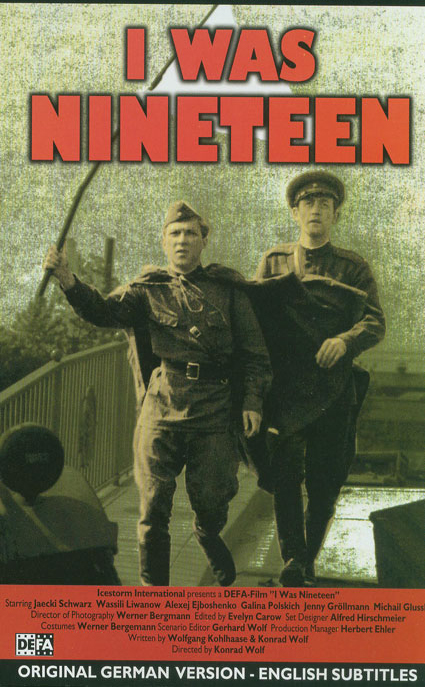
I Was Nineteen – Ich war neunzehn (1968) East German WWII Movie

The East German movie I Was Nineteen – Ich war neunzehn is based on the film director Konrad Wolf’s war diaries. Set in April 1945, it is an episodic movie which tells the story of 19 year-old Gregor Hecker who moves with a Red Army  scouting team towards Berlin.

Hecker is of German origin, he left Germany with his parents at the age of 8 and has lived in Russia ever since. Returning to his home country is peculiar for him. He speaks fluently German and Russian but feels much closer to the Russians.

The movie shows a vast panorama of German society. People who have lost everything and despair, those who believe the war can still be won, some who are afraid of the Russians, others who threaten them. Gregor and his group try to persuade all the German soldiers and officers they meet to surrender; some follow the suggestions, some keep on fighting although the war is almost over.

As I said, the movie is episodic, more than a coherent story line we have a lot of short stories which illustrate the different reactions to the end of the war.

The Russians are also depicted in their variety, peasants and people with higher education, people from all sorts of social and ethnic backgrounds are shown.

I liked the movie, the characters are likable and the approach was interesting however I don’t think it’s a very realistic movie. Sure, it accurately depicts how estranged someone like Gregor would have felt, how different he was from the other Germans but that’s how far realism goes. What I didn’t find realistic is how peacefully they behaved. The Russians in this movie were all good-natured, mostly gentle, protective of women and children. I don’t think that was the case, there are too many horrible stories which tell otherwise.

The movie isn’t a German but an East German movie which may explain why the Russians were depicted in such a positive light.

There is only one instance in which it is shown how much they must have hated the Germans for what they had done to them. When a German woman asks Gregor whether she can sleep in the house he and his fellow soldiers have occupied a female soldier shouts at her in Russian and Gregor translates. She tells her that it serves her right to be afraid and that what the Germans did to the Russians was so horrible and painful that it deserved punishment.

Despite these reservations I’m very glad I watched this. The movie is available with English subtitles I just couldn’t find a corresponding trailer.