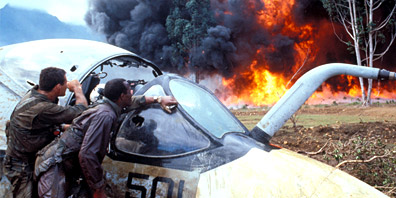
Escape from Huang Shi aka The Children of Huang Shi (2008)

Believe it or not but Escape from Huang Shi is an Australian, Chinese, German co-production telling the true story of a British journalist. What a combination. This gives the movie a very authentic feel, especially due to the fact that we hear as much Chinese as English (and some Japanese).

If anyone has liked the movie Crouching Tiger, Hidden Dragon as much as I did (I think it is one of the best movies ever. One could almost call it a martial-arts fairytale), he or she will be pleased to see Michelle Yeoh and  Yun-Fat Chow in the same movie (however no joint scenes).

But this is not the only pleasant surprise of this quite enjoyable movie.

The story is similar to Welcome to Sarajevo, only this journalist here, played by Jonathan Rhys Meyers (who is really good in this), is doing something even more courageous. He stays in the country to help the orphans.

It is absolutely incredible what some people are capable of doing even when facing adversity at its worst. This is a story of someone who was capable of overcoming his own fear, of reinventing a life for himself and a group of orphan boys and creating a home for them.

George Hogg, a young British journalist, arrives in China in 1937 finding the country being invaded by the Japanese. Air raids, floods of refugees on the streets, he´s afraid and thrilled at the same time hoping for the story of his life. He gets it only not the way he had hoped for. He soon sees himself in great danger and is led by an Australian nurse to Huang Shi. She leaves him there to struggle with famine, the depressions and aggressions of some 60 orphaned boys who have seen the worst and the insecurity of a life on the border of a war.

In wonderful pictures we see him overcome the urge to escape and help those children transform the barren land around them into a fertile garden. He is assisted in this  by a mysterious tradeswoman Madam Wang (Michelle Yeoh) who sells more than just seeds, by Chen (Yun-Fat Chow) the leader of a communist partisan group and of course the Australian nurse (Radha Mitchell) he is secretly in love with.

When the Japanese and the air raids start to approach Huang Shi, Hogg must make a decision. He wants to flee and take the children on a journey over 500 perilous miles across the snow-bound Liu Pan Shan mountains to safety on the edge of the Mongolian desert. This seems almost impossible to achieve.

The movie reminded me a little bit of  The Painted Veil (no, it is not a war movie). Same beautifully filmed landscapes. And those sumptuous  and, for us exotic, Chinese interiors of the time. The story is already quite captivating but the beauty of those landscapes alone would have been enough to enchant us.
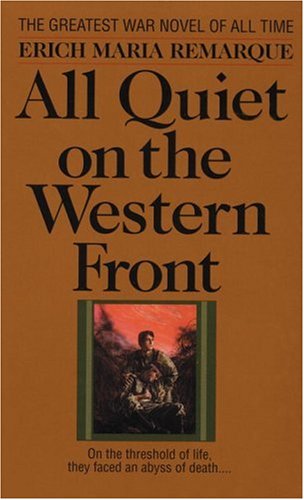
To Remake or Not to Remake: e.g. All Quiet on the Western Front, Psycho, Dangerous Liaisons

We have been flooded by a recent wave of remakes (Fame, Predators, …) some of which seem redundant to say the least. I do not think it does make any sense to remake a movie that is fairly recent and to re-do it just the way it was, only exchanging the actors to attract a younger crowd of spectators.

However, some movies  like theater plays (e.g. Hamlet, hence the title of this post) make interesting material for reinterpretation.

I remember that when I heard Hitchcock´s Psycho had been remade by Gus Van Sant I thought it was pointless but when I saw it  I found that it had its charm. Adding color and playing with this gave it a totally new feel. If you want to get a bit of an impression watch this YouTube movie someone did to compare both versions.

All Quiet on the Western Front is one of those movies that can do with a remake. I know it is a classic and one of the most important war movies of all times and many a reader will think it hateful to encourage such a thing. Still I believe it would benefit from it. (I know that it has already been done for TV).  All Quiet on the Western Front is really old. We are talking 1930. The acting has still the feel of  the silent movie era that only just ended in 1927. The acting is over dramatic. A lot of  the facial expressions are exaggerated (not as bad as in the real silent movies more like on the stage).  The whole pictorial language of the acting, so to speak, is hard for us to understand. To enjoy a movie like this nowadays you have to know a lot about film history and be interested in it.

What works very well in the original All Quiet on the Western Front is the depiction of the atrocities of war. Whenever the focus is not on the actors it is fabulous. Hands that are gripping barbed wire but are no longer attached to a body… Those very nuanced shots in black and white accentuate the horror and give a more realistic impression. Black blood looks somehow more like the real blood than overly red blood does.

All this will be a challenge for the film director of the upcoming 2012 version.

Furthermore let´s not forget that the movie is also already a reinterpretation since it is based on the novel by Erich Maria Remarque.  And like with plays where no one takes offense when another director takes it up again, one could claim that this is not really a remake of the movie but a reinterpretation of the book. (I can think of another literary phenomenon that has been turned into a movie at least three times and all of the versions I have seen are extremely interesting and well done. I´m thinking of Les liaisons dangereuses aka Dangerous liaisons the novel by Choderlos de Laclos. First there was the French movie by Vadim (1959), then the Stephen Frear´s remake (1988) with Michelle Pfeiffer, Glenn Close and John Malkovich and last but not least Cruel Intentions (1999) with Ryan Phillippe, Reese Witherspoon and Sarah Michelle Gellar.)

I have uttered my reservations as to the cast of the new All Quiet on the Western Front (see my post on My Boy Jack and Daniel Radcliffe) but apart from that I´m curious to see if they will do the book (and not so much the film) justice.

Remarques´s book is one of the best anti-war books of all times. It is so good that when I had finished  it and read that it had been translated into 50 languages and sold over 20 million times I could not believe that anyone anywhere in this world could have ever wanted to start a war again.

Unfortunately literature is not as powerful as that.

Under Fire: A Century of War Movies, edited by Jay Slater (2009)

Under Fire is simply a must-have for people seriously interested in war movies or even movies in general.

It contains a collection of essays on all sorts of topics regarding war movies, from WWI to the wars in Afghanistan and Iraq. Many different people have contributed to this very dense work. Well-known film critics and academics alike.

This is really something to sink your teeth into. Quite demanding reading but extremely insightful.

For example did you know how important YouTube´s influence was on contemporary Iraq movies (yes, I even started to understand Redacted)? Or how Vietnam changed the war movies? Do you know a lot about British propaganda movies of WWII? Did you consider to interpret Starship Troopers as WWII and Nazi satire?

These are only a few topics of many that are analysed in these very thoroughly researched essays.

Sure, this is no movie guide as such. It is not recommending or rating anything. Under Fire provides criticism and analysis for those who like to interpret not only the apparent but also the subtext.

This book is really worth having and I am quite excited about this find that manages so well to show the variety, the depth and the virtuosity of war movies.

Here you find the link to the publishing house. It contains an interview with the editor and interesting additional chapters.

Barnes and Noble

amazon.com

amazon co.uk

Katyn (2007) or The Crime and the Lie about a Gruesome Massacre on Polish Officers

This is an outstanding movie. Truly outstanding from every possible point of view. Narrative style, cinematography, actors, story, technical aspects. Absolutely great.

The Polish movie Katyn is about the massacre of some 22000 Polish officers by the Russian army and the subsequent  disposal of their bodies in the Katyn forest in 1940. Once the mass grave is found in 1943 the so-called Katyn list is established.  After having waited anxiously for the return of their fathers, husbands, sons and brothers the families are now informed if or if not their loved ones have been among the victims. However not all the victims are on the list. Many more a still missing and may or may not have been murdered. Many wives still wait for their husbands in 1945.

The movie focuses on two families. One is the family of a Polish General, the other the family of a Polish officer. The story is told in two sequences. The first half tells the story until the massacre, the second tells the story of the lie and ends again with the massacre but this time shown much more explicitly (The way these murders were executed…How can people do this to people?). After the first half we think the story should be over but in reality it only just begins. Seeing it first from the point of view of the victims, we are then guided towards the point of view of the families who wait for them. Their ordeal is a different but very cruel one. Even though everybody knows who killed those officers, officially it is said to have been a massacre committed by the Germans. To say otherwise would be very dangerous. The political climate of the time that made it impossible to even mention a critical view of this incident until 1989 is palpable in all its atrocity.

On my DVD of this movie is an interview with the Polish filmmaker Andrzej Wajda. He tells the interviewer how difficult it was to make this movie. He didn´t know how to tell the story. Should he tell his father´s story, who had been among those officers, or his mother´s who was one of those who did not give up hope until 1945. He decided eventually to tell both stories, juxtapose them, have one mirror the other. This is very skillfully done. Wajda belongs to the so-called Polish Film School and has made many movies, two of his better known earlier ones also deal with WWII:  A Generation aka Pokolenie (1955) and Kanal (1957) about the Uprising in the Warsaw Ghetto.

This film is truly the work of a master, of someone who does not just deliver a story but who weaves it carefully, adding symbolism and criticism alike. And  still it is highly watchable.