NaPolA Elite für den Führer aka Before the Fall (2004) Looking into the Mechanics of Black Pedagogy

To call this movie brilliant is an understatement. The German movie NaPola is quite an achievement. It perfectly illustrates the German concept of Schwarze Pädagogik meaning Poisonous or Black Pedagogy. Psychologists believe today that this harmful pedagogy was one of the root causes for the success of Hitler and the wide acceptance of Nazism.

NaPola is the story of two boys,  their friendship and “the pity of it all”. Friedrich (Max Riemelt) personifies the Nazi ideal to a high degree. Strong, able, intelligent. A talented young boxer. It doesn´t take long and he is recruited for one of Hitler´s NaPolA´s (National Political Academy) where the elite of German youth is trained, educated and above all fanaticized. NaPolA´s are in part boot camp, in part higher education. Once in school, he meets Albrecht (Tom Schilling), the son of a Gauleiter. Albrecht is the very opposite of Friedrich. He is  frail, sensitive and intellectual. His father, a fanatic,  obnoxious idiot hates his son´s guts. Albrecht personifies everything  he despises. Too small, too weak, too spiritual. Because Albrecht´s father is a Gauleiter, life at the NaPola is not so difficult for him  as he is protected. For Friedrich it is not difficult as he is very sporting and strong but many of the others show sings of being traumatized. Discipline, total obedience and endurance are the key words of this education. As unlikely as it seems, the two boys like each other a lot and become very close friends until the tragic end. The story of the two boys is exemplary for many stories of children and young people who were sent to NaPola´s. Towards the end of the war, when it was quite obvious that Germany was going to lose, Hitler sent all the boys from the Napola´s to the front where 50% of them died.

Everybody who knows me or follows this blog knows I am a sucker for great score. None other than Angelo Badalamenti (see all the scores and listen to his work on his fantastic Homepage) who did the scores for two of my top favourite movies Mulholland Drive and Lost Highway (Yes, they are not war movies.) did the score for NaPolA. It´s perfection. Badalamenti is no Hans Zimmer, he is far more subtle.

This is a 5/5 star movie and  a must-see for many reasons.

I would like to point out that whoever is interested in some psychological analysis of the Third Reich may find ample material in Erich Fromm´s The Anatomy of Human Destructiveness and Alice Miller´s For Your Own Good: Hidden Cruelty in Child-Rearing and the Roots of Violence.

Further war movies with children or young people can be found on my list Children in War Movies.
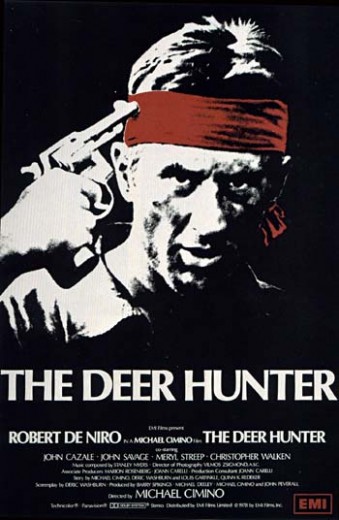
Remembering The Deer Hunter (1978)

Isn´t it weird sometimes what we remember about certain movies? I don´t know when it was, but I think it must have been a very long time ago, that I watched The Deer Hunter for the first time. Looking back the only thing I did remember was the Russian roulette scene and the cage that was submersed in water. I didn’t remember any combat scenes and nothing that went on before they volunteered or after they returned from the  war. What actually happened is that  my memory turned The Deer Hunter into a pure POW movie.

I finally watched it again and was surprised. I saw a totally new movie. Powerful is the best word to describe it, even though this does it little justice. Sure, what I remembered was still there but it shrank considerably and took up less than a tenth of the whole movie. Strange I think,  because since I have seen it again I must say, yes, the roulette scene, the whole POW part is maybe the most impressive but it is not the most important. And it is totally fictious. It is as if Michael Cimino had chosen to show the war in this way because he thought facts would not be drastic enough. Looking at all the other Vietnam war movies that have been done since I must say that especially because of these scenes The Deer Hunter is not the best Vietnam war movie there is but it is one of the more original ones. And it is an extraordinarily good movie about a certain type of people and how they were affected by the war.

What I will remember from now on is young men who live in a grim industrial town. They are second generation  Russian immigrants who are enthusiastic and idealistic and want to fight for their country not knowing what they get themselves into. A bunch of friends for whom life only just begun and whose dreams will be shattered for ever. Who return having left the easy-going, careless “Deer Hunter”-personality behind. They are completely changed and broken and we ask ourselves at the end : is there still enough left of them to begin a new life?

It is not my favourite Vietnam movie but it  ranks high up among the 10 best as I stated before (see my list 10 Vietnam War Movies You Must See Before You Die ).

What about you? Which is the part you like best about The Deer Hunter. Would it have been possible to leave the roulette part out altogether? How high would you rank it within the 10 best Vietnam war movies and how high within the best including every war/subgenre?

The Bridge on the River Kwai (1957) Almost Everybody´s War Movie Darling

Yes, I know, it’s hard to believe but until a few days ago I had never watched The Bridge on the River Kwai. I couldn’t give you any specific reason. Just never happened. I have never been to New York either. Just because something is great, famous or whatever not doesn’t mean everybody has experienced it. While I can go on blogging about war movies without having visited New York, it wasn’t any longer acceptable that I had not watched one of the all-time favourite war movies of so many. One of the six that made it on the list about which I wrote the other day.

So I did it. I watched it and… As odd as this is, it wasn’t what I had expected. I am not talking about the story. I was quite familiar with it as is almost everybody. No, it was the cinematography that stunned me. This is a lush and astonishingly beautiful movie with intense and memorable pictures. As I read after having watched it, this striving for esthetics has been criticized (especially the cute girls and half-naked men in shallow pools… William Holden had to shave his chest hair off and we can see him in every single of his half-naked scenes with glistening torso. Can’t say that impressed me much but it is an interesting detail).

Beautiful pictures, together with great acting, a gripping story, an anti-war statement, the juxtaposition of  British and American characters and an astonishing ending make a great combination. There is something for everybody in it, I guess. No wonder it got 7 Academy Awards including best picture, best director, best actor (Alec Guinness), best writing, best music, best film editing, best cinematography.

The story can be told in a few sentences. A Japanese prison camp somewhere between Rangoon and Bangkok. Colonel Saito, one of those sadistic officer types, forces the prisoners, including their officers to help building a bridge over the River Kwai. Col. Nicholson, the highest ranking British officer in the camp, opposes and offends him. As a consequence he is sent to a very harsh solitary confinement. He is in a certain way as stubborn and fanatic as Saito himself and won’t give in. Somehow though they realise that they need each other and come to an agreement. Nicholson will supervise the construction of the bridge that will be built by British prisoners only. The bridge is meant to bear testimony for future generations to the endurance and skills of British soldiers.

The American Shears (William Holden) is also in this camp. He can’t understand any of this. For him it is important to survive. Honor and courage are secondary. The only thing he wants is to escape. One night he manages it finally and makes it back to high command. There he is told that he will have to go back, accompanying a little troop, as he knows the terrain. It has been decided that the bridge will be blown up. From this moment on two stories run in parallel. The one in the camp and the other one following the little troop through the jungle (the movie has actually been filmed in Sri Lanka, should anyone wonder).

I won’t spoil the ending for those who haven’t seen it. Let me just say it is not a happy one.

I think one of the most important elements in this movie is certainly the juxtaposition of the two extremes as they are personified by the British officer Nicholson and the American Shears. Nicholson’s way is slightly outdated and not very life-affirming. Alec Guinness is memorable in this role. Apparently he turned it down at first because he thought it was too anti-British (I can’t blame him).

The Bridge on the River Kwai is based on the novel by Pierre Bulle. The ending is different from the one in the book though. Both are based on true events. The Japanese had indeed British prisoners build a railway line from Rangoon to Bangkok. Countless people died. Many years after the war the Japanese government apologized for these events.

Robin Hood (2010) or This is the Robin Hood we were waiting for

I don’t care if Robin Hood is really a war movie. There is a lot of warfare and talk of war but the purists would probably deny it the access to the war movie realm. I can’t. I am biased. I am partial to Russell Crowe – my favourite actor – I am partial to Ridley Scott – watch all of his movies, they are worth it – I am partial to Cate Blanchett – one of my favourite actresses. In short Robin Hood  is well done, has a great cast and is very entertaining. It doesn’t make the world a better place or will revolutionize cinema history but  it is well woth watching.

I waited for this to come out on BluRay before I watched it and was looking forward to it like a child (Is it available yet? Is it available yet?). I was not disappointed. I truly enjoyed every minute of it.

What we get to see is the pre-history of Robin Hood, the years before he becomes an outcast (will there be a sequel?). At the beginning he is in the middle of a big battle in which  King Lionheart is  fighting against the French. Robin Longstride  is not a noble man and since he is too outspoken he endangers himself and those who follow him. He is sentenced and if King Richard hadn´t died, he would have been bad off. But Richard Lionheart is killed and Robin takes advantage of the chaos that follows the king’s death and escapes with his buddies to the sea.

Sir Robert Loxley who is to bring the crown back to England and hand it over to the new king is murdered on his way home. At that very moment Robin and his men come along and the dying man asks him to return his sword to his father Sir Walter Loxley (Max von Sydow). Robin decides to pretend to be Sir Robert Loxley and first brings the crown to the new king and then travels on to the estate of the Loxley´s where he meets Marion, Roberts widow. Of course there is a love story but it is not corny. The country is in bad shape. People suffer. They are famished and impoverished and exploited by their king. The noblemen from the North want to overthrow the new king but there is a threat coming from the South. One of the king´s people is a traitor and conspires with France. It will take combined efforts to save Britain from invasion.

I won’t tell you if this is achieved and how Robin Hood got his name, nor will I tell you why he became an outcast. You got to find out for yourself.

Some historical facts about Robin Hood can be found on the  BBC British history page.