Ridiculous War Movie Characters

Maybe I am going to hurt a few feelings here, I am sorry, but I can’t help it. I discussed war movie characters I liked, some that I found obnoxious and now it’s the turn of those I think ridiculous. There are not that many  (I certainly forgot quite a few). The question is probably also, what do I consider to be ridiculous.  Let me explain my choices.

4. David Schwimmer as Herbert M. Sobel in Band of Brothers. This is really a ridiculous character. He is insufferable and makes himself look ridiculous by misjudging his own capabilities.

3. Blackburn in Black Hawk Down. I do have my problems with Orlando Bloom outside of Lord of the Rings. Occasionally I do believe he shouldn’t have done anything else than Lord of the Rings. When I spotted him in Black Hawk Down I couldn’t help sniggering. On top of looking silly the poor guy has one of the most ridiculous accidents in war movie history. He falls out of the chopper before the action even begins.

2. Nicolas Cage as Sgt. Joe Enders in Windtalkers. I have spoken at length about Windtalkers in an earlier post. A lot of my criticism is linked to Nicolas Cage being just so outrageously ridiculous in this movie. Bad, bad acting. If you suffer from post-traumatic stress, please, don’t look as if you were  having indigestion. It is not becoming.

1. Mel Gibson in Braveheart. This simply beats it. Is anyone allowed to look this  ridiculous? He was just the wrong man for this role. No amount of kilt-wearing, long hair or war paint can make this guy look like some pre 20th century warrior. This cast was a total no-go. I can not even remember the movie anymore, I was so entranced by his appearance. Mel Gibson on his worst hair day. My absolute no 1. ridiculous war movie character. (Don’t get me wrong, I think he did a lot of very good movies, but this one was not for him). Actually, they should have let him ride a bike in it.

Any other suggestions?

War Requiem (1989) Derek Jarman’s Impressive Interpretation of Benjamin Britten’s Eponymous Requiem

Futility 

Move him into the sun —
Gently its touch awoke him once,
At home, whispering of fields unsown.
Always it woke him, even in France,
Until this morning and this snow.
If anything might rouse him now
The kind old sun will know.

Think how it wakes the seeds —
Woke, once, the clays of a cold star.
Are limbs so dear-achieved, are sides
Full-nerved, — still warm, — too hard to stir?
Was it for this the clay grew tall?
— O what made fatuous sunbeams toil
To break earth’s sleep at all?


I have never seen anything like the War Requiem before. Although I used to like Derek Jarman‘s movies (especially Caravaggio, Sebastiane and The Tempest) I wasn’t aware that this existed before I saw a review on the War Movie Blog. This is certainly not for everybody. If you don’t like classical music, especially requiem’s you will have a hard time. I tell you this right away. Jarman took Britten’s War Requiem, which consists of a proper requiem and sung versions of Wilfred Owen’s poems, and illustrated it. Wilfred Owen is the young poet we also see in the movie Regeneration. He was killed in action one week before the end of in WWI. As you can see I added two of his poems for you.

War Requiem is actually a silent movie so to speak. We see images, acted scenes and hear Britten’s music. In part it’s a reenactment of Wilfred Owen’s story, in part we see actual footage of different wars. Documentary and art are entwined and the result is extremely rich and interesting. The acting is of course somewhat exaggerated as the actors are miming not acting as they don’t talk (silent movie style). The two main actors are Nathaniel Parker (Owen) and Tilda Swinton (The Nurse): Sean Bean (The German Soldier) and Laurence Olivier (The old Soldier) are in minor roles. There is a bit with Tilda Swinton who plays the nurse that is very annoying (scene 10). But that was the only bit I found hard to take. The rest is impressive. Beautiful images. Colors are very important and highly overdrawn as they are in all of Jarman’s movies. In this one it is the color red that is artificially bright. Colors have a special meaning in Jarman’s work. He wrote a book, Chroma: A Book of Colors, dedicated to color interpretations and his last movie is dedicated solely to the color Blue. The tragedy behind all this is that Jarman was going blind towards the end of his life. He suffered from AIDS related illnesses and finally succumbed to them.

War Requiem is remarkable also because it is not only an anti-war movie but also an “anti war movie movie”. If you watch all of it and don’t give up in the middle you might be astonished to see what kind of actual footage you see towards the end. I have never seen anything like it before and felt very uncomfortable. The footage we see – especially from Vietnam and Angola – is horrible and gruesome. What is even more horrible is that you see the difference between wounds in a war movie and these head wounds and other wounds in these documentary bits. It simply doesn’t look the same. You see immediately that these people are really dead. I think to see something like this would be good for every person who regularly watches war movies. The atrocities of war are so much more horrible in reality. It was extremely sobering to say the least.

This is a really special movie. It is an interesting contribution to cinema history as well as to war movies  in general. But it is not for everybody.

Anthem for Doomed Youth 

What passing-bells for these who die as cattle?
Only the monstrous anger of the guns.
Only the stuttering rifles’ rapid rattle
Can patter out their hasty orisons.
No mockeries for them; no prayers nor bells,
Nor any voice of mourning save the choirs, —
The shrill, demented choirs of wailing shells;
And bugles calling for them from sad shires.

What candles may be held to speed them all?
Not in the hands of boys, but in their eyes
Shall shine the holy glimmers of goodbyes.
The pallor of girls’ brows shall be their pall;
Their flowers the tenderness of patient minds,
And each slow dusk a drawing-down of blinds.


Gardens of Stone (1987) Coppola’s Vietnam Oddity

What the hell was that? Sorry but I did not get this movie. I was so thrilled when I heard from one of my readers about this a while back and thought that would be just the movie for me. I was always fascinated by military cemeteries. Those rows and rows of crosses. Each cross a life. Each cross a story. To dedicate a movie to those who bury the dead seemed so worthwhile. But somehow Coppola‘s Gardens of Stone doesn’t keep the promise it makes. Instead of an in-depth exploration of what it means to be the one to bury those who come back in caskets we get a little bit of everything which sums up to nothing. The acting is quite good, James Caan, Anjelica Huston and James Earl Jones do a good job but the story is too predictable. The movie starts with a funeral and then rewinds so we know already what is going to happen.

Sgt Hazard (James Caan) and Sgt Goody Nelson (James Earl Jones), two  Korea veterans and close friends, are Honour Guards at Arlington military cemetery. Hazard wants nothing more than going to Vietnam and teach the young soldiers how to survive over there. When a friend asks them to look after his son Willow who joins the unit, it seems to be Hazard’s mission to keep him from harm. As the funeral of the beginning  shows us, all his endeavors are futile.

It is exactly this predictability that finishes off this movie. And then there is the relationship of Hazard with the anti-war Washington Post correspondent Samantha. Their discussions pro or contra war are so boring. And totally without any consequences as she keeps on dating him… Of course there is also the young man who want to fight for his country and who is exemplary for so many who died doing just that.

The movie intersperses actual TV footage in order to give a bit of  “real war movie” flavor.

Apparently – I am speaking as a total layman – this movie is highly appreciated by people in the military. It is said to be very accurate and true to military life and rites.

Before I give you my final statement here is what  Jamie Russell writes:

Beautifully shot, wonderfully acted (Caan and Jones’ performances offer a truly outstanding sense of military camaraderie), Gardens of Stone remains one of the most problematic films to have come out of the war – part pro-military, part peacenik, 100% pro-American. (Vietnam War Movies, p. 46)

In my own words: It’s deadly boring hotchpotch.

Here’s the trailer

And a Nightingale Sang (1989) A Very Realistic British WWII TV Romance/Drama

War and Romance make often a succesful combination. WWII and Romance even more so. I think I have seen a fair share of them and although it is not my favorite genre I like it when it is well done. I don’t think I would have heard of And A Nightingale Sang (based on the book by C.P.Taylor) if it hadn’t been recommended by Gray Freitas. I finally felt like watching it and was really not disappointed. It is actually a very realistic depiction of life in the British town Newcastle from beginning of WWII to its end rather than a romance.

And a Nightingale Sang has all the charm of British TV. It is bittersweet, lighthearted and hilariously funny at the same time. At the center is the slightly dysfunctional and very eccentric Stotts family. The mother is a fervent Catholic and constantly going to church to confess. To her dismay she realises that she has a crush on the vicar. The father is tempted by communism and drives everybody crazy by playing the piano endlessly. The grandfather mourns his dead whippet and later carries his cat, Winston, everywhere, even into the air-raid shelter. The daughters both fall in love for the first time. Joyce gets married and regrets it immediately, while disabled Helen falls in love with a married man. The depiction of  wartime life in an English town is excellent. The bombings, the rushing to the shelters, the scarcity of provisions, but also the fun and the attempt to make the most of it. The people at the center of this story are all likable eccentrics.

The end is certainly the best bit in the movie. I almost wished I had been there. That must have been something, to know the war was over and Germany had been defeated. The cheer and joy are conveyed nicely. I cannot remember having seen any other movie showing it like this.

Realism and entertainment make a great combination. Plus really great acting (Joan Plowright as the mother, Phyllis Logan as Helen and Stephen Tompkinson as Eric). And what about the romance? Touching and realistic as well.

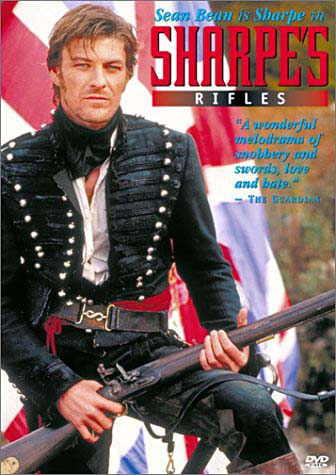
Sharpe’s Rifles (1993) First of a Series of 14 British TV Movies on the Napoleonic Wars

If America only knew how good this was, it would be the highest rated Made-For-TV movie series of all time (hard to believe there are more people out there that would rather watch “The Columbo Mysteries” than Bernard Cornwell’s Sharpe Chronicles- that just goes to show the power of major network name-brand advertising. (Comment from a US IMBD reviewer)

The British TV movie Sharpe´s Rifles is the first of 14 installments focussing on the fictional character Lt.Sharpe. Bernard Cornwell’s novels are the source for this series. There are certain parallels to the Hornblower series (see Hornblower post) with the difference that Sharpe shows the Napoleonic wars on land. Unlike the Hornblower sequences these are full-length movies, each 110 minutes long.

I started to watch it on the last weekend and am really quite taken by it. This enthusiasm is certainly also due to Sean Bean´s starring as Sharpe. He is an excellent choice for this rough but likable maverick and daredevil.

In the first movie we get to know Sharpe and the motley crew of Chosen Men (snipers riflemen) that is very unwillingly under his command. Sharpe who is a sergeant is promoted to lieutenant because he saves General Wellesley´s life. Promoting someone from the ranks who is, like Sharpe, not a gentleman, proves to be somewhat problematic. The other officers don´t accept him because he is not one of them, the soldiers do not accept him because he is one of them. He really has a hard time proving himself and on top of that they are at war.

Sharpe´s Rifles takes place in 1809 in Portugal. Spain and Britain are supposedly allies against France but it seems as if Spain is not 100% decided on which side they want to fight.

Sharpe and his men, together with a company of officers and soldiers, are sent on a secret mission to find a banker that has disappeared and are attacked by a group of French soldiers. Apart from Sharpe and his men everybody gets killed.

In this movie Sharpe also meets Teresa or “El comandante Teresa” for the first time. Having survived rape and the butchering of her family by the French she holds  a bit of a grudge against the French and men in general. Even so, love at first sight strikes them both. The whole love story part did actually remind me a lot of the one in The Last of the Mohicans. Teresa is a strong woman, the leader of her men and a very capable fighter herself.

After they have met, the main story line follows Sharpe, his men and Teresa on their way to a little Spanish town where they must raise the Spanish flag. Ok, this is not a gripping idea but it is excusalbele as this was the first movie in a long series and its main goal is to introduce us to the characters.

From the reviews I read I can deduce that there are much better installments still to come. As a first part this was very, very promising and I am looking forward to watch more of it.

No worries, I am not going to review them all. I´ll probabaly do some sort of final assessment once if have seen the others. For the time being I just wanted to share my discovery.

Below you find the beginning of part I. I think this should help you decide if you want to go for it.