I don’t care if Robin Hood is really a war movie. There is a lot of warfare and talk of war but the purists would probably deny it the access to the war movie realm. I can’t. I am biased. I am partial to Russell Crowe – my favourite actor – I am partial to Ridley Scott – watch all of his movies, they are worth it – I am partial to Cate Blanchett – one of my favourite actresses. In short Robin Hood is well done, has a great cast and is very entertaining. It doesn’t make the world a better place or will revolutionize cinema history but it is well woth watching.
I waited for this to come out on BluRay before I watched it and was looking forward to it like a child (Is it available yet? Is it available yet?). I was not disappointed. I truly enjoyed every minute of it.
What we get to see is the pre-history of Robin Hood, the years before he becomes an outcast (will there be a sequel?). At the beginning he is in the middle of a big battle in which King Lionheart is fighting against the French. Robin Longstride is not a noble man and since he is too outspoken he endangers himself and those who follow him. He is sentenced and if King Richard hadn´t died, he would have been bad off. But Richard Lionheart is killed and Robin takes advantage of the chaos that follows the king’s death and escapes with his buddies to the sea.
Sir Robert Loxley who is to bring the crown back to England and hand it over to the new king is murdered on his way home. At that very moment Robin and his men come along and the dying man asks him to return his sword to his father Sir Walter Loxley (Max von Sydow). Robin decides to pretend to be Sir Robert Loxley and first brings the crown to the new king and then travels on to the estate of the Loxley´s where he meets Marion, Roberts widow. Of course there is a love story but it is not corny. The country is in bad shape. People suffer. They are famished and impoverished and exploited by their king. The noblemen from the North want to overthrow the new king but there is a threat coming from the South. One of the king´s people is a traitor and conspires with France. It will take combined efforts to save Britain from invasion.
I won’t tell you if this is achieved and how Robin Hood got his name, nor will I tell you why he became an outcast. You got to find out for yourself.
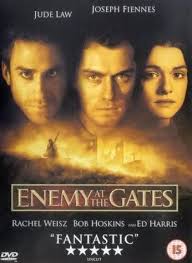
Very obviously every country chooses to advertise movies in a different way. Same thing with books. I thought it might be interesting to pick a movie, Enemy at the Gates in this case, and just look what I come up with. It’s interesting, dont’ you think? I can’t quite figure out which is which, apart from the last one, of course, that is the French poster. Now in France they even chose another title. Stalingrad.
Which is the one that you prefer? Which one captures the story best? I think I would prefer the third one if it had been Ed Harris’ instead of Joseph Fiennes’ face, although… I am not sure.
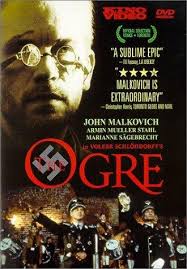
Volker Schlöndorff’s The Ogre aka Der Unhold (France/Germany/UK) is based on Michel Tournier’s novel Le Roi des Aulnes aka The Ogre. The Ogre is a highly symbolical, original and complex movie that attempts nothing less than to explore Nazi symbolism and ideology, German culture and mythology by telling the incredible story of Abel Tiffauges, a man who loves children and animals and who makes himself believe he is more than just human. The movie is filmed in English, French and German.
Plot
Abel Tiffauge’s story has five very distinct parts. Part I. Childhood. The French boy Abel grows up in a Catholic private school for boys. He is the outsider, the odd one, the one others pick on, the one the priests punish whenever someone has done something. Especially a very fat boy exploits Abel whenever possible. But he is also his only friend. When Abel is wronged again he wishes a catastrophe upon everybody. And it happens. From now on he believes he is invincible and powerful. Part II. Grown-up. Abel is still odd and a loner but he is also an auto mechanic with a flourishing business. Abel is also an amateur photographer and likes to take pictures of kids. There is nothing he loves more than kids. This very innocent fondness is mistaken for child molesting. Instead of being sent to prison, the falsely accused is sent to war. Part III. POW. Abel is captured together with his officers and sent to a German camp, somewhere near the Polish (?) border. During the day when everybody works he sneaks off to an abandoned hut and befriends a moose. One day he meets Goering’s forester. Part IV. Goering. If Goering was anything like the Goering portrayed in this part, then he was one of the most revolting beings to have ever walked this Earth. Abel is to help on his hunting lodge and gets a close look at the way the Nazis and their friends spend their leisure time. Drinking, eating, hunting. Very vulgar. Part V. The Erlking. Abel is sent to Kaltenborn Castle an elite training camp for German boys. He is happy like never before and loves to be able to take care of these boys but he also takes an active part in their training. Soon he starts to collect the boys from the neighbourhood and the people who are afraid of him call him the ogre. He doesn’t realize that he is doing wrong. When the Russians approach and people from concentrations camps are liberated, he starts to understand what he has been part of. He tries to help a Jewish boy and almost gets killed.
Meaning
So much for the content of The Ogre. But that is only one part. The movie shows us in stunning pictures what it must have been like to face Nazi ideology. The power of the imagines they created by using potent symbols is amazing. The visualization of this ideology is fantastic. Just take a look at the trailer and you see some of it. The boys standing in the form of a giant Swastika holding burning torches in the night. But then there is also the undercurrent of German culture, of everything that was good about Germany and was perverted by the Nazis. The love of the forest, love of animals, children, poetry. Goethe’s famous ballad The Erlking is quoted and put into pictures in a very spooky way. Without knowing this poem a great part of the movie’s meaning stays hidden.
Who’s riding so late through th’ endless wild?
The father ‘t is with his infant child;
He thinks the boy ‘s well off in his arm,
He grasps him tightly, he keeps him warm.
My son, say why are you hiding your face ?
Oh father, the Erlking ‘s coming apace,
The Erlking ‘s here with his train and crown!
My son, the fog moves up and down. –
Be good, my child, come, go with me!
I know nice games, will play them with thee,
And flowers thou ‘It find near by where
I live, pretty dress my mother will give.”
Dear father, oh father, and do you not hear
What th’ Erlking whispers so close to my ear?
Be quiet, do be quiet, my son,
Through leaves the wind is rustling anon.
Do come, my darling, oh come with me!
Good care my daughters will take of thee,
My daughters will dance about thee in a ring,
Will rock thee to sleep and will prettily sing.”
Dear father, oh father, and do you not see
The Erlking’s daughters so near to me?
My son, my son, no one ‘s in our way,
The willows are looking unusually gray.
I love thee, thy beauty I covet and choose,
Be willing, my darling, or force I shall use!
“Dear father, oh father, he seizes my arm!
The Erlking, father, has done me harm.
The father shudders, he darts through the wild;
With agony fill him the groans of his child.
He reached his farm with fear and dread;
The infant son in his arms was dead.
The Cast
John Malkovich as Abel Tiffauges is astonishing. I think it is one of his best roles. He is such a weird-looking actor and that is perfect for this role. I particularly like the three German actorsHeino Ferch, Armin Müller-Stahl and Gottfried John. But everybody else, especially those many little boys and girls, are very convincing.
For me this is a 5/5 star movie. It has incredible pictures, is dense and complex and invites you to rethink Nazi ideology and symbolism like not many others. It is better than the Boy in the Striped Pyjamas that is for sure. But not as good as Pan’s Labyrinth.
Other war movies with children as main characters can be found on my list Children in War Movies.
The filmsite has undertaken to analyze as many lists as possible and came up with a total of 6 war movies that had equally high ranks on all the lists, including other genres than war movies.
While I do agree with some choices I really disagree with others. I suffered through Battleship Potemkin which doesn’t mean it is bad but I don’t think Apocalypse Now and Schindler’s List deserve to be among the 6 most appreciated war movies. What’s funny though is the fact that these two movies are such opposites in the way they treat their subject. While one is easily understood and a very simple, true story – one man’s fight for justice and humanity , so to speak – the other one is a conflicting, ambiguous movie. There are a few war movies that are multilayered, Apocalypse Now is certainly one of them. Not easily accessible for everyone like Schindler’s List. Yeah, well, people are fickle, why shouldn’t this be reflected in lists?
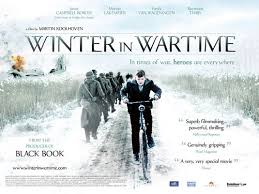
Winter in Wartime is a Dutch-Belgian co-production filmed in three languages, German, Dutch and English. The same producers who did the outstanding movie Zwart Boek aka Black Book did also this one. There are some resemblances picture wise but apart from that the two movies are very different. Winter in Wartime is to be classified among the long list of Children in War Movies (please see my post Children in War Movies).
Michiel, a young boy of 14 years, gets drawn into the Dutch Resistance after one of his older friends, an active member of the Resistance, gets shot. Michiel takes it upon himself to help a young RAF pilot who has been shot down in the woods near his village. As young as he is Michiel has a strong sense of right and wrong and despises his father whom he accuses of collaborating with the Germans. He idealizes his uncle Ben who thinks his brother is a coward.
Occupied Holland is swarming with Germans. It is extremely dangerous for Michiel to help the young injured British soldier and he has to let his sister who is a nurse in on his secret. After a German soldier is found shot in the woods the Germans arrest Michiel’s father. Although his uncle says he can help him, the father is shot.
Michiel’s only mission from then on is to save his the young pilot. The ywill attempt to flee several times. Michiel will learn a few important lessons and come out wizened of this experience.
The movie is very beautiful as we see long takes on the snow-covered Dutch countryside. Snow flakes fall softly in many a scene, the whiteness of the woods builds a stark contrast to the dark uniforms of the Germans. Michiel is a wonderful character. Such a young boy with such an incredible idealism and courage. The young actor, Martijn Lakemeier, did a great job. So did Jamie Campbell Bower as the pilot Jack. I also liked the relationship between the boy and his father or rather how the opinion the boy is change through the events. Apart from that I’m not too sure about this movie. You could watch it with very young people or children to teach them something about the war and values but I think it is too much of a purely invented story and does lack realism. If you watch it you will understand what I mean. There are a few things that just seem extremely farfetched.
Don’t get me wrong, it is watchable. Just not great. If you have never seen a movie on Dutch Resistance, go for Black Book. If you’d like to watch something on Nordic Resistance, try Max Manus or Flame & Citron. All three are great. This one is probably a 3.5-4.




 All About War Movies