Attack on Leningrad aka Leningrad (2009) Russian/UK Movie on the Siege of Leningrad

There are numerous ways to tell a story. Numerous point of views to choose. Sometimes choices are convincing. Often they are not. Attack on Leningrad belongs to the second category. The choices the film director and his team made to tell this story were absolutely not convincing. I am very disappointed. This is very sad as this movie had incredible potential. Told another way this could have been one of the very great. As it is now it’s just an average movie on a shocking theme. How sad this is, became fully clear to me after I watched the interview with film director Aleksandr Buravsky on the DVD. He had the chance to create something great, why didn’t he do it?

The Siege of Leningrad is one of the unspeakable atrocities that the Germans committed during WWII. Hitler had the idea to starve the people of Leningrad within a few weeks, maximum two months in order to gain superiority on the Eastern Front. The siege lasted 872 days. Leningrad was a big city of almost 5 million people at the time. At least 1.5 million died during the siege. I was interested in this topic since I had read Helen Dunmore’s excellent novel The Siege. It’s a daring book from a master storyteller. I had hoped for an equally good movie (the movie is NOT based on Dunmore’s book).

In 1941 a young ambitious British journalist is flown to Leningrad, together with a whole group of foreign correspondents, to cover a story on Leningrad. While the journalists are there, Leningrad is attacked by the Germans and cut off from the rest of the world. She is believed to be dead and left behind while some of the other journalists manage to escape to Moscow. A young female Russian police officer helps her. Those two extremely different women form a bond that becomes a friendship. The two women fight for their life and the lives of a few others, almost until the end of the siege. The circumstances are horrible. It is extremely cold, people are famished and die in the streets, they cut open animals that are still alive, they eat dead humans, lick glue from paper hangings. It’s all very drastic and well shown. Still the movie didn’t work because of the invention of this English journalist. It’s a tacky, pretty unbelievable and unnecessary story. The movie has Russian and English parts and whenever we see Russian parts it is strong and convincing and as soon as it moves to the English parts it is just sadly arbitrary.

Why invent a story like that when there was such a lot of material at hand? Accounts of eye witnesses, for example. In the interview Buravsky mentions the famous Russian composer Shostakovich who was in Leningrad during the siege where he composed his 7th symphony. Wouldn’t that have been a great story? Or what he said about Stalin… Apparently he could have freed Leningrad much earlier but decided against it. He deliberately let them starve as Leningrad, the former St.Petersburg, the home of the Tsars was the center of the intelligentsia and the arts. In doing so he could get rid of people who were undesirable in his regime… A dictator like Stalin was certainly not fond of intellectuals and artists or other people who were used to thinking for themselves. That would have been a great story as well.

Since it is a Russian/UK co-production I suspect the choices had something to do with funding. Too bad.

Still, for people who have never heard or are not very familiar with the siege of Leningrad this movie is a good opportunity to learn something about it. And it is watchable. The Russian cast is very good, the pictures are very nice but all in all it’s a lost opportunity for something that could have been better than average. 3.5/5

Full Metal Jacket (1987) One of the Most Important But Ambiguous Vietnam Movies

In the hand of another filmmaker than Stanley Kubrick this wouldn’t have become the breathtakingly awesome movie this is. Full Metal Jacket is a visceral experience if there ever was one, a movie whose images will burn themselves into your memory forever. Not an unworthy beginning to a new year of blogging. But also a very controversial one.

As probably most of you know, Full Metal Jacket is like two movies in one. The first part, is the boot camp part, the second the combat part.

During the boot camp part the new recruits are transformed into killers, men who belong to a brotherhood. The drill instructor Gunnery Sgt Hartmann (R. Lee Ermey) is by far one of the most obnoxious war movie characters. But what a performance. Try saying one of the numerous bits he utters without stammering. This part also introduces us to Private Joker (Matthew Modine), an aspiring, cynical journalist. Private Joker symbolizes the controversies around this war. We will see him later, in combat, wearing a peace button and simultaneously a “Born to Kill” slogan on his helmet. Another of this movies memorable characters has his major part in this sequence, Gomer Pyle (Vincent d’Onofrio), a fat and clumsy recruit who winds everybody up because they are punished for his failures that are endless. His final scenes bear all the traces of other Kubrick movies like A Clockwork Orange and The Shining.

Once in the combat zone in Vietnam, we meet other colorful characters, one of them Animal Mother (Adam Baldwin), a pure killing machine. At the beginning of his stay Joker is bored like hell. He is a journalist with Stars and Stripes. The guys basically hang around and wait for something to happen and instructions on what they have to report. The Vietnamese they see are either hookers or Vietcong. Any others don’t seem to pass their radar.

The last part is an intense combat part in the cit of Hue. They come under fire and some of them are killed by a sniper hiding in one of the bombed out buildings. As there may still be many people who have never seen Full Metal Jacket I will stop here. It should suffice to say that the last part is intense and not easy to watch.

What struck me most in this movie are the pictures and the colours. Smoke and fire, burning red heaven, bombed out buildings  and palm trees. Apparently the parts in the buildings were filmed in the docklands of London. I don’t know about the rest of the movie. The music is interesting as well. There is a mix between songs of the era and original score that would do any horror movie justice.

I have left out many important, visually powerful and interesting moments. I just wanted to give a short introduction to one of the most extreme and most important war movies that has ever been made. If you haven’t seen it yet, you should watch it.

Full Metal Jacket is also one of those movies that is focussing on the themes War and Journalism and Women in War Movies. Believe me, if you haven’t seen it, we got some interesting elements on both in this movie. If you have seen it, you know what I mean.

I don’t think it is the best Vietnam movie. At least not for me. Of the combat Vietnam movies I consider Platoon, Hamburger Hill, and maybe even We Were Soldiers to be superior. Why? I think, it is fantastic from a cinematographic point of view, but as an anti-war statement I always found it a tad ambiguous. Pretty much like Apocalypse Now.

What do you think?

Stalingrad (1993) The German Movie That is One of the Best War Movies Ever

Joseph Vilsmaier’s Stalingrad is one of the most powerful war movies I have ever seen. It bears testimony to Germany’s outstanding filmmaking capacities. It is also one of the rare that I have watched at least three times and every time I discovered something new. That’s why it is difficult to write a decent review and not one that is so long that you jump to the next post without even finishing the introduction.

Stalingrad focuses closely on five characters, four of which have been together since they fought at El Alamein.  We first see them on leave in Italy  from where they board a train to the Eastern Front. They don’t really have a clue where they are going or what for. They know the Führer says it is crucial and they have to trust him on that but first voices can be heard that doubt the decision-making of their command. During their train trip they meet their new Lieutenant, Witzlan (Thomas Kretschmann), for the first time. He isn’t battle hardened like the others are, in fact he has never fought at all and there is immediately a lot of friction.

When they get off the train in Stalingrad they face total chaos. There are heavily wounded soldiers everywhere, fighting is extremely heavy and they are in the midst of it all right away. The German officers in Stalingrad are mostly cruel Nazis, the treatment of Russian prisoners is harrowing. Witzlan is, as the privates discover now, a very humane person. He will not tolerate abuse and cruelty and comes into conflict with superiors on that subject. He may be inexperienced but he has a great character and his decision making isn’t all that bad, as we soon see.  As a matter of fact his subordinates learn to respect him a lot. One of the majors however is one of the most obnoxious characters of war movie history, a real jerk.

Stalingrad consists more or less of seven very distinct parts, the first one is the leave in Italy, followed by a heavy infantry combat one, then a sequence in which they are doing forced labour, next is the so-called “tank episode”, then they escape, meet again later with a part of their original group and finally try again to escape, out of Russia and back to Germany.

Because Stalingrad focuses practically only on five people it is a very intimate and emotional movie You have the feeling to know these people, you care for them, they are really humans with all their strengths and flaws. They are no heroes, they are normal people caught in what was one of the biggest tragedies of WWII, one of the battles that cost the most lives.

And there is the setting and seasonal implications. Russia in winter is one of the coldest places on earth. This really is a winter movie. Snow, ice, freezing and the total hopelessness of the people involved makes it unforgettable. Most of those who survived the battles froze to death later.

I have often wondered, if I had to choose, which climate I would choose. Fighting in the desert, in the jungle or in the icy cold planes of Russia? All three settings bear their own horrors as did the war soaked trenches of France and Belgium. My father fought in the desert, where you fight exhaustion, thirst, Fata Morgana and hallucinations from the heat and have to endure long walks through arid barren country where you can’t hide and are an easy target.

From my own personal point of view, I tink that icy Russia would be the worst. Stalingrad is for me the worst battle that ever took place. The battle and its aftermath are horrible.

I haven’t seen the Finnish movie Talvisota aka The Winter War yet, this might be similar, also a winter movie, but apart from that I think the extreme that is depicted in Stalingrad is unique. No other war movie achieves to convey such a powerful anti-war statement.

It think it safe to say that it is not only one of my Top 10 but it is also generally acknowledged as one of the best ever.  It manages to combine very intimate portraits of five soldiers, intense infantry combat, the depiction of a grueling climate and one of the biggest miscalculations of Hitler. 5/5 is an absolute understatement.

Silent Night (2002) Christmas in War Movies I

This review is part of a sequence of reviews of war movies that have Christmas as their main theme. There are many war movies in which a part takes place during Christmas or in which it is evoked but that are not the ones I’d like to focus on. I want to focus on those that really center on it.

The first one I’m reviewing is, as you can see, Silent Night, A  Midnight Clear, Joyeux Noël and maybe one or two older ones will follow.

The TV drama Silent Night is based on true facts. It is set on Christmas Eve 1944, just after the Battle of the Bulge. A mother and her young son are seeking refuge in the family’s hunting lodge in the middle of the Ardennes Forest. They walk through the war-torn woods, approach the front line and pass dead bodies, troops of soldiers and tanks.

They have just arrived at the lodge when two American soldiers arrive, carrying one of their wounded. The woman lets them stay reluctantly but makes them leave their weapons in front of the house. Elisabeth Vincken (Linda Hamilton) is not what you would call a patriot. She has lost her eldest son at Stalingrad, her husband is probably dead as well and the youngest, Fritz, would like to join the Hitler Youth which she wants to prevent at all costs.

While they are looking after the badly wounded soldier, a group of three German soldiers arrives at the hut and the encounter almost ends in mutual shooting. Elisabeth is a very strong woman, very determined and persuasive. After some initial discussions and negotiations they agree to leave their weapons behind, enter the house and spend the night there in peace.

I don’t think that anyone present during this Christmas dinner was likely to ever forget it. It would certainly be the most memorable Christmas of their lives. They sit around the table, share their food and stories, talk about the way in which this and the former war affected them. Still,  tensions do not subside completely. The German lieutenant has a particularly hard time to stay peaceful. He is bitter and aggressive, however, after a moment of escalation, he starts to see how absurd this all is and gives in as well. There is a final test that will show if these men have truly become friends in one evening. And if so, will they stay friends later on?

One  thing, as often, that truly bothered me were the bad accents. Americans speaking German with heavy American accents and then fake English accents. But cheer up, I have been assured that it doesn’t bother you if you don’t speak German.

The movie has a few very sentimental moments but it is overall not bad at all, no it is quite a pleasant movie that achieves to capture the spirit of Christmas. Recommended Sunday afternoon viewing with loads of snow, drama and some genuinely heartfelt moments.

I also included Silent Night in my update Children in War Movies List.

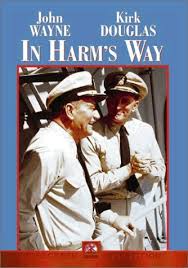
In Harm’s Way (1965) or John Wayne, Pearl Harbor and Some Decent Naval Combat in the Pacific

I don’t know how many war movies John Wayne did. The only thing I know, he did a lot. I’ve seen The Longest Day but apart from that Otto Preminger‘s black and white movie  In Harm’s Way was my first. I actually quite liked it. It’s a decent movie with some interesting female leads and a love story between John Wayne and Patricia Neal’s character that resembles a real relationship and not some ridiculously soppy romance.

I already mentioned it in my post on Pearl Harbor as it starts on the night before the attack of Pearl Harbor. At the center of the movie is Admiral Torrey who is first demoted and then promoted again. The movie analyses what is going on outside of the actual battles; the planning, the men’s love and private lives. Torrey meets his son who is in the Navy for the first time after several years. Their relationship is very conflict-laden but evolves during the movie. Torry gets to know the nurse Lt. Maggie Haynes (Patricia Neal) who is probably one of the greatest nurses in any war movie. Kirk Douglas plays a real asshole, Commander Eddington. We see a few decent battle scenes but nothing too exciting.

Too cut  a long story short, In Harm’s Way is a movie for John Wayne fans, for people who want to watch something older about the war in the Pacific, for those who like a well-told story that focuses on relationships and for those who can overlook a few gender related oddities (Two things struck me. One was the “tea scene” and the other the way people react to Eddington’s crime). As a war movie I would rate it 3.5-4/5.

Don’t miss the trailer. I have never seen a trailer like this. I first thought it was a parody and then I realised it was just unreflected promotion. It has real historical value. Just watch it and thank God that trailers have evolved through the years.