Europa Europa aka Hitlerjunge Salomon (1990) The Story of a Jewish Boy Hiding Among Nazis

Agnieszka Holland’s movie Europa, Europa is based on the true story of Salomon Perel. It is frequently mentioned as one of the top 100 war movies. It’s a harrowing and quite unbelievable story, still I have to confess that I did not like it.

The Perels are a Jewish family living in Germany at the beginning of the war. When anti-Jewish acts become more and more frequent, they are attacked and the daughter is killed. Salomon’s parents send the young boy and his brother to Poland where he should try to survive at any cost. He looses his brother early in the movie and ends in a Russian communist orphanage. Here he is given a passport and has to undergo some serious communist re-education. When the Germans invade Russia, the orphanage is attacked. They all flee and Salomon gets captured on the way by a Nazi patrol. All the Jews are shot immediately and it is only thanks to an extreme presence of mind that Salomon manages to make them belive that he is a true German and that he can be extremely useful as interpreter since he speaks Russian fluently. The soldiers take him along and he fights with them, helps them as a translator. He has to be super careful that no one sees him naked and this will stay a constant topic throughout the movie. The fact that he is circumcised would give his identity away.

A German officer hears of the young boy and that he is an orphan. He likes the bright boy and thinks of adopting him but first he sends him to one of the Nazi elite schools where he will be educated and trained. Here again, he has to be careful in order to not be found out. There are a few incredible scenes in the school. In one scene a teacher shows that one can see unmistakably, that, despite his dark hair, Salomon is of pure Aryan breed. The pupils are taught to hate the Jews and how to detect them. The absurdity of such scenes is incredible and Nazi madness made apparent.

Salomon is barely 16 years old and falls in love for the first time. Although the girl is willing “to do it”, he has to say no. The danger of being detected is too big.

It is incredible to think that he got away with it for so long. He blended in so perfectly, was such a good actor and so cold-blooded that they never even suspected him to be Jewish.

After the war Salomon finds out that his whole family died in a ghetto in Poland. He leaves Europe and settles in Palestine. At the end of the movie we catch a glimpse of the real Salomon Perel.

It took me a while to figure out why I didn’t like this movie. I didn’t like it because I didn’t like Salomon. I suspect that I found his behaviour cowardly. He isn’t much better than a collaborator. It disgusted me to see him act and talk like a Nazi. Sure, he was only a boy, he wanted to survive, he lost his family… I think sometimes it’s better to die than to sell out. Bit harsh, I know, but surviving is not everything.

I’d be really interested to know what others think of this movie.

Europa, Europa is part of the Children in War Movies List

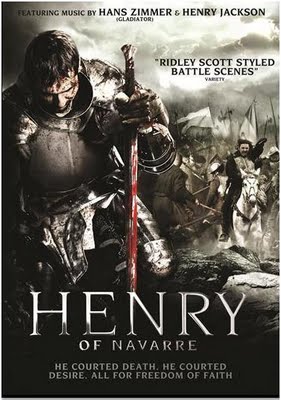
Henry of Navarre aka Henry 4 (2010)

Based on Heinrich Mann’s eponymous novel Henry of Navarre aka Henry 4 is a large-scale epic about one of the bloodiest chapters in French history. This is a fascinating and eerily beautiful movie. It is a French-German co-production which explains why there are as many French as German actors.

I’m quite familiar with French history from Louis XIV on but what came before is somewhat blurred. I knew about the massacre of St. Bartholomew’s Day (La St. Barthélemy) and the Edict of Nantes, was familiar with the Queen Margot and Catherine de Medici, I had even heard the famous saying “Paris vaut bien une messe” meaning “Paris is worth a mass” but I wouldn’t have tied all this together and associated it with Henry of Navarre, future King Henry IV of France. What a bloody story, full of treachery, passion, fanaticism, civil war and murder.

Henry, King of the little kingdom of Navarre, is forced to go to war at an early age. By the time he turns twenty it is all he knows. It is the time in which France is divided in two. Catholics are on one side, Protestants (Huguenots) on the other. The Civil War or Wars of Religion rage and tear the country apart. Paris and the court are held by Catholics who are to a certain extent ruled by the Pope. They don’t get married without the assent of the Holy Father. The people of the kingdom of Navarre and Henry himself are Protestants. The opposing parties meet on the battlefield more often than anywhere else.

France is unofficially reigned by the scary Catherine de Medici, the King’s mother. Charles, the King, is an anxious man, constantly afraid of being poisoned or murdered. His fear is well grounded as we will soon find out. Catherine de Medici had the reputation of being a cruel, despotic woman who had people executed on a whim. But even she is tired of war and arranges a marriage between her daughter, the beautiful Margot, and Henry of Navarre.

The marriage is overshadowed by the death of Henry’s mother, presumably she was poisoned. As soon as they are married someone orders to massacre all the protestants in the city which will be the famous St. Bartholomew’s Day Massacre.

The following two-thirds of the story follow Henry until he finally becomes Henry IV, King of France. Many people had to lose their life to make this a possibility.

The movie excels in making these people come to life and shows us a King who was far beyond the ordinary. He was  much-loved, tolerant and accepting of people of every religious conviction. This may well have been the first step towards France becoming a secular country, something it has remained until today. Henry was also a womanizer, a trait the film-makers enjoyed to illustrate.

For those who aren’t familiar with the story of Henry IV, I’m not going to reveal too much. It should suffice to say that love plays a major role. He will also divorce the Queen Margot as she cannot give him the much-needed heir and will get married to Marie de Medici.

I didn’t know much about Henry IV, so I’m not sure how well-chosen Julien Boisselier is. He’s a pleasant, likable looking man and did a very good job.

Ulrich Noethen as Charles IX, is very convincing. He is an experienced actor who has starred in movies like The Downfall.

Having studied old French literature I had to read Agrippa D’Aubignés Les Tragiques. It’s a harrowing account of the times and the Wars of Religion. I liked that Agrippa played a prominent role in the movie. He is played by the excellent German actor Joachim Król. Agrippa was one of Henry’s best friends and only left him towards the end, to withdraw from the world and start to write his famous book.

The most fascinating character of them all, is Catherine de Medici. Hannelore Hoger, a German TV star, plays her very well. She gives an uncanny, eerie and quite scary Catherine de Medici.

All in all, I enjoyed Henry of Navarre a lot and will re-watch it. If you like epic movies, beautiful cinematography and French history you will enjoy it.

I’d like to thank Showbox Media Group for sending me a review copy of the movie.

Henry of Navarre is out to buy on Blu-ray and 2 disc-DVD on 4th July 2011, courtesy of Showbox Media Group.

12 French War Movies You Must See Before You Die

France, a country that has endured and fought many wars, was at the center of many a battle and armed conflict, a country famous for its outstanding filmmaking has produced a very modest amount of war movies. You will find numerous WWII movies on the Resistance and a fair amount of rather psychological war-time movies but if you are looking for combat movies, you will not be lucky. I know of no French air combat or submarine movie at all.

There may be many reasons and I can only attempt an interpretation, comparing French cinema in general to the cinema of other countries. What becomes apparent soon is that the French are not keen on producing large-scale, epic or very action driven cinema. French movies are psychological and intimate. They focus on the dynamics between a few people, their interaction, the dialogue. Many of the most famous French movies focus on tiny details, small things. It’s easily understood that this doesn’t fit in with infantry combat movies with their huge casts and more action driven story lines.

In choosing 12 movies  I tried to pick the few real combat movies I knew and added the ones that I think excellent or that absoultely need to be watched. I also tried to covera wide range. I left out good ones, I’m sure.

For those who want to further explore French cinema the website French War Movies offers a great overview.

I discovered one huge problem for the non-native speaker when I watched La Grande Illusion recently as I bought a movie with English subtitles. Almost 2/3 of the dialogue was missing. I noticed the same when I watched and reviewed the Italian Rome, Open City (here is my review). Since French and Italian movies are dialogue driven, it’s very hard for a non-native speaker to fully appreciate them. I’m sure this is done better in more recent movies, still it is a problem.

With all this said, let’s open the curtain for twelve stunning movies:

La Grande Illusion aka Grand Illusion (1937): WWI. Jean Renoir’s movie is one of the great classics of European cinema starring the late great Jean Gabin. A POW movie that offers a lot. Interesting German characters included. (Here is the review)

Nuit et brouillard aka Night and Fog (1955): WWII. Alain Resnais’ Holocaust classic. Death Camps. Final Solution. Documentary/original footage about the horrors of the concentration camps. Gut-wrenching. Impressive. A must-see. (Here is the review)

Hiroshima Mon Amour (1959): WWII. Another movie by Alain Resnais. A love story between a French woman and a Japanese man from Hiroshima. Interspersed with original footage of Hiroshima. Very special and poetic based on the scenario by Marguerite Duras. A must see for French cinema aficionados. (review upcoming)

L’armée des ombres aka The Army of Shadows (1969): WWII. Jean-Pierre Melville’s Resistance masterpiece. Another classic. Claustrophobic, impressive, sparse. Excellent actors. One of the most depressing movies I’ve ever seen. (Here is my review)

L’honneur d’un capitaine aka A Captain’s Honor (1982): Post war. Algeria. A captain who died on the battle field in Algeria is accused of having been a torturer and a murdered. His widow tries to prove that he wasn’t guilty. (review upcoming)

Dien Bien Phu (1992) : Indochina. Infantry Combat. Schoendoerffer’s movie shows the final defeat of the French in Indochina. Not nice to watch at all. (review upcoming)

Le pianiste aka The Pianist (2002): WWII. Holocaust. Tells the story of a Jewish pianist in the Warsaw ghetto. Harrowing and beautiful. My favourite Holocaust movie. Very moving. (review upcoming)

La chambre des officiers aka The Officer’s Ward (2001): WWI. Everything you never wanted to know about the horrible facial wounds that were so frequent during WWI. Made me quite sick. Painfully well-done  (Here is the review)

Un long dimanche de fiançailles aka A Very Long Engagement (2004): WWI. Based on Sébastien Japrisot’s eponymous novel it tells the harrowing story of young Mathilde who travels to the no man’s land of WWI in search of her lost fiancé.  This is one of the darling movies of international film critics. I did like it but wasn’t awed. Starring the much-loved Audrey Tautou. (review upcoming)

Joyeux Noël aka Merry Christmas (2005): WWI. The story of the little peace during the Great War. During the first Christmas in WWI, German, French and British/Scottish troops cease fire and play football together. Wonderful movie with great actors. One of  my Top 10 all-time favourites and one of the bestanti-war movies that exist. (Here is the review)

L’ennemi intime aka Intimate Enemies (2007): Algeria. One of the very few French Infantry Combat movies. Very good and very critical. About the ugly side of an ugly war that was officially no war. If you want to find out why I found this hard to watch, you’ll have to read the About page. (Here is the review)

L’armée du crime aka The Army of Crime (2009): WWII. French Resistance. Based on the true story of a group of young people and immigrants who fought a desperate fight against the Nazis. They were led by the poet Manouchian. This is an absolutely stunning and very tragic movie. One to watch and re-watch. It went directly on my Top 10. (Here is the review)

Henry of Navarre (2010) DVD Giveaway

It is the mid-16th Century and France is awash with blood, as the protestant Huguenots fight for survival against dark forces led by the treacherous Catherine De Medici. When she orchestrates the ultimate betrayal at the infamous St. Bartholomew’s Day Massacre, King Henry IV will fight his life’s greatest battle to ensure her treachery does not go unanswered…

Based on the novel by Heinrich Mann, experience an epic chronicle of one man’s heroic struggle against overwhelming forces in this action-packed and spectacular “5- STAR(Cambridge Film Festival) motion picture event with RIDLEY SCOTT STYLED BATTLE SCENES(Variety).

I’m really looking forward to watch this movie. This is the type of epic period drama that I love. And since I’m a sucker for great film music and love Hans Zimmer who has written the score of Henry of Navarre, there is twice as much to look forward to. Based on Heinrich Mann’s eponymous novel, starring Julien Boisselier, this international production offers large-scale cinema.

What’s even better, I am able to give away one DVD of Henry of Navarre courtesy of Showbox Media. All you have to do is leave a comment. I will draw the winners next Saturday and announce them on the following Sunday.

The giveaway is open internationally but the DVD is REGION 2 coded.

Henry of Navarre is out to buy on Blu-ray and 2 disc-DVD on 4th July 2011, courtesy of  Showbox Media Group.

The giveaway is now closed.

The Cranes are Flying – Letyat Zhuravli (1957)

It’s nice to watch a movie that is almost flawless like Mikhail Kalatozov’s The Cranes are Flying, a masterpiece of Russian cinema. It’s touching and beautiful and for once free of any traces of propaganda as it was filmed after Stalin’s death.

I haven’t seen many movies depicting the Russian home front during WWII, so that was interesting as well.

The Cranes are Flying tells the love story of Boris (Aleksey Batalov)  and Veronica (Tatyana Samojlova), two young people who are very much in love and whose love is deeply affected by the outbreak of the war.

The only thing Veronica hopes when she hears about the war is that Boris will not be drafted, only he has other plans. He has already volunteered and his hasty departure doesn’t even permit to say good-bye.

Scenes like the one in which Veronica runs to the train station and hopes to see Boris one last time and say good-bye but is held back by the masses is quite tragic. She can see him but he doesn’t see her and no matter how much she fights to get his attention, it is utterly futile. We see many scenes like this in the movie, in which the camera stays for a long time on Veronica’s expressive face, which mirrors her tumultuous feelings and despair, and in which she seems to fight forces that are beyond her.

After Boris departure Veronica faces utter loneliness. Day in and out she waits for a letter from him but nothing arrives.  When she looses her parents in an air raid, she is completely alone. Fortunately Boris father is a kind man and asks her to live with them.

Boris cousin who was always very interested in Veronica tries to seduce her once Boris is gone and when she doesn’t give in, he finally rapes her. Desperate and lonely Veronica accepts to get married to him.

The family lives together in very quarters. The father and his eldest daughter are both doctors and constantly needed at the hospital. Even though she is now married, Veronica still waits for a letter from the front.

In the second half of the movie scenes from the front and the home front are interwoven.

The story is moving and sad but what is really compelling about this movie is the cinematography. The black and white shots are haunting. The way Veronica’s face is filmed is wonderful. Tatyana Samojlova really has a captivating and expressive face.

I was surprised about the characters as well. The father is one of the most positive father figures cinema has to offer. He is kind, gentle and understanding but at the same time determined and strong. He isn’t very patriotic and doesn’t think it is admirable to volunteer.

This is one of those movies that should not be missed and that will probably be even better when you watch it a second time.