War Requiem (1989) Derek Jarman’s Impressive Interpretation of Benjamin Britten’s Eponymous Requiem

Futility 

Move him into the sun —
Gently its touch awoke him once,
At home, whispering of fields unsown.
Always it woke him, even in France,
Until this morning and this snow.
If anything might rouse him now
The kind old sun will know.

Think how it wakes the seeds —
Woke, once, the clays of a cold star.
Are limbs so dear-achieved, are sides
Full-nerved, — still warm, — too hard to stir?
Was it for this the clay grew tall?
— O what made fatuous sunbeams toil
To break earth’s sleep at all?


I have never seen anything like the War Requiem before. Although I used to like Derek Jarman‘s movies (especially Caravaggio, Sebastiane and The Tempest) I wasn’t aware that this existed before I saw a review on the War Movie Blog. This is certainly not for everybody. If you don’t like classical music, especially requiem’s you will have a hard time. I tell you this right away. Jarman took Britten’s War Requiem, which consists of a proper requiem and sung versions of Wilfred Owen’s poems, and illustrated it. Wilfred Owen is the young poet we also see in the movie Regeneration. He was killed in action one week before the end of in WWI. As you can see I added two of his poems for you.

War Requiem is actually a silent movie so to speak. We see images, acted scenes and hear Britten’s music. In part it’s a reenactment of Wilfred Owen’s story, in part we see actual footage of different wars. Documentary and art are entwined and the result is extremely rich and interesting. The acting is of course somewhat exaggerated as the actors are miming not acting as they don’t talk (silent movie style). The two main actors are Nathaniel Parker (Owen) and Tilda Swinton (The Nurse): Sean Bean (The German Soldier) and Laurence Olivier (The old Soldier) are in minor roles. There is a bit with Tilda Swinton who plays the nurse that is very annoying (scene 10). But that was the only bit I found hard to take. The rest is impressive. Beautiful images. Colors are very important and highly overdrawn as they are in all of Jarman’s movies. In this one it is the color red that is artificially bright. Colors have a special meaning in Jarman’s work. He wrote a book, Chroma: A Book of Colors, dedicated to color interpretations and his last movie is dedicated solely to the color Blue. The tragedy behind all this is that Jarman was going blind towards the end of his life. He suffered from AIDS related illnesses and finally succumbed to them.

War Requiem is remarkable also because it is not only an anti-war movie but also an “anti war movie movie”. If you watch all of it and don’t give up in the middle you might be astonished to see what kind of actual footage you see towards the end. I have never seen anything like it before and felt very uncomfortable. The footage we see – especially from Vietnam and Angola – is horrible and gruesome. What is even more horrible is that you see the difference between wounds in a war movie and these head wounds and other wounds in these documentary bits. It simply doesn’t look the same. You see immediately that these people are really dead. I think to see something like this would be good for every person who regularly watches war movies. The atrocities of war are so much more horrible in reality. It was extremely sobering to say the least.

This is a really special movie. It is an interesting contribution to cinema history as well as to war movies  in general. But it is not for everybody.

Anthem for Doomed Youth 

What passing-bells for these who die as cattle?
Only the monstrous anger of the guns.
Only the stuttering rifles’ rapid rattle
Can patter out their hasty orisons.
No mockeries for them; no prayers nor bells,
Nor any voice of mourning save the choirs, —
The shrill, demented choirs of wailing shells;
And bugles calling for them from sad shires.

What candles may be held to speed them all?
Not in the hands of boys, but in their eyes
Shall shine the holy glimmers of goodbyes.
The pallor of girls’ brows shall be their pall;
Their flowers the tenderness of patient minds,
And each slow dusk a drawing-down of blinds.


Gardens of Stone (1987) Coppola’s Vietnam Oddity

What the hell was that? Sorry but I did not get this movie. I was so thrilled when I heard from one of my readers about this a while back and thought that would be just the movie for me. I was always fascinated by military cemeteries. Those rows and rows of crosses. Each cross a life. Each cross a story. To dedicate a movie to those who bury the dead seemed so worthwhile. But somehow Coppola‘s Gardens of Stone doesn’t keep the promise it makes. Instead of an in-depth exploration of what it means to be the one to bury those who come back in caskets we get a little bit of everything which sums up to nothing. The acting is quite good, James Caan, Anjelica Huston and James Earl Jones do a good job but the story is too predictable. The movie starts with a funeral and then rewinds so we know already what is going to happen.

Sgt Hazard (James Caan) and Sgt Goody Nelson (James Earl Jones), two  Korea veterans and close friends, are Honour Guards at Arlington military cemetery. Hazard wants nothing more than going to Vietnam and teach the young soldiers how to survive over there. When a friend asks them to look after his son Willow who joins the unit, it seems to be Hazard’s mission to keep him from harm. As the funeral of the beginning  shows us, all his endeavors are futile.

It is exactly this predictability that finishes off this movie. And then there is the relationship of Hazard with the anti-war Washington Post correspondent Samantha. Their discussions pro or contra war are so boring. And totally without any consequences as she keeps on dating him… Of course there is also the young man who want to fight for his country and who is exemplary for so many who died doing just that.

The movie intersperses actual TV footage in order to give a bit of  “real war movie” flavor.

Apparently – I am speaking as a total layman – this movie is highly appreciated by people in the military. It is said to be very accurate and true to military life and rites.

Before I give you my final statement here is what  Jamie Russell writes:

Beautifully shot, wonderfully acted (Caan and Jones’ performances offer a truly outstanding sense of military camaraderie), Gardens of Stone remains one of the most problematic films to have come out of the war – part pro-military, part peacenik, 100% pro-American. (Vietnam War Movies, p. 46)

In my own words: It’s deadly boring hotchpotch.

Here’s the trailer

The Messenger (2009) or Fighting, Dying, Notifying

Some people say that The Messenger should have won the Academy Award instead of  The Hurt Locker. It is very possible that they are right.

As long as there are wars there will be fighting. As long as there is fighting there will be dying. And as long as people die in combat someone will have to notify the families. This difficult duty is the job of the Casualty Notification Officer. The Messenger explores this difficult task. To notify people is difficult for many reasons. Some are devastated and the their grief is unbearably raw. Others can´t even accept it. Some turn against the messenger, some are openly aggressive. Some are kind and caring.

Staff Sergeant Will Montgomery (Ben Foster) comes back from a tour in Iraq badly injured. He is said to be a hero even though he can’t accept this. He gets appointed to assist Captain Tony Stone (Woody Harrelson) who has done the job as Casualty Notification Officer for a very long time. He tells Will to strictly follow procedures. Don´t touch the relatives. Inform them directly. Be clear and precise and leave again.

The first job they get is already a harrowing one and Will realises that it might be even more difficult than he thought it would be. After their job is done, they go for a drink. Tony is a AA, so all he drinks is hot water with lemon. He asks Will very direct questions about everything. At first Will is reluctant to answer but he has no choice.

One day the two have to inform a young woman of the death of her husband. Will is very touched by her and her reaction and contacts her again later and they start to form a bond.

There are many different stories and storylines that are interwoven which is the strength of this movie. In it´s essence I would say, yes, this is a movie about war, but it is even more a movie about relationships. Deep relationships. Each and every single person in this movie carries a deep wound, either physical or psychological. Injuries, heartbreak, loss, betrayal. They have endured a lot and try to cope and heal by opening up to each other.

Ben Foster and Woody Harrelson are remarkable. Remarkable is actually and understatement.

I think The Messenger achieves a very rare thing. It gives us real people. Courageous and open people. And it says a lot of profound things about war and its consequences. Ultimately when there is a war, there will be death and dying. No one should forget this.

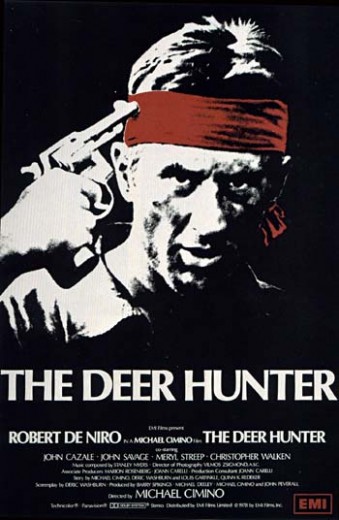
Remembering The Deer Hunter (1978)

Isn´t it weird sometimes what we remember about certain movies? I don´t know when it was, but I think it must have been a very long time ago, that I watched The Deer Hunter for the first time. Looking back the only thing I did remember was the Russian roulette scene and the cage that was submersed in water. I didn’t remember any combat scenes and nothing that went on before they volunteered or after they returned from the  war. What actually happened is that  my memory turned The Deer Hunter into a pure POW movie.

I finally watched it again and was surprised. I saw a totally new movie. Powerful is the best word to describe it, even though this does it little justice. Sure, what I remembered was still there but it shrank considerably and took up less than a tenth of the whole movie. Strange I think,  because since I have seen it again I must say, yes, the roulette scene, the whole POW part is maybe the most impressive but it is not the most important. And it is totally fictious. It is as if Michael Cimino had chosen to show the war in this way because he thought facts would not be drastic enough. Looking at all the other Vietnam war movies that have been done since I must say that especially because of these scenes The Deer Hunter is not the best Vietnam war movie there is but it is one of the more original ones. And it is an extraordinarily good movie about a certain type of people and how they were affected by the war.

What I will remember from now on is young men who live in a grim industrial town. They are second generation  Russian immigrants who are enthusiastic and idealistic and want to fight for their country not knowing what they get themselves into. A bunch of friends for whom life only just begun and whose dreams will be shattered for ever. Who return having left the easy-going, careless “Deer Hunter”-personality behind. They are completely changed and broken and we ask ourselves at the end : is there still enough left of them to begin a new life?

It is not my favourite Vietnam movie but it  ranks high up among the 10 best as I stated before (see my list 10 Vietnam War Movies You Must See Before You Die ).

What about you? Which is the part you like best about The Deer Hunter. Would it have been possible to leave the roulette part out altogether? How high would you rank it within the 10 best Vietnam war movies and how high within the best including every war/subgenre?

Rescue Dawn (2006) or One Man´s Ordeal in a Vietcong Prison Camp

Dieter Dengler, a young American fighter pilot of German origins, is shot down over Laos, in 1965, just when the Vietnam war is about to start. Naïve and enthusiastic he doesn’t think that much harm could come his way but when he is captured by Vietcong he learns otherwise. Thanks to his astonishing resourcefulness, his unabashed optimism and his sense for camaraderie he survives the worst imaginable circumstances. He endures torture, hunger, pain and humiliations by sadistic guards, petty accusations and nagging by fellow prisoners. He carefully plans their escape and finally succeeds, only to find his ordeal is not over.

Werner Herzog is known for movies that often have lush jungle vegetation as a backdrop. No difference here. The same cinematographic language that I knew from movies like Aguirre, Fitzcarraldo, Cobra Verde and Grizzly Man that have made Herzog famous. The beauty of the forest, the plants and giant insects are captured here as well, but  then the comparison to other movies stops. Rescue Dawn was one of the most revolting films I have ever seen. Probably it is shockingly true to the events that Dieter Dengler had to endure, nevertheless I found it hard to watch. Seeing people eat handfuls of larvae and maggots was not my cup of tea. Sure it is well done and all but yuk, yuk, yuk.

Apart from being disgusted I am also awed. It´s incredible what some people can endure and how they manage to survive the worst.

Christian Bale is very good although  he acts quite badly at the beginning. Steve Zahn and Jeremy Davis are outstanding.

Required viewing for Werner Herzog fans, POW movie fans and every one like me mad enough to think they have to see every decent war movie no matter what´s at stake for the stomach nerves.