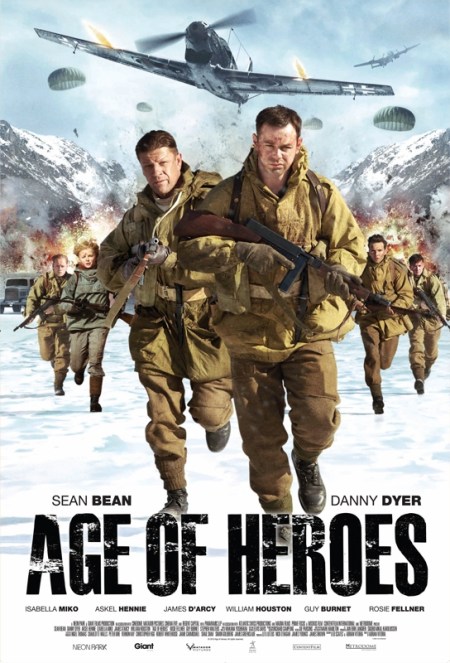
It would be very hard for me not to watch a movie starring Sean Bean and that is why I was looking forward to Age of Heroes a movie based on the true story of Ian Fleming’s Commando Unit. Lucky yesterday wasn’t one of my impatient days or I wouldn’t have finished it. It would have been too bad as the movie improves considerably after the first 15 extremely dodgy minutes are over. But, judging from the ratings on IMDb, people didn’t forgive the movie its beginning…
Age of Heroes follows a British special forces unit on a crucial mission called “Operation Grendel”. The men, being part of Ian Fleming‘s so-called Commando unit, one of the first special forces units, have undergone a very hard training. They are led by a hard but funny training officer (William Houston) and their highly appreciated leader Major Jones (Sean Bean). Jones is one of the best leaders I’ve seen in a war movie. He is tough but just, clever, courageous and not without kindness. Part of the unit is the Norwegian born American Steinar (Axel Hennie, Max Manus). This makes a lot of sense as the mission takes place behind enemy lines in occupied Norway. The Commando unit will have to drop in Norway and get some German radars in order to analyze them. The whole operation has been planned and is closely supervised by Ian Fleming (James D’Arcy) in London. A lot of what he experienced during the war when he was an assistant of the Director of Naval Intelligence was later used in his James Bond novels.
Needless to say that this was a dangerous suicide mission and, typical for this type of endeavor, many things went wrong and people died. As we get to know the characters well before they go on their mission, we care for them. One of them is introduced early, in the unfortunately weird beginning that takes place in France, and we get to know and like the others in the British training camp.
All in all it was an entertaining movie if somewhat flawed. It is flawed because it reminded me of some recent Resistance movies and lack of originality is a flaw. But it was also flawed because the film makers seem not to have been decided whether they wanted this to be more of an action or more of a war flick. The story is a war story but the movie is told like an action film.
If you like Sean Bean and have never heard of the Commando unit, the precursor of the SAS, you will enjoy watching it and, due to the action twist it is quite gripping.
Agnieszka Holland’s movie Europa, Europa is based on the true story of Salomon Perel. It is frequently mentioned as one of the top 100 war movies. It’s a harrowing and quite unbelievable story, still I have to confess that I did not like it.
The Perels are a Jewish family living in Germany at the beginning of the war. When anti-Jewish acts become more and more frequent, they are attacked and the daughter is killed. Salomon’s parents send the young boy and his brother to Poland where he should try to survive at any cost. He looses his brother early in the movie and ends in a Russian communist orphanage. Here he is given a passport and has to undergo some serious communist re-education. When the Germans invade Russia, the orphanage is attacked. They all flee and Salomon gets captured on the way by a Nazi patrol. All the Jews are shot immediately and it is only thanks to an extreme presence of mind that Salomon manages to make them belive that he is a true German and that he can be extremely useful as interpreter since he speaks Russian fluently. The soldiers take him along and he fights with them, helps them as a translator. He has to be super careful that no one sees him naked and this will stay a constant topic throughout the movie. The fact that he is circumcised would give his identity away.
A German officer hears of the young boy and that he is an orphan. He likes the bright boy and thinks of adopting him but first he sends him to one of the Nazi elite schools where he will be educated and trained. Here again, he has to be careful in order to not be found out. There are a few incredible scenes in the school. In one scene a teacher shows that one can see unmistakably, that, despite his dark hair, Salomon is of pure Aryan breed. The pupils are taught to hate the Jews and how to detect them. The absurdity of such scenes is incredible and Nazi madness made apparent.
Salomon is barely 16 years old and falls in love for the first time. Although the girl is willing “to do it”, he has to say no. The danger of being detected is too big.
It is incredible to think that he got away with it for so long. He blended in so perfectly, was such a good actor and so cold-blooded that they never even suspected him to be Jewish.
After the war Salomon finds out that his whole family died in a ghetto in Poland. He leaves Europe and settles in Palestine. At the end of the movie we catch a glimpse of the real Salomon Perel.
It took me a while to figure out why I didn’t like this movie. I didn’t like it because I didn’t like Salomon. I suspect that I found his behaviour cowardly. He isn’t much better than a collaborator. It disgusted me to see him act and talk like a Nazi. Sure, he was only a boy, he wanted to survive, he lost his family… I think sometimes it’s better to die than to sell out. Bit harsh, I know, but surviving is not everything.
I’d be really interested to know what others think of this movie.
France, a country that has endured and fought many wars, was at the center of many a battle and armed conflict, a country famous for its outstanding filmmaking has produced a very modest amount of war movies. You will find numerous WWII movies on the Resistance and a fair amount of rather psychological war-time movies but if you are looking for combat movies, you will not be lucky. I know of no French air combat or submarine movie at all.
There may be many reasons and I can only attempt an interpretation, comparing French cinema in general to the cinema of other countries. What becomes apparent soon is that the French are not keen on producing large-scale, epic or very action driven cinema. French movies are psychological and intimate. They focus on the dynamics between a few people, their interaction, the dialogue. Many of the most famous French movies focus on tiny details, small things. It’s easily understood that this doesn’t fit in with infantry combat movies with their huge casts and more action driven story lines.
In choosing 12 movies I tried to pick the few real combat movies I knew and added the ones that I think excellent or that absoultely need to be watched. I also tried to covera wide range. I left out good ones, I’m sure.
For those who want to further explore French cinema the website French War Movies offers a great overview.
I discovered one huge problem for the non-native speaker when I watched La Grande Illusion recently as I bought a movie with English subtitles. Almost 2/3 of the dialogue was missing. I noticed the same when I watched and reviewed the Italian Rome, Open City (here is my review). Since French and Italian movies are dialogue driven, it’s very hard for a non-native speaker to fully appreciate them. I’m sure this is done better in more recent movies, still it is a problem.
With all this said, let’s open the curtain for twelve stunning movies:
La Grande Illusion aka Grand Illusion (1937): WWI. Jean Renoir’s movie is one of the great classics of European cinema starring the late great Jean Gabin. A POW movie that offers a lot. Interesting German characters included. (Here is the review)
Nuit et brouillard aka Night and Fog (1955): WWII. Alain Resnais’ Holocaust classic. Death Camps. Final Solution. Documentary/original footage about the horrors of the concentration camps. Gut-wrenching. Impressive. A must-see. (Here is the review)
Hiroshima Mon Amour (1959): WWII. Another movie by Alain Resnais. A love story between a French woman and a Japanese man from Hiroshima. Interspersed with original footage of Hiroshima. Very special and poetic based on the scenario by Marguerite Duras. A must see for French cinema aficionados. (review upcoming)
L’armée des ombres aka The Army of Shadows (1969): WWII. Jean-Pierre Melville’s Resistance masterpiece. Another classic. Claustrophobic, impressive, sparse. Excellent actors. One of the most depressing movies I’ve ever seen. (Here is my review)
L’honneur d’un capitaine aka A Captain’s Honor (1982): Post war. Algeria. A captain who died on the battle field in Algeria is accused of having been a torturer and a murdered. His widow tries to prove that he wasn’t guilty. (review upcoming)
Dien Bien Phu (1992) : Indochina. Infantry Combat. Schoendoerffer’s movie shows the final defeat of the French in Indochina. Not nice to watch at all. (review upcoming)
Le pianiste aka The Pianist (2002): WWII. Holocaust. Tells the story of a Jewish pianist in the Warsaw ghetto. Harrowing and beautiful. My favourite Holocaust movie. Very moving. (review upcoming)
Un long dimanche de fiançailles aka A Very Long Engagement (2004): WWI. Based on Sébastien Japrisot’s eponymous novel it tells the harrowing story of young Mathilde who travels to the no man’s land of WWI in search of her lost fiancé. This is one of the darling movies of international film critics. I did like it but wasn’t awed. Starring the much-loved Audrey Tautou. (review upcoming)
Joyeux Noël aka Merry Christmas (2005): WWI. The story of the little peace during the Great War. During the first Christmas in WWI, German, French and British/Scottish troops cease fire and play football together. Wonderful movie with great actors. One of my Top 10 all-time favourites and one of the bestanti-war movies that exist. (Here is the review)
L’ennemi intime aka Intimate Enemies (2007): Algeria. One of the very few French Infantry Combat movies. Very good and very critical. About the ugly side of an ugly war that was officially no war. If you want to find out why I found this hard to watch, you’ll have to read the About page. (Here is the review)
L’armée du crime aka The Army of Crime (2009): WWII. French Resistance. Based on the true story of a group of young people and immigrants who fought a desperate fight against the Nazis. They were led by the poet Manouchian. This is an absolutely stunning and very tragic movie. One to watch and re-watch. It went directly on my Top 10. (Here is the review)
It’s nice to watch a movie that is almost flawless like Mikhail Kalatozov’s The Cranes are Flying, a masterpiece of Russian cinema. It’s touching and beautiful and for once free of any traces of propaganda as it was filmed after Stalin’s death.
I haven’t seen many movies depicting the Russian home front during WWII, so that was interesting as well.
The Cranes are Flying tells the love story of Boris (Aleksey Batalov) and Veronica (Tatyana Samojlova), two young people who are very much in love and whose love is deeply affected by the outbreak of the war.
The only thing Veronica hopes when she hears about the war is that Boris will not be drafted, only he has other plans. He has already volunteered and his hasty departure doesn’t even permit to say good-bye.
Scenes like the one in which Veronica runs to the train station and hopes to see Boris one last time and say good-bye but is held back by the masses is quite tragic. She can see him but he doesn’t see her and no matter how much she fights to get his attention, it is utterly futile. We see many scenes like this in the movie, in which the camera stays for a long time on Veronica’s expressive face, which mirrors her tumultuous feelings and despair, and in which she seems to fight forces that are beyond her.
After Boris departure Veronica faces utter loneliness. Day in and out she waits for a letter from him but nothing arrives. When she looses her parents in an air raid, she is completely alone. Fortunately Boris father is a kind man and asks her to live with them.
Boris cousin who was always very interested in Veronica tries to seduce her once Boris is gone and when she doesn’t give in, he finally rapes her. Desperate and lonely Veronica accepts to get married to him.
The family lives together in very quarters. The father and his eldest daughter are both doctors and constantly needed at the hospital. Even though she is now married, Veronica still waits for a letter from the front.
In the second half of the movie scenes from the front and the home front are interwoven.
The story is moving and sad but what is really compelling about this movie is the cinematography. The black and white shots are haunting. The way Veronica’s face is filmed is wonderful. Tatyana Samojlova really has a captivating and expressive face.
I was surprised about the characters as well. The father is one of the most positive father figures cinema has to offer. He is kind, gentle and understanding but at the same time determined and strong. He isn’t very patriotic and doesn’t think it is admirable to volunteer.
This is one of those movies that should not be missed and that will probably be even better when you watch it a second time.
I don’t think there are many movies as hard to watch as Alain Resnais’ famous testimony Night and Fog. It’s a testimony to one of the darkest chapters in human history. The film is only 30 minutes long and combines actual footage with a documentary part on the concentration camps in 1955.
I have to admit that this movie made me physically sick. I could literally not stomach it.
The camera takes us to a concentration camp in 1955. This is pretty much what they still look like today. I think most of them have been preserved the way they were and can be visited. The camera approaches the camp and a monotonous voice that almost sounds as if reading a poem tells us what we see and meditates about the fact that this all looks so normal, that all the names like Dachau, Buchenwald, Auschwitz, Treblinka were once just names and spots on a map.
From those initial pictures the movie switches to actual footage and we see first the trains, then the arrival in the camps, the conditions of the barracks, the hospitals where they performed horrible vivisections, the showers, the furnace, the piles of bodies.
The combination of the voice, the back and forth between the images of today and the actual footage showing those emaciated faces, the grimaces of those who died in pain, the huge mountains of hair and shoes and skin… It’s hard to bear.
I think this is one of the most important films on the extermination camps there is.
Most of it can be watched on YouTube but it would be better to watch it in one go to get the full impact.
I had to watch all of it. I think those masses who endured all this deserved it. Who am I to complain about an upset stomach? After turning it off I was back in my own cozy life, while they had really been there…
Most important of all, a movie like this, that bears testimony to an atrocity, helps us to not forget and to never ever let it happen again.


 All About War Movies