The Way To the Stars aka Johnny in the Clouds (1945) A British WWII Movie about British and American Pilots on a UK Bomber Base

Starting just before the Battle of Britain The Way to the Stars tells the story of two friends and the people that surround them on a British airbase. Flight Lt. David Archdale (Michael Redgrave) and Pilot Officer Peter Penrose become friends when Penrose (John Mills) arrives at the base where Archdale is squadron leader in 1940.  The years go by. Penrose who was a total rookie at the beginning of the movie becomes a good pilot. Archdale gets married to the hotel manageress Toddy and they have a baby. Penrose falls in love with Iris who lives at the hotel with her very stern aunt.

In 1942, just before the Americans join the base, Archdale doesn’t return from a mission. Shortly before this he withdrew Penrose from flying duty as he had done far too many missions. He was now a controller which he hated. When his friend dies he becomes very bitter  and breaks up with Iris.

The arrival of the Americans in 1942 changes the tone of the movie. We could say that we become witnesses of a real culture clash. I think this is very well done and the movie manages to do both countries great justice. I enjoyed this a lot as it is so insightful and does poke fun at both.

One of the American pilots, the eponymous Johnny (Douglass Montgomery), plays an important role in the second half of the movie.  He is married but he likes Toddy a great deal, probably falls in love with her. This is not a clichéd story of an adultery but a nuanced  tale of two people who meet each other, feel very close and realize that under other circumstances they would have become lovers.

For the aviation buffs out there I have to say that we see no combat scenes but we benefit greatly from the time during which this movie was shot as you will hardly see so many original planes and different types of planes in any other movie (certainly not in anything modern). We get a particularly  good feel for the American Flying Fortress. An important part of the movie takes place in Toddy’s hotel which allows for some great character portraits. It is quite a motley crew that one would have encountered in a hotel during the war. Another interesting aspect.

In many ways this is a unique movie. Touching and quite accurate in the depiction of life on an airbase at the time. 4/5

War Requiem (1989) Derek Jarman’s Impressive Interpretation of Benjamin Britten’s Eponymous Requiem

Futility 

Move him into the sun —
Gently its touch awoke him once,
At home, whispering of fields unsown.
Always it woke him, even in France,
Until this morning and this snow.
If anything might rouse him now
The kind old sun will know.

Think how it wakes the seeds —
Woke, once, the clays of a cold star.
Are limbs so dear-achieved, are sides
Full-nerved, — still warm, — too hard to stir?
Was it for this the clay grew tall?
— O what made fatuous sunbeams toil
To break earth’s sleep at all?


I have never seen anything like the War Requiem before. Although I used to like Derek Jarman‘s movies (especially Caravaggio, Sebastiane and The Tempest) I wasn’t aware that this existed before I saw a review on the War Movie Blog. This is certainly not for everybody. If you don’t like classical music, especially requiem’s you will have a hard time. I tell you this right away. Jarman took Britten’s War Requiem, which consists of a proper requiem and sung versions of Wilfred Owen’s poems, and illustrated it. Wilfred Owen is the young poet we also see in the movie Regeneration. He was killed in action one week before the end of in WWI. As you can see I added two of his poems for you.

War Requiem is actually a silent movie so to speak. We see images, acted scenes and hear Britten’s music. In part it’s a reenactment of Wilfred Owen’s story, in part we see actual footage of different wars. Documentary and art are entwined and the result is extremely rich and interesting. The acting is of course somewhat exaggerated as the actors are miming not acting as they don’t talk (silent movie style). The two main actors are Nathaniel Parker (Owen) and Tilda Swinton (The Nurse): Sean Bean (The German Soldier) and Laurence Olivier (The old Soldier) are in minor roles. There is a bit with Tilda Swinton who plays the nurse that is very annoying (scene 10). But that was the only bit I found hard to take. The rest is impressive. Beautiful images. Colors are very important and highly overdrawn as they are in all of Jarman’s movies. In this one it is the color red that is artificially bright. Colors have a special meaning in Jarman’s work. He wrote a book, Chroma: A Book of Colors, dedicated to color interpretations and his last movie is dedicated solely to the color Blue. The tragedy behind all this is that Jarman was going blind towards the end of his life. He suffered from AIDS related illnesses and finally succumbed to them.

War Requiem is remarkable also because it is not only an anti-war movie but also an “anti war movie movie”. If you watch all of it and don’t give up in the middle you might be astonished to see what kind of actual footage you see towards the end. I have never seen anything like it before and felt very uncomfortable. The footage we see – especially from Vietnam and Angola – is horrible and gruesome. What is even more horrible is that you see the difference between wounds in a war movie and these head wounds and other wounds in these documentary bits. It simply doesn’t look the same. You see immediately that these people are really dead. I think to see something like this would be good for every person who regularly watches war movies. The atrocities of war are so much more horrible in reality. It was extremely sobering to say the least.

This is a really special movie. It is an interesting contribution to cinema history as well as to war movies  in general. But it is not for everybody.

Anthem for Doomed Youth 

What passing-bells for these who die as cattle?
Only the monstrous anger of the guns.
Only the stuttering rifles’ rapid rattle
Can patter out their hasty orisons.
No mockeries for them; no prayers nor bells,
Nor any voice of mourning save the choirs, —
The shrill, demented choirs of wailing shells;
And bugles calling for them from sad shires.

What candles may be held to speed them all?
Not in the hands of boys, but in their eyes
Shall shine the holy glimmers of goodbyes.
The pallor of girls’ brows shall be their pall;
Their flowers the tenderness of patient minds,
And each slow dusk a drawing-down of blinds.


And a Nightingale Sang (1989) A Very Realistic British WWII TV Romance/Drama

War and Romance make often a succesful combination. WWII and Romance even more so. I think I have seen a fair share of them and although it is not my favorite genre I like it when it is well done. I don’t think I would have heard of And A Nightingale Sang (based on the book by C.P.Taylor) if it hadn’t been recommended by Gray Freitas. I finally felt like watching it and was really not disappointed. It is actually a very realistic depiction of life in the British town Newcastle from beginning of WWII to its end rather than a romance.

And a Nightingale Sang has all the charm of British TV. It is bittersweet, lighthearted and hilariously funny at the same time. At the center is the slightly dysfunctional and very eccentric Stotts family. The mother is a fervent Catholic and constantly going to church to confess. To her dismay she realises that she has a crush on the vicar. The father is tempted by communism and drives everybody crazy by playing the piano endlessly. The grandfather mourns his dead whippet and later carries his cat, Winston, everywhere, even into the air-raid shelter. The daughters both fall in love for the first time. Joyce gets married and regrets it immediately, while disabled Helen falls in love with a married man. The depiction of  wartime life in an English town is excellent. The bombings, the rushing to the shelters, the scarcity of provisions, but also the fun and the attempt to make the most of it. The people at the center of this story are all likable eccentrics.

The end is certainly the best bit in the movie. I almost wished I had been there. That must have been something, to know the war was over and Germany had been defeated. The cheer and joy are conveyed nicely. I cannot remember having seen any other movie showing it like this.

Realism and entertainment make a great combination. Plus really great acting (Joan Plowright as the mother, Phyllis Logan as Helen and Stephen Tompkinson as Eric). And what about the romance? Touching and realistic as well.

Grave of the Fireflies aka Hotaru no haka (1988) An Anime War Movie

Thanks to Novroz who mentioned Grave of the Fireflies pointing out I should review it on this site I finally watched this very beautiful anime last night.

Animes are maybe not everybody’s cup of tea and I am far from being an expert having only seen the other Studio Ghibli treasure Princess Mononoke aka Mononoke-hime still I know when I see a masterpiece. And Grave of the Fireflies is a masterpiece and should have been added on my Children in War Movies List before. This is an artfully drawn anime with a very moving story. It is a must-see for anime fans and people interested in war movies alike.

War does affect people in different ways. Some fight in it and die in it. Some get injured and are sent home. Others return suffering from post-traumatic shock. But many stay at home. All the old people, the children and the women. What about those people on the homefront? What happens to them? How do they cope with constant air raids, lack of food and other supplies? How do children cope? This is what Grave of the Fireflies shows us. You have to watch the first five minutes very carefully or you might not get the full meaning of the movie. It is quite subtle and could be missed.

Seita and Setsuko, a brother and his little sister, are two Japanese children whose lives are profoundly affected by the war. Their mother dies in an air raid while their father, an officer of the Japanese Royal Navy, is at war. The two children find refuge at the house of their aunt. But close quarters and lack of food doesn’t help and they are soon not welcome any more. Left with some money the children leave the house of their realtives and live in a shelter outside of town. The brother who is ten years older cares touchingly for his little sister but he can hardly find anything to eat. He tries to buy something but no one sells anything. He tries to steal and gets beaten up. The little girl gets weaker and weaker and finally falls very ill. When Japan surrenders Seita hears from someone that the Navy has been completely destroyed. His father is very probably dead as well.

The end of this movie is particularly good. It’s very sad and I can understand that people who are less familiar with war movies in general might be very shaken. I don’t think it is advisable to watch it with little children although it is not gruesome but the way death and war are treated is very emotional. The little girl is absolutely amazing. So realistic.

Even though this is a war movie it is also a meditation on life’s fragility and fugacity. A very poetical and emotional movie with wonderful pictures.

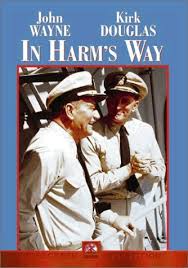
In Harm’s Way (1965) or John Wayne, Pearl Harbor and Some Decent Naval Combat in the Pacific

I don’t know how many war movies John Wayne did. The only thing I know, he did a lot. I’ve seen The Longest Day but apart from that Otto Preminger‘s black and white movie  In Harm’s Way was my first. I actually quite liked it. It’s a decent movie with some interesting female leads and a love story between John Wayne and Patricia Neal’s character that resembles a real relationship and not some ridiculously soppy romance.

I already mentioned it in my post on Pearl Harbor as it starts on the night before the attack of Pearl Harbor. At the center of the movie is Admiral Torrey who is first demoted and then promoted again. The movie analyses what is going on outside of the actual battles; the planning, the men’s love and private lives. Torrey meets his son who is in the Navy for the first time after several years. Their relationship is very conflict-laden but evolves during the movie. Torry gets to know the nurse Lt. Maggie Haynes (Patricia Neal) who is probably one of the greatest nurses in any war movie. Kirk Douglas plays a real asshole, Commander Eddington. We see a few decent battle scenes but nothing too exciting.

Too cut  a long story short, In Harm’s Way is a movie for John Wayne fans, for people who want to watch something older about the war in the Pacific, for those who like a well-told story that focuses on relationships and for those who can overlook a few gender related oddities (Two things struck me. One was the “tea scene” and the other the way people react to Eddington’s crime). As a war movie I would rate it 3.5-4/5.

Don’t miss the trailer. I have never seen a trailer like this. I first thought it was a parody and then I realised it was just unreflected promotion. It has real historical value. Just watch it and thank God that trailers have evolved through the years.