Costa-Gavras’ Music Box (1989) A Court Room Drama About War Criminals

Music Box is not a war movie in the strict sense of the term, especially not since it takes place some 40 years after the war. But it is about what happened to war criminals after the war. The one or the other is still caught today. Many tried to hide in distant countries. Some live in South America but there are certainly also a lot in the US. Since I want to watch Der Stellvertreter aka Amen by Costa-Gavras, I thought it might be interesting to re-watch this one before. I remembered that it moved me quite a bit when I saw it for the first time. I found it totally gripping. As much of the suspense comes from the question whether or not the accused committed the crimes I could concentrate on other elements this time.

Just imagine for one second, someone told you, your mother, or your father was a war criminal. He is said to have left the country shortly after the war and gone to the US where he led an exemplary life as a devoted father, able worker and much liked colleague. Imagine the two of you had a very close relationship. You love the stories your father tells you about his childhood and his youth, the horrors of the war and how he managed to flee to a more welcoming country. Your son adores him, your in-laws respect him. But then, one day, the US government accuses him of being a monster and wants to extradite him to Hungary where he would be judged. That is the story of Music Box. Ann Talbot’s (Jessica Lange) father, Viktor Laszlo, a Hungarian immigrant is accused of having committed war crimes. Ann is a successful lawyer and decides, after some initial reluctance, to defend her father. She doesn’t doubt for one second that he is innocent and soon she is able to prove that there have been wrong accusations before, that the Communist countries often try to get at those who fled from them. She is outraged by the injustice that is done to her father and equally shocked by the crimes, the man who is called Mischka, has committed. Torture, executions and rape. But what is the worst he is accused of is the fact that he showed no mercy, compassion or any other signs of empathy. Mischka enjoyed what he did. Much of it took place on the banks of the Danube in Budapest, near the famous Chain Bridge. One of the last parts of this gripping court-room drama takes place in Budapest. A nice addition to the movie. Budapest is a town I am particularly fond of but when I had seen the movie for the first time, I hadn’t been there yet. I didn’t even remember that part of it was filmed there.

Jessica Lange, Armin Mueller-Stahl and Frederic Forrest, the main actors are fantastic. Armin Mueller-Stahl is one of the very great German actors. I have often problems when actors fake an accent but he does it well.

For one reason or the other, I always compare Music Box to Sophie’s Choice. I find them both equally convincing from a psychlogical point of view. Both have outstanding female actresses in main roles. And they both have this typical 80ies feel.

I was wondering how I would rate this movie. It is interesting and gripping, psychlogically accurate but doesn’t deserve 5/5. It is somewhere between 4 and 4.5 because it is a tad too sentimental.

NaPolA Elite für den Führer aka Before the Fall (2004) Looking into the Mechanics of Black Pedagogy

To call this movie brilliant is an understatement. The German movie NaPola is quite an achievement. It perfectly illustrates the German concept of Schwarze Pädagogik meaning Poisonous or Black Pedagogy. Psychologists believe today that this harmful pedagogy was one of the root causes for the success of Hitler and the wide acceptance of Nazism.

NaPola is the story of two boys,  their friendship and “the pity of it all”. Friedrich (Max Riemelt) personifies the Nazi ideal to a high degree. Strong, able, intelligent. A talented young boxer. It doesn´t take long and he is recruited for one of Hitler´s NaPolA´s (National Political Academy) where the elite of German youth is trained, educated and above all fanaticized. NaPolA´s are in part boot camp, in part higher education. Once in school, he meets Albrecht (Tom Schilling), the son of a Gauleiter. Albrecht is the very opposite of Friedrich. He is  frail, sensitive and intellectual. His father, a fanatic,  obnoxious idiot hates his son´s guts. Albrecht personifies everything  he despises. Too small, too weak, too spiritual. Because Albrecht´s father is a Gauleiter, life at the NaPola is not so difficult for him  as he is protected. For Friedrich it is not difficult as he is very sporting and strong but many of the others show sings of being traumatized. Discipline, total obedience and endurance are the key words of this education. As unlikely as it seems, the two boys like each other a lot and become very close friends until the tragic end. The story of the two boys is exemplary for many stories of children and young people who were sent to NaPola´s. Towards the end of the war, when it was quite obvious that Germany was going to lose, Hitler sent all the boys from the Napola´s to the front where 50% of them died.

Everybody who knows me or follows this blog knows I am a sucker for great score. None other than Angelo Badalamenti (see all the scores and listen to his work on his fantastic Homepage) who did the scores for two of my top favourite movies Mulholland Drive and Lost Highway (Yes, they are not war movies.) did the score for NaPolA. It´s perfection. Badalamenti is no Hans Zimmer, he is far more subtle.

This is a 5/5 star movie and  a must-see for many reasons.

I would like to point out that whoever is interested in some psychological analysis of the Third Reich may find ample material in Erich Fromm´s The Anatomy of Human Destructiveness and Alice Miller´s For Your Own Good: Hidden Cruelty in Child-Rearing and the Roots of Violence.

Further war movies with children or young people can be found on my list Children in War Movies.

The Bridge on the River Kwai (1957) Almost Everybody´s War Movie Darling

Yes, I know, it’s hard to believe but until a few days ago I had never watched The Bridge on the River Kwai. I couldn’t give you any specific reason. Just never happened. I have never been to New York either. Just because something is great, famous or whatever not doesn’t mean everybody has experienced it. While I can go on blogging about war movies without having visited New York, it wasn’t any longer acceptable that I had not watched one of the all-time favourite war movies of so many. One of the six that made it on the list about which I wrote the other day.

So I did it. I watched it and… As odd as this is, it wasn’t what I had expected. I am not talking about the story. I was quite familiar with it as is almost everybody. No, it was the cinematography that stunned me. This is a lush and astonishingly beautiful movie with intense and memorable pictures. As I read after having watched it, this striving for esthetics has been criticized (especially the cute girls and half-naked men in shallow pools… William Holden had to shave his chest hair off and we can see him in every single of his half-naked scenes with glistening torso. Can’t say that impressed me much but it is an interesting detail).

Beautiful pictures, together with great acting, a gripping story, an anti-war statement, the juxtaposition of  British and American characters and an astonishing ending make a great combination. There is something for everybody in it, I guess. No wonder it got 7 Academy Awards including best picture, best director, best actor (Alec Guinness), best writing, best music, best film editing, best cinematography.

The story can be told in a few sentences. A Japanese prison camp somewhere between Rangoon and Bangkok. Colonel Saito, one of those sadistic officer types, forces the prisoners, including their officers to help building a bridge over the River Kwai. Col. Nicholson, the highest ranking British officer in the camp, opposes and offends him. As a consequence he is sent to a very harsh solitary confinement. He is in a certain way as stubborn and fanatic as Saito himself and won’t give in. Somehow though they realise that they need each other and come to an agreement. Nicholson will supervise the construction of the bridge that will be built by British prisoners only. The bridge is meant to bear testimony for future generations to the endurance and skills of British soldiers.

The American Shears (William Holden) is also in this camp. He can’t understand any of this. For him it is important to survive. Honor and courage are secondary. The only thing he wants is to escape. One night he manages it finally and makes it back to high command. There he is told that he will have to go back, accompanying a little troop, as he knows the terrain. It has been decided that the bridge will be blown up. From this moment on two stories run in parallel. The one in the camp and the other one following the little troop through the jungle (the movie has actually been filmed in Sri Lanka, should anyone wonder).

I won’t spoil the ending for those who haven’t seen it. Let me just say it is not a happy one.

I think one of the most important elements in this movie is certainly the juxtaposition of the two extremes as they are personified by the British officer Nicholson and the American Shears. Nicholson’s way is slightly outdated and not very life-affirming. Alec Guinness is memorable in this role. Apparently he turned it down at first because he thought it was too anti-British (I can’t blame him).

The Bridge on the River Kwai is based on the novel by Pierre Bulle. The ending is different from the one in the book though. Both are based on true events. The Japanese had indeed British prisoners build a railway line from Rangoon to Bangkok. Countless people died. Many years after the war the Japanese government apologized for these events.

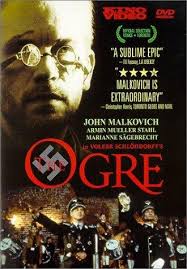
The Ogre aka Der Unhold (1996) or Nazism, Symbolism and the Erlking

Volker Schlöndorff’s The Ogre aka Der Unhold (France/Germany/UK) is based on Michel Tournier’s novel Le Roi des Aulnes aka The Ogre. The Ogre is a highly symbolical, original and complex  movie that attempts nothing less than to explore Nazi symbolism and ideology, German culture and mythology by telling the incredible story of Abel Tiffauges, a man who loves children and animals and who makes himself believe he is more than just human. The movie is filmed in English, French and German.

Plot

Abel Tiffauge’s story has five very distinct parts. Part I. Childhood. The French boy Abel grows up in a Catholic private school for boys. He is the outsider, the odd one, the one others pick on, the one the priests punish whenever someone has done something. Especially a very fat boy exploits Abel whenever possible. But he is also his only friend. When Abel is wronged again he wishes a catastrophe upon everybody. And it happens. From now on he believes he is invincible and powerful. Part II. Grown-up. Abel is still odd and a loner but he is also an auto mechanic with a flourishing business. Abel is also an amateur photographer and likes to take pictures of kids. There is nothing he loves more than kids. This very innocent fondness is mistaken for child molesting. Instead of being sent to prison, the falsely accused is sent to war. Part III. POW. Abel is captured together with his officers and sent to a German camp, somewhere near the Polish (?) border. During the day when everybody works he sneaks off to an abandoned hut and befriends a moose. One day he meets Goering’s forester. Part IV. Goering. If Goering was anything like the Goering portrayed in this part, then he was one of the most revolting beings to have ever walked this Earth. Abel is to help on his hunting lodge and gets a close look at the way the Nazis and their friends spend their leisure time. Drinking, eating, hunting. Very vulgar. Part V. The Erlking. Abel is sent to Kaltenborn Castle an elite training camp for German boys. He is happy like never before and loves to be able to take care of these boys but he also takes an active part in their training. Soon he starts to collect the boys from the neighbourhood and the people who are afraid of him call him the ogre. He doesn’t realize that he is doing wrong. When the Russians approach and people from concentrations camps are liberated, he starts to understand what he has been part of. He tries to help a Jewish boy and almost gets killed.

Meaning

So much for the content of The Ogre. But that is only one part. The movie shows us in stunning pictures what it must have been like to face Nazi ideology. The power of the imagines they created by using potent symbols is amazing. The visualization of this ideology is fantastic. Just take a look at the trailer and you see some of it. The boys standing in the form of a giant Swastika holding burning torches in the night. But then there is also the undercurrent of German culture, of everything that was good about Germany and was perverted by the Nazis. The love of the forest, love of animals, children, poetry.  Goethe’s famous ballad The Erlking is quoted and put into pictures in a very spooky way. Without knowing this poem a great part of the movie’s meaning stays hidden.

Who’s riding so late through th’ endless wild?
The father ‘t is with his infant child;
He thinks the boy ‘s well off in his arm,
He grasps him tightly, he keeps him warm.

My son, say why are you hiding your face ?
Oh father, the Erlking ‘s coming apace,
The Erlking ‘s here with his train and crown!
My son, the fog moves up and down. –

Be good, my child, come, go with me!
I know nice games, will play them with thee,
And flowers thou ‘It find near by where
I live, pretty dress my mother will give.”

Dear father, oh father, and do you not hear
What th’ Erlking whispers so close to my ear?
Be quiet, do be quiet, my son,
Through leaves the wind is rustling anon.

Do come, my darling, oh come with me!
Good care my daughters will take of thee,
My daughters will dance about thee in a ring,
Will rock thee to sleep and will prettily sing.”

Dear father, oh father, and do you not see
The Erlking’s daughters so near to me?
My son, my son, no one ‘s in our way,
The willows are looking unusually gray.

I love thee, thy beauty I covet and choose,
Be willing, my darling, or force I shall use!
“Dear father, oh father, he seizes my arm!
The Erlking, father, has done me harm.

The father shudders, he darts through the wild;
With agony fill him the groans of his child.
He reached his farm with fear and dread;
The infant son in his arms was dead.

The Cast

John Malkovich as Abel Tiffauges is astonishing. I think it is one of his best roles. He is such a weird-looking actor and that is perfect for this role. I particularly like the three German actors Heino Ferch, Armin Müller-Stahl and Gottfried John. But everybody else, especially those many little boys and girls, are very convincing.

The Director

Volker Schlöndorff can look back on a career with many an important movie. He is not just any director but one of the very great. He has done the war movies The Tin Drum and The Ninth Day and the movies Swann in Love, The Handmaid’s Tale and Ulzhan.

The Score

Michael Nyman is one of my favourite composers. He is foremost famous for the scores he wrote for Peter Greenaway and Jane Campion. This one here is OK but not as outstanding as his other work like Draughtman’s contract, Gattaca and The Piano to name but a few.

For me this is a 5/5 star movie. It has incredible pictures, is dense and complex and invites you to rethink Nazi ideology and symbolism like not many others. It is better than the Boy in the Striped Pyjamas that is for sure. But not as good as Pan’s Labyrinth.

Other war movies with children as main characters can be found on my list  Children in War Movies.

Cross of Iron aka Steiner – Das eiserne Kreuz (1977) or Showdown on the Eastern Front

…Peckinpah successfully stripped the combat of the patriotic heroism and glory that usually accrue to it in war films (Stephen Prince quoted in Under Fire p. 52)

Sam Peckinpah´s only war movie, Cross of Iron, is a UK/German co-production and probably one of the best war movies you can possibly see. It is based loosely on the battle of Krymskaya that took place during the German retreat in 1943. The original source is Willi Heinrich´s Das geduldige Fleisch aka The Willing Flesh. Heinrich fought himself on the Eastern Front. It contains quite a lot of  graphic infantry combat scenes. Steiner is one of my top favourite characters, right after Sgt. Elias, however much more cynical but a good man at heart. I have read reviews of this movie that were not favourable and I admit, it could be misunderstood. If you do not pay very close attention and take into account the opening and final credits, you might simply not see the profundity of the anti-war statement.

Cross of Iron opens on a cheerful children´s tune Hänschen Klein ging allein, in die weite Welt hinein, Stock und Hut, stehn ihm gut… While we hear this tune we see black and white footage of grim content interspersed with pictures and stills of Hitler Youth to show us the slow ideological infiltration of the German youth.

The movie tells us a story from the point of view of a German platoon on the Eastern Front in 1943. At the heart of the story is the antagonism between Sgt. Steiner (James Coburn) a much admired veteran who has already earned two Crosses of Iron and Captain Stransky (Maximilian Schell) an arrogant, conceited Prussian officer whose only goal is to be awarded such a cross. When tensions intensify Stransky does not inform Steiner and his platoon of their retreat and the men are left stranded behind enemy lines. They barely make it back and Stransky let´s his men open fire on them. We get to see a scene that resembles many a Western showdown.

The final credits are quite different from the opening ones. The statement  clearly is: war is pure madness. We hear a hysterically laughing Steiner, the annoying children´s song of the beginning and see black and white photos. Those photos are interesting, the first shows the execution of young Soviet partisans (see more info in B Hellqvists comment below) followed by the pictures of children in different wars, Vietnam, somewhere in Africa…

This movie wouldn’t be the controversial movie it is if there were not other extremely important elements that have not so much to do with the core story. Steiner has an affair with a nurse (Senta Berger) after being wounded. This scene, that has been criticized, is meant to emphasize his cynicism and, I believe, should be seen paired with the other female roles in this movie, namely the female Russian soldiers Steiner´s troop encounters on the retreat. It is rare that you see female soldiers in war movies unless they are Russian. Running out of men and considering women – due to their assumed patience – to be better snipers Russia recruited a lot of women towards the end of the war. There are a few Russian movies dedicated solely to female soldiers (I will review them in due time). But let’s get back to Cross of Iron. The encounter of those female soldiers and Steiner´s men gives us one of the most graphic scenes I have ever seen in a war movie. Not for the fainthearted.

All in all, apart from the central story of hatred between two men from different social classes, the movie is complex and composite. It certainly gains by being watched twice. The actors are all very good. James Coburn is fantastic.  Maximilian Schell is very good and so are James Mason, David Warner and Senta Berger.

What I liked a lot is how daring Cross of Iron is. It does not shy away from touching topics that are normally left out, it goes beyond what we are used to see and stays in your mind long after you watched it.

I must admit that personally and for reasons that elude me, I was always extremely fascinated by the tales of the Eastern front. This dates back to my childhood when I found a book in my grandmother´s library called “Letters home from Stalingrad” (it is as good as Letters home from Vietnam and not less tragic). Thinking that without the British and the Americans the outcome of the war between these two countries would have determined all of Europe´s fate gives me the creeps…

“What will we do when we have lost the war?”

“Prepare for the next one.” (Cross of Iron)

Cross of Iron is among my Top 20, that is for sure.