Marine Raiders (1944)

Marine Raiders

Marine Raiders is a black and white US movie from 1944. I’ve got it with a bunch of other “forgotten” war movies.  Unfortunately, after having seen it, I’m pretty sure I know why it was forgotten. It wasn’t dreadful but it was certainly not very good. Fortunately it’s a very short movie (77 minutes).

The two friends Major Steve Lockhart (Pat O’Brien) and Captain Dan Craig (Robert Ryan) are fighting together at Guadalcanal. Dan shows a lot of bravery when he goes on a “let’s-kill-as-many-of-those-beastly-Japs-as-we-can-rampage” after having seen the cruelty inflicted on one of his buddies.

From Guadalcanal the two men are sent to Australia where Dan meets Lt. Ellen Foster (Ruth Hussey) and falls in love with her. During their date there’s a Japanese air raid and Dan is injured. Ellen is sent away for two days and while she’s gone, Dan is sent back home to San Diego where he and Steve will train new recruits.

Before being sent to an island in the South Pacific, they briefly return to Australia. Dan and Ruth get married before Dan’s sent into battle. The last 15 minutes of the film show intense fighting.

That’s the whole story. A romance bracketed by two major battles. The Japanese are depicted as cruel and vicious, but luckily the Marines win every battle. And there is some tired chow-related humour.

Marine Raiders is still interesting as it’s very similar to the outstanding TV Mini series The Pacific. One could call Marine Raiders an uninspired precursor. So, for those interested in film history, it’s still worth watching. Just keep in mind, it’s not only a forgotten movie, but a forgotten B-movie.

http://www.youtube.com/watch?v=tFquH2Q6xGo

WWII in Color – A Documentary

I just came across this documentary on YouTube and thought I must share this.

https://www.youtube.com/watch?v=gmkg4TpgEGM

I hadn’t heard of it before and certainly wasn’t aware of such a lot of original footage in color. I only watched the beginning so far and can already tell it really gets to you so much more in color.

The Best Years of Our Lives (1946)

The Best Years of Our Lives

I’m actually a bit surprised that I really liked this melodramatic movie, despite the fact that the gender roles and the messages about family and marriage are cringe-worthy. While I felt it’s dated, I could still understand why this won 7 Oscars when it came out.

The Best Years of Our Lives shows three WWII veterans returning home to small-town America. The three men meet on the plane home. Homer is a young marine, Fred is an equally young airforce captain and war hero, while Al is a fortysomething Infantry Sgt. The three men go back to very different lives. Homer who has lost both arms is scared that people will react badly, especially his childhood love Wilma. Fred returns to his wife to whom he’d been married for only 20 days before going abroad. He used to work in a drugstore before the war and hopes that becuase he is a highly decorated officer now, he will find a better job. Al, the oldest of the trio, has been married for twenty years and has two grown-up children. He used to work in a prominent position in a bank and is pretty sure to return to an equally good position.

On the rather lengthy trip they share some of their fears and hopes, and before parting they decide they will meet some day at a bar that belongs to Homer’s uncle.

The three men soon find out that returning is very difficult. They have changed, society has changed and people don’t react with a lot of empathy. By the time they meet at the bar for the first time, all three of them are disillusioned about their home and, even more about themselves.

The first part of the film is really good, but then it turns too melodramatic for my taste, although I liked the love story between Fred and Al’s daughter. The movie is worthwhile for many reasons. Some of the scenes are really gopd, the acting is great and the cinematography was convincing too. Some critics found the end too corny. While I wouldn’t exactly deny that, I liked the scene set at the aircraft graveyard, which takes place towards the end. I think it is one of my favourite war movie scenes (see below).

What is worth mentioning is that Howard Russell who plays Homer had lost both of his hands in 1944. I think you can easily imagine how authentic that makes Homer.

A trailer

http://www.youtube.com/watch?v=IELMoOcSKf8

And here’s the aircraft graveyard scene

http://www.youtube.com/watch?v=tU0d3DVcKoY

The Desert Fox (1951) Biopic on Field Marshal Rommel’s Final Years

The Desert Fox

The Desert Fox, starring James Mason as Field Marshal Rommel, is based on the biography of Rommel by Desmond Young. The movie opens with British commandos trying to assassinate Rommel in 1941 and then forwards to 1943 showing Rommel at El Alamein.  Rommel, who is of poor health, is just back on the front line and faces a pretty desperate situation. The German troops are far outnumbered and any reasonable commander would give the order to withdraw. Not so Hitler whose consultants all encourage him to give orders to either win or die. For the first time, the movie tells us, Rommel starts to doubt the Führer’s sanity. It will not be the last time. On the very contrary. The movie tries to show a Rommel who goes from doubt to open criticism and even knows the group around von Stauffenberg will attempt to assassinate Hitler. While not tied to the assassination he’s still found guilty of treason and given a chance to either get a fake trial or to commit suicide in order to assure the future of his wife and son.

I must admit I expected this movie to be far better than it was. The story is interesting, of course, but the way this was filmed was not much better than a B-movie. Mason is good, I wouldn’t say he’s great but he’s good. There is just one problem. He doesn’t look like Rommel. What didn’t work is that most of the movie is either composed of real footage or scenes filmed in the studio which makes the whole movie look like a theater play broken up by documentary material.

The other problem is that we don’t really get to know Rommel. Given that the title of the movie is The Desert Fox and not “Rommel’s Downfall” or some such thing, I expected that we will learn why Rommel was considered to be such a great general. Although he was their enemy, the Allies admired and feared him. The movie only shows us a Rommel who is very realistic, who knows when a battle can’t be won, who makes great suggestions, but isn’t heard. The movie also fals in showing Rommels’ humanity. It seems he was never accused of war crimes. He refused to kill Jewish soldiers, civilians and prisoners.

The best part is that the movie shows how Rommel first doubts the people who consult Hitler before he doubts the man himself. Once he’s understood that his Führer is nothing but a maniac, he speaks his mind openly and confronts him.

I watched the movie Patton two years ago and thought it was outstanding. If anyone knows of a biopic of Rommel which is equally good, please let me know.

I didn’t mind watching The Desert Fox, but it’s certainly not the ultimate movie on Rommel.

Rommel’s son Manfred died last month. It’s interesting to know that he formed a friendship with Patton’s and Montgomer’y sons.

Here’s one of the best scenes in which Rommel confronts Hitler

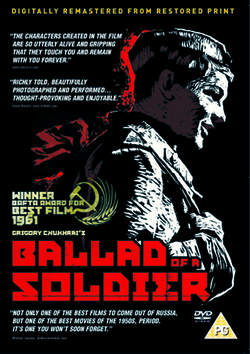
Ballad of a Soldier – Ballada o soldate (1959)

Ballad of a Soldier

Grigory Chukhray‘s movie Ballad of a Soldier  aka Ballada o Soldate is an iconic Russian war movie, which is often mentioned together with another famous Russian movie of the same time, The Cranes are Flying aka Letyat zhuravli. Both films are excellent and combine heartfelt stories with luminous black and white cinematography.

Ballad of a Soldier begins with a scene showing a woman looking into the distance. The road we see is the only one leading to and from the village in which the woman lives. She doesn’t expect anyone to come. Her son has died during the war and nobody will ever know what would have become of him. The movie then rewinds to a famous scene on the Russian frontline and we see her son, nineteen year-old Alyosha, a young signalman, blowing up two German tanks on his own. This heroic act would bring him a  medal but he’d rather be granted a leave to visit his widowed mother and fix her roof. The general in charge, one of a few kind officers, allows him to take a five-day leave.

Russia is a huge country and travelling by train would always take a long time, but during a war it’s almost impossible. Alyosha’s trip quickly turns into an Odyssey. Because he’s kind and helpful, he misses his train more than once. At first he helps a soldier who has lost his leg, then he assists a young girl and the two young people fall in love. Later he helps people after the train is hit by a bomb. When he finally arrives at home, he has only time to hug his mother, exchange a few words and has to leave again immediately. Since we know that he will die during the war, this scene is all the more poignant.

The movie shows how everyone is affected by war, even those who don’t fight. In focussing on someone as kind as Alyosha, someone who genuinely cares for other people the movie makes a powerful anti-war statement. Much more than his heroic act of the beginning, his humanity and kindness make us sad and we deplore that he will never return to his mother, nor get a chance to find the girl he fell in love with.

Something that struck me was that all of the Russian officers, and most of the soldiers in this movie are depicted in a positive way.

Like in The Cranes Are Flying, many shots focus on the faces of the actors who are very expressive. While the first film sticks more to the point of view of a woman, this is told mostly from the point of view of a young man, which makes them great companion pieces. The scenes between mother and son are short but still I’d say it’s one of the most touching portraits of a mother/son relationship. After all, it’s his love for his mother, that makes Alyosha persevere on his journey.

I’d like to recommend this movie. It stands out and makes a powerful statement.

If you’d like to watch other Russia war movies – here is a list: 12 Russian war movies you must see