War and Romance make often a succesful combination. WWII and Romance even more so. I think I have seen a fair share of them and although it is not my favorite genre I like it when it is well done. I don’t think I would have heard of And A Nightingale Sang (based on the book by C.P.Taylor) if it hadn’t been recommended by Gray Freitas. I finally felt like watching it and was really not disappointed. It is actually a very realistic depiction of life in the British town Newcastle from beginning of WWII to its end rather than a romance.
And a Nightingale Sang has all the charm of British TV. It is bittersweet, lighthearted and hilariously funny at the same time. At the center is the slightly dysfunctional and very eccentric Stotts family. The mother is a fervent Catholic and constantly going to church to confess. To her dismay she realises that she has a crush on the vicar. The father is tempted by communism and drives everybody crazy by playing the piano endlessly. The grandfather mourns his dead whippet and later carries his cat, Winston, everywhere, even into the air-raid shelter. The daughters both fall in love for the first time. Joyce gets married and regrets it immediately, while disabled Helen falls in love with a married man. The depiction of wartime life in an English town is excellent. The bombings, the rushing to the shelters, the scarcity of provisions, but also the fun and the attempt to make the most of it. The people at the center of this story are all likable eccentrics.
The end is certainly the best bit in the movie. I almost wished I had been there. That must have been something, to know the war was over and Germany had been defeated. The cheer and joy are conveyed nicely. I cannot remember having seen any other movie showing it like this.
Realism and entertainment make a great combination. Plus really great acting (Joan Plowright as the mother, Phyllis Logan as Helen and Stephen Tompkinson as Eric). And what about the romance? Touching and realistic as well.
Don’t ask me how I found this list. Browsing the internet, of course, but what was I looking for? Whatever. I found it on Army Times and would like to share it with you. I am sure that more than one of my readers will be equally puzzled by some of their choices.
If you want to know their reasons you will have to read their article. While I certainly agree with a few of them I have absolutely no clue how Top Gun got on this list. What the heck? And where is Saving Private Ryan (see my post) and Platoon? While they were at it they could have put Pearl Harbor on No. 1.
What are your thoughts on the list? All worthy candidates?
Thanks to Novroz who mentioned Grave of the Fireflies pointing out I should review it on this site I finally watched this very beautiful anime last night.
Animes are maybe not everybody’s cup of tea and I am far from being an expert having only seen the other Studio Ghibli treasure Princess Mononoke aka Mononoke-hime still I know when I see a masterpiece. And Grave of the Fireflies is a masterpiece and should have been added on my Children in War Movies List before. This is an artfully drawn anime with a very moving story. It is a must-see for anime fans and people interested in war movies alike.
War does affect people in different ways. Some fight in it and die in it. Some get injured and are sent home. Others return suffering from post-traumatic shock. But many stay at home. All the old people, the children and the women. What about those people on the homefront? What happens to them? How do they cope with constant air raids, lack of food and other supplies? How do children cope? This is what Grave of the Fireflies shows us. You have to watch the first five minutes very carefully or you might not get the full meaning of the movie. It is quite subtle and could be missed.
Seita and Setsuko, a brother and his little sister, are two Japanese children whose lives are profoundly affected by the war. Their mother dies in an air raid while their father, an officer of the Japanese Royal Navy, is at war. The two children find refuge at the house of their aunt. But close quarters and lack of food doesn’t help and they are soon not welcome any more. Left with some money the children leave the house of their realtives and live in a shelter outside of town. The brother who is ten years older cares touchingly for his little sister but he can hardly find anything to eat. He tries to buy something but no one sells anything. He tries to steal and gets beaten up. The little girl gets weaker and weaker and finally falls very ill. When Japan surrenders Seita hears from someone that the Navy has been completely destroyed. His father is very probably dead as well.
The end of this movie is particularly good. It’s very sad and I can understand that people who are less familiar with war movies in general might be very shaken. I don’t think it is advisable to watch it with little children although it is not gruesome but the way death and war are treated is very emotional. The little girl is absolutely amazing. So realistic.
Even though this is a war movie it is also a meditation on life’s fragility and fugacity. A very poetical and emotional movie with wonderful pictures.
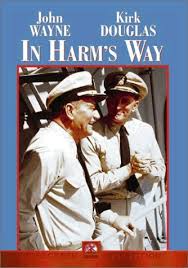
I don’t know how many war movies John Wayne did. The only thing I know, he did a lot. I’ve seen The Longest Day but apart from that Otto Preminger‘s black and white movie In Harm’s Way was my first. I actually quite liked it. It’s a decent movie with some interesting female leads and a love story between John Wayne and Patricia Neal’s character that resembles a real relationship and not some ridiculously soppy romance.
I already mentioned it in my post on Pearl Harbor as it starts on the night before the attack of Pearl Harbor. At the center of the movie is Admiral Torrey who is first demoted and then promoted again. The movie analyses what is going on outside of the actual battles; the planning, the men’s love and private lives. Torrey meets his son who is in the Navy for the first time after several years. Their relationship is very conflict-laden but evolves during the movie. Torry gets to know the nurse Lt. Maggie Haynes (Patricia Neal) who is probably one of the greatest nurses in any war movie. Kirk Douglas plays a real asshole, Commander Eddington. We see a few decent battle scenes but nothing too exciting.
Too cut a long story short, In Harm’s Way is a movie for John Wayne fans, for people who want to watch something older about the war in the Pacific, for those who like a well-told story that focuses on relationships and for those who can overlook a few gender related oddities (Two things struck me. One was the “tea scene” and the other the way people react to Eddington’s crime). As a war movie I would rate it 3.5-4/5.
Don’t miss the trailer. I have never seen a trailer like this. I first thought it was a parody and then I realised it was just unreflected promotion. It has real historical value. Just watch it and thank God that trailers have evolved through the years.
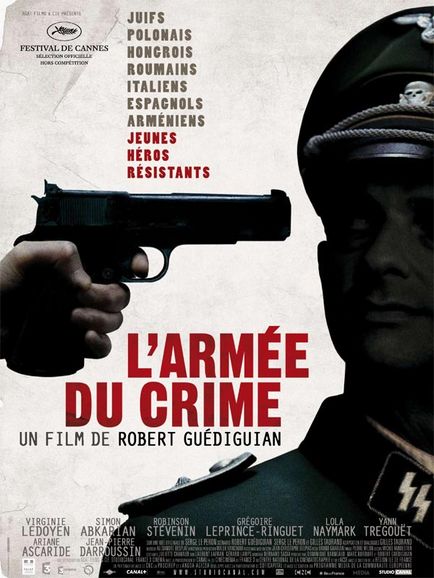
Robert Guédiguian‘s movie L’armée du Crime or The Army of Crime is one of the best war movies I have ever seen. I already said that it entered my Top 10 immediately. The question that remains: which one I am going to kick out? I’ll have to think about this later. For now let me tell you why I think The Army of Crime is such a brilliant piece of filmmaking. Apart from being based on actual events and being historically very accurate it is beautifully filmed. The actors are outstanding. The protagonists are heroical like not many but at the same time the movie doesn’t shy away to point its fingers not only at the Germans but also at the extremely shameful role the French government played during WWII. We had the heroism of the Resistance and Partisan groups on one side and the cowardly collaborators in the government, the police and among normal people on the other side. Shame on all of them. The movie shows all these aspects, nothing is hidden. This is the third French movie I have seen in a short period, L’armée des ombres aka The Army of Shadows being the first, The Officers’ Ward aka La chambre des officiers the second. I must say these movies manage something that not many others achieve. They get under your skin. You don’t only watch these movies, you live them. They don’t let you indifferent. Especially not this one.
1943, Paris, the Armenian poet Missak Manouchian (Simon Abkarian) becomes the leader of a special unit of the French Resistance. His people, men and women, are all very young immigrants. They are Hungarian, Polish and Romanian Jews and Spanish, Italian and Armenian Communists. They decide to form a group and fight for France, the country of the Human Rights, to free and to defend her. They are determined and well-organized and soon will be declared enemies number one. The German occupiers and the French police strike back savagely. They hunt them and use every possible way to capture and destroy them, be it bribery, torture or coercion. In the end they are betrayed and all of them are shot.
The movie tells not only the story of the group and their actions as a whole but shows many intimate portraits of all the individual members. I have hardly ever seen a movie displaying so much diversity. This is underlined by a brilliant score with influences of the music of all the different countries that came together in this fight.
The torture scenes are very graphic. We are not spared anything. The most incredible is that with the exception of one person none betrayed the others. Not even under the worst of torture I have ever herad of. While they were operating in the underground most of their families were being deported to camps. Manouchian is an exemplary man. A larger than life character. He does not use arms lightly unlike some of the other reckless young people. He is a poet, an orphan, a gentle man, married to a beautiful French wife, Melinée (Virginie Ledoyen), whom he loves dearly.
I would like to urge each and every reader to watch this movie as my words will never really manage to convey its utter beauty. It is also worth mentioning that we see a lot of Paris. The Army of Crime is one of those very rare movies that are, simply put, masterpieces in which every element is perfect.
The following people died for France: (AR = found on the Red Poster or Affiche Rouge):
Celestino Alfonso (AR), Spanish, 27
Olga Bancic, Romanian, 31
Joseph Boczov [József Boczor; Wolff Ferenc] (AR), Hungarian, 38
Georges Cloarec, French, 20
Rino Della Negra, Italian, 19
Thomas Elek [Elek Tamás] (AR), Hungarian, 18
Maurice Fingercwajg (AR), Polish, 19
Spartaco Fontano (AR), Italian, 22
Jonas Geduldig, Polish, 26
Emeric Glasz [Békés (Glass) Imre], Hungarian, 42
Léon Goldberg, Polish, 19
Szlama Grzywacz (AR), Polish, 34
Stanislas Kubacki, Polish, 36
Césare Luccarini, Italian, 22
Missak Manouchian (AR), Armenian, 37
Armenak Arpen Manoukian, Armenian, 44
Marcel Rayman (AR), Polish, 21
Roger Rouxel, French, 18
Antoine Salvadori, Italian, 43
Willy Szapiro, Polish, 29
Amédéo Usséglio, Italian, 32
Wolf Wajsbrot (AR), Polish, 18
Robert Witchitz (AR), French, 19



 All About War Movies