10 War Mini-Series You Must See

When I wrote my post on ANZACS the other day I realized that there are quite a few great war mini-series out there. There are certainly more than 10 but out of all those I’ve seen or heard of, I would say, the 10 that I mention below are the ten you should really not miss. They all cover different wars or different aspects of the same wars. Many of them are better than most movies. My favourites are Band of Brothers, Hornblower, Sharpe and Generation Kill.

Wings (1976) WWI Air Combat. I must admit, I haven’t seen this yet but it has a great reputation among air combat fans and should be a nice companion to the WWII based series Piece of Cake.

Danger UXB (1979) WWII – Bomb disposal unit. I liked this series when I watched it quite a bit. It gives you a good feel for what a bomb disposal unit had to go through during the Blitz. All the different types of bombs. The characters are appealing and we get a good impression of civilian life during the Blitz as well. Here is my review.

Das Boot 1985 – WWII submarine. Das Boot exists in two versions. One is the cinema the other the TV version which was twice as long. I have seen the cinema version which is one of the best war movies there is. Some people prefer the longer TV version. It’s worth checking out.

ANZACS (1985) WWI. Infantry combat. I just reviewed the final episodes of this excellent mini-series that follows the ANZACS from Australia to Gallipoli and from there to the Somme and back home again. Great combat scenes and a nice “band of brothers” feel. It also contrasts British command and Australian insubordination in a funny way. Here is my review.

Piece of Cake (1988) WWII Air Combat. The series follows the men of the Hornet Squadron during the early weeks of WWII. It shows how inexperienced boys become excellent fighter pilots.

Sharpe (1993 – 2008) – Napoleonic wars. Infantry and cavalry. Based on the novels by Bernard Cornwell this is a very elaborate and suspenseful series. In its center is the character Sharpe an enlisted man who is such an excellent soldier that he is soon raised to the rank of officer. This is problematic as he isn’t an aristocrat. He faces injustice and adversity. Sean Bean stars as Sharpe. It’s one of the best roles of his career. Here is my post.

Hornblower (1998 -2003) – Napoleonic wars. Naval combat. This is another extraordinary tale of one man’s ascent. Ioan Gruffud stars as Horatio Hornblower which might explain why I hear this series mentioned quite often by women.  If you like Master & Commander, you will love this. It’s like a very long version with an appealing central character. It is based on the books by C.S. Forester. Here is my post.

Band of Brothers (2001) WWII. Infantry combat. This is one of the most amazing series. Based on the book Band of Brothers it follows the paratroopers of Easy Company from 1941 – 1945, starting in the US until the freeing of the KZ’s. The characters of this tight-knit company are very well depicted and you really care for all of them. Seeing them die or get wounded is harrowing. Some of the episodes, like the one called Bastonge, are so intense, they still overshadow most other WWWII infantry combat scenes I’ve seen before or after.

Generation Kill (2008) Iraq. Special unit. This is a series that is hard to get into, especially when you are used to others. It has a very slow build-up but after two episodes I really appreciated it. It achieves a very authentic depiction of modern warfare and shows how problematic it is to send a generation used to war games into combat. It shows how much is absolutely boring, just standing around and waiting. At the center of the unit is the “Iceman” Sgt Brad Colbert played by Alexander Skrasgard. The Iceman is an amazing character and even more so because he is based on a real person. This guy really always keeps his cool. The series is based on the account of an embedded journalist. Here’s the link to the book. And here is my post on The Iceman.

The Pacific (2010) – WWII. Infantry combat. If you do not compare this series to Band of Brothers, you will like it. It’s less the story a group of people than individual stories. The soldiers are also shown during their leaves and some love stories are incorporated. However the combat scenes are even grittier that those in Band of Brothers. Not pretty at all. My favourite episode is Rain on Cape Gloucester. Here is my Pacific short review.

ANZACS Part IV and V (1985) The Battles of Amiens and Hamel

This is just a short wrap-up post. I finally watched the last two episodes of the ANZACS mini-series and I liked them as much as the first three. There were a few predictable moments and the end was a bit anti-climatic but very realistic.

I would really like to recommend the series once more. It’s excellent. It’s also an amazing story. The bravery and courage of the ANZACS was really something. I already said it in another post that one thing that struck me was the way they went to war. They took it like some sporting adventure, they were big on comradeship and good spirits. It seemed a bit stretched at first but I’ve done some research and some of my readers confirmed that this was the way they were.

What you get to understand as well, when you watch this series is the huge difference the end of the war represented for the Australians and the French. All through the series you see the ravaged landscape, the bombed villages and although some places remind the lads of home, their country remained untouched. I’m not saying the contribution wasn’t great, no, but when they were finally back home, they could really leave the war behind. That was not possible for the French soldiers who had to cope with a devastated country. The land has still not fully recovered until today. There are still places where you see craters and trenches, where they left the barbed wire and there are still bombs exploding.

While Part IV is still heavy on combat, Part V, which is a bit anti-climatic, is a quiet part. It centers on the Armistice and the ANZACS’ return home to Australia.

Here are the reviews of Part I GallipoliPart II The Somme  and Part III Passchendaele.

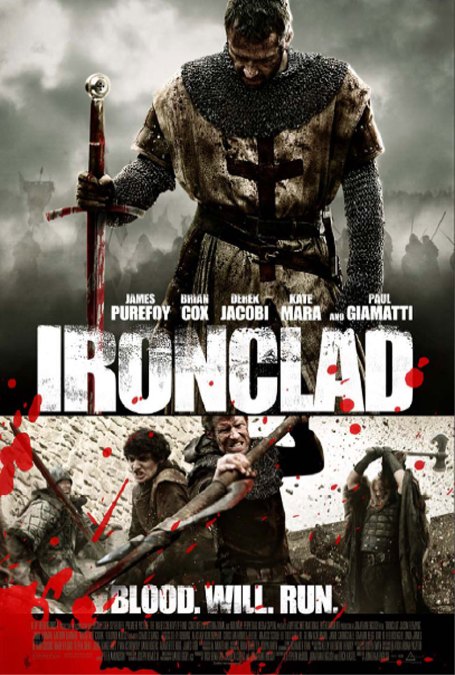
Ironclad (2011) A Medieval Gorefest

I don’t think you will hear me say this very often but I must say it this time: This movie was way too gory for me. That bothered me more than the liberties that were taken with history. Or, to be honest, I’m not sufficiently familiar with 13th century England. I know the movie is loosely based on historical facts but the details elude me.

Having said all this you probably think I didn’t enjoy it. Wrong. I like Ironclad a lot. In a guilty pleasure kind of way and during those moments when there was no chopping off of hands, feet and tongues to be seen. I like stories about a small group of men fighting a large number, I like sieges and I think the time period makes for great battles scenes and fights with swords, bows and arrows. And for once the love story wasn’t too corny.  All in all the battle scenes reminded me a bit of the one in Lord of the Rings (Helms Deep) and the love story had a Last of the Mohicans feel (of course not that good but nice enough). Compared to movies like Centurion, I would say, it was much better.

King John of England is a hated monarch. In 1215 rebellious barons force him to sign the Magna Carta a document that will uphold the rights of free-men. A few months later he reneges on his word and with a small army tries to get the kingdom back.

A small group of Knights Templar help one of the barons to fight him. They find some more men, mercenaries, who join them in their fight. They are only seven but all of them experienced fighters. They know he will try to visit each and every baron and take revenge on him. If they can prevent him from entering Rochester Castle, they can prevent his entering England. The group of seven men rides to the castle and arrives just in time before the king’s men. They are in for a long and harrowing siege.

Their number is tiny and it doesn’t seem realistic that they should be able to fight the large army of King John. Their hope is the French army that is approaching and will help them against King John.

Being inside of a castle like Rochester Castle has a few advantages but their losses are high anyway. Every time the army of the king attacks,  a defense layer of the castle goes. Those who are captured are tortured and mutilated. After a few weeks of siege, the people inside of the walls are starving, the baron to whom the castle belongs starts to freak out and the nerves lay bare.

It’s  a very action-driven and suspenseful movie. The actors are quite good, although I needed to get used to Paul Giamatti as King John. He looks really insane. The leader of the group of seven men is the Knights Templar and played by James Purefoy. I personally liked him better than Fassbender in Centurion. I thought the battle scenes and fights were well done and the special effects were quite good as well.

Rated in the category of medieval action-war adventure it deserves at least 4 out of 5 stars

Nacht fiel über Gotenhafen aka Darkness Fell on Gotenhafen (1960) One of the Biggest Ship Disasters in History

What a surprisingly good movie. I discovered it purely by chance and didn’t expect much but it was well worth watching. The central theme of Nacht fiel über Gotenhafen aka Darkness Fell on Gotenhafen is the tragic sinking of the huge cruise ship Wilhelm Gutsloff. The Wilhelm Gustloff was named after a famous Nazi leader. In the final days of the war it was used to transport refugees from Eastern Prussia to safer German territory. The disaster of its sinking is called by some “the unknown disaster” and if it weren’t for websites like WM.S. Wilhelm Gustloff-The Unknown Disaster it would probably stay widely unknown outside of Germany. The Gutsloff was torpedoed by a Russian submarine and sank with over 6000 people on board. Most of them died, among them 4000 children. The sinking of the Wilhem Gutsloff is seen today as one of the symbols of the Downfall of the Third Reich.

Before watching I thought the whole movie would focus on the final hours but that wasn’t the case and that’s why it was such a great movie. Apart from a few melodramatic elements in the beginning, it’s surprisingly well done. Another main theme of Darkness Fell on Gotenhafen is the situation on the home front, what the women and children had to endure during the war in the city.

The film tells the story of one woman and starts with a ball on the Wilhelm Gutsloff on her maiden voyage as a cruise ship. Maria is engaged to Kurt but Hans is in love with her as well. Later, during the war, Maria and Kurt are now married and Kurt is fighting with the army, Hans, who is officer on a ship, is visiting the city and meets Maria. He is still in love with her and seduces her. She gets pregnant and afraid of the reaction of her husband and because the city is constantly bombed, she flees to a friend in the country, somewhere in East Prussia. She meets a group of interesting characters, a French POW and the widow of a an Army General.

Maria and her friends believe at first that they are safe in Prussia. They are far from any front and assume the war will soon be won. When tales of the Russian approach are heard, they don’t believe them at first until it becomes certain that Germany is about to lose the war and the Russians approach fast. Hans who wanted to see his son, has been staying with them for a while. He tells them about the Gutsloff that will evacuate a great number of women and children. He can convince them that they have no other chance. Finally  they abandon the house and flee together with many others to the Gutsloff. The Russians have already arrived and kill and shoot people.

The ship waits the whole night until it is allowed to sail. Nobody sees any danger. They think the Russians are still too far away and fought back by the German fleet. When the ship finally sails it is soon torpedoed. The ship sinks fast, too fast for most of the passengers.

One could say, the movie has five parts. Each part focusses on other elements of the war. First the war is only a foreboding, then we see how the civilians in the cities struggle, the fear and loneliness of the women, how many flee to the country and how they still believe the war can be won although its lost already. The moments on the ship are excellent and tell quite a few mini-stories. The end is done very well too, dramatic but not melodramatic.

I was surprised that there were such a lot of strong female characters in a 60s movie. Brigitte Horney, one of the great German actors, is outstanding in her role as widow of a General.

The movie has an English title but I have no idea whether it has been subtitled or not. And there was no trailer to be found. If you understand German, you can watch it on YouTube.

Max Schmeling – Fist of the Reich aka Max Schmeling – Eine deutsche Legende (2010) Biopic of the German Heavy Weight Legend

Yes, I did it, I watched a Uwe Boll movie. I have never watched any of his other movies before, it seems they are a bit on the trashy side and I’m not tempted to watch the controversial sounding Auschwitz. Now that this has been clarified, I will concentrate solely on Max Schmeling – Fist of the Reich aka Max Schmeling – Eine deutsche Legende. The reception of this movie is a bit surprising. It got 4.1 on IMDB, the only person who reviewed it gave it 3/10. The reviewer is German. On amazon.de the reviews are mostly 1/5 and 2/5 stars. When you hop over to amazon.co.uk you are in for a surprise. The reviewers rate it  mostly 5/5. I’m pretty sure, I can tell you why this is the case. (Personally I would rate it 3/5 or 6/10).

The way the story is told is somewhat plump. It’s linear storytelling apart from the very first moment where we see Max Schmeling in uniform traipsing around Corfu. These are painful moments for German-speaking people as we hear the “actor” Henry Maske talk. Imagine Schwarzenegger talking through a half-swallowed potato… You can hardly understand what the guy is saying, it’s obvious he is no actor. Every time he opens his mouth during the movie, native German speakers will either laugh or cringe. I’m quite sure this (plus Boll’s reputation) were the main reasons why it got such bad German ratings.

Once you have passed this initial bad scene you will start to understand that Henry Maske was a perfect choice. Even Schmeling himself was wishing for Maske to play the role one day.

Schmeling was a gutsy boxer, one with courage, who loved to prove himself. At the same time he was very fair with his opponents. When the Nazi’s started to rise he was on the rise as well. They liked to win over athletes as they corresponded to the Nazi ideal of strength, health and invincibility. Schmeling who held the heavy-weight champion title for quite a while was especially liked by Hitler. But when Schmeling announced that he, his trainer (Heino Ferch who is excellent as always) and his Jewish agent were flying over to New York to fight against Joe Lewis, the Nazi leaders were strictly opposed. Joe Lewis had the reputation of being invincible. He knocked out all of his opponents in a few minutes. And he was African-American which seemed hardly the right choice for someone belonging to the master race, as the Nazis called themselves. It took guts to disregard the orders and fly to New York anyway.

What happened in New York is boxing history. Max Schmeling knocked out Joe Louis and after this he was definitely  the Nazis’ favourite pet athlete. Still, when he announced he would go back to New York and face Joe Luis again, they didn’t approve. They were right this time.

He returned beaten and was sent off to war immediately. No other athlete had to go to war, but someone who lost against an African-American and ridiculed the master race had to be punished.

All these are things, I didn’t know. I didn’t know either that Schmeling and his wife were one of the most famous couples in German history. She was an actress and they got married before he flew to New York for the first time. They stayed happy together until her death in the 80s. Schmeling lived until 2005. After the war he had a hard time making a living and wasn’t denazified at first.

For all those who moan about Henry Maske’s acting I’d like to say, that it is not fair. This is a boxing film. 60% of the movie centers on the fights, training and boxing. If you like boxing, you will like this movie as Maske is an excellent boxer. He was the world title holder for many years – not in heavyweight but in light heavyweight – and used to be one of the best-liked German sports people. He is originally from the former German Democratic Republic which explains the mumbling to a certain extent as their accent is a bit on the rough side.

I’m fond of Maske, he is a likable person, I also like boxing and found the fights gripping. Certainly not a great film but entertaining and interesting.

I only found a German trailer but the movie has been subtitled.

http://www.youtube.com/watch?v=tGv1X2JewBU