Children in War Movies: A List

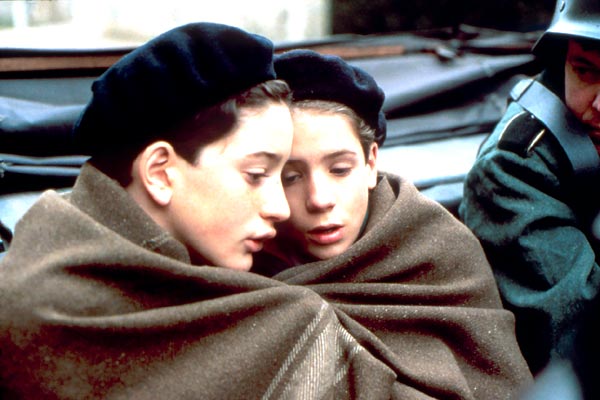
In this post I would like to focus on war  movies in which children have leading roles and are not just supporting actors like in The Hurt Locker to name but one example.

There are many movies whose sole focus are children. They come from different countries, show different conflicts and times but they have one thing in common: they are all good, very good or outstanding. This is quite remarkable. It is as if those film directors who aim for entertainment only would shy away from showing children in war movies. All the movies listed below are very different in tone. Some are light and almost playful, like Hope and Glory, some are depressing and raw like Come and See, others have the quality of a fairytale like Pan´s Labyrinth.

I am sure my list is not exhaustive. If you know of any others, let me know. I will try and review most of them in later posts,  like I already did with Hope and Glory (see post), Welcome to Sarajevo (link to post), The Children of Huang Shi (see post) and Savior (see post). I am stating the name and the year and country in brackets. The conflict and where the war takes place follow behind. I did include a few movies with teenagers in it like The Bridge or Napola, but most of the others focus on much smaller children. I did also  include Savior as the newborn is central to the story.

I am sure you will discover many you did not know yet as I did.

The Drum (GB, 1938): India

Mrs Miniver (US 1942): WWII, British Homefront

Since You Went Away (US, 1944): WWII, American Homefront (here is my review)

Roma, Città Aperta aka Rome, Open City (Italy, 1945): WWII, Italy

Kim (US, 1950): India

Forbidden Games aka Jeux interdits (1952, France): WWII, France

The Bridge aka Die Brücke (1959, Germany): WWII, Germany

Two Women aka La ciociara (1960, Italy/France): WWII, Italy

Ivan’s Childhood aka Ivanovo detstvo (1962, Soviet Union): WWII, Russia

Hornet´s Nest (1970, USA): WWII, Italy

Lacombe Lucien (1974, France): WWII, France

The Tin Drum aka Die Blechtrommel (Germany, 1979): WWII, Germany

Hope and Glory (1987, UK): WWII, Blitz  (Here is my review)

Empire of the Sun (1987, USA) : Chinese-Japanese War WWII

Au-revoir les enfants aka Goodbye, Children (1987, France/Germany): WWII, Holocaust,France

Grave of the Fireflies aka Hotaru no haka (1988, Japan): WWII, Japan. Anime. (See my post)

Europa, Europa aka Hitlerjunge Salomon (1990 Germany/France/Poland): WWII, Germany (See my review)

Come and See aka Idi i smotri(1985, Soviet Union): WWII, Byelorussia

The Ogre aka Der Unhold (1996, France/Germany/UK): WWII, Nazi Germany

Welcome to Sarajevo (1997, USA) : Bosnia

Life is beautiful aka La vita è bella (1997, Italy): WWII, Holocaust (see post on La vita è bella)

Savior (1998, USA ): Bosnia

Silent Night (2002, USA): WWII, Germany (see my post on Silent Night)

Innocent Voices aka Voces inocentes (2004, Mexico/USA/Puerto Rico): El Salvador (see my post on Innocent Voices)

Turtles can fly aka Lakposhtha parvaz mikonand (2004, Iran/France/Iraq): Iraq

Before the Fall aka Napola (2004, Germany): WWII, Germany (see my review of NaPola)

Pan´s Labyrinth aka El laberinto del fauno (2006, Spain): WWII Franco´s Spain

Under the Bombs aka Sous les Bombes (2007, France/Lebanon): 2006, Lebanon (see my review of Under the Bombs)

Miracle at St. Anna (2008, US): WWII, Italy (here is my review)

The Boy in the Striped Pyjamas (2008, UK/USA): WWII, Holocaust (see my review)

Escape from Huang Shi aka The Children of Huang Shi (2008, Australia, China, Germany, USA): Japanese occupation of China

Winter in Wartime aka Oorlogswinter (2008, Netherlans, Belgium): WWII, occupied Hollad in Winter, 1945 (here is the link to my post)

The Fortress of War aka Brestskaya krepost (2010, Russia): WWII, Russia 1941. Germans attack the Brest Fortress (here is the link to my post).

The Round-Up – La Rafle (2010, FR/GE/HU): WWII, Paris, the round-up of 13000 Jews in the Vel d’Hiv (here is my review)

This list is being updated regularly.
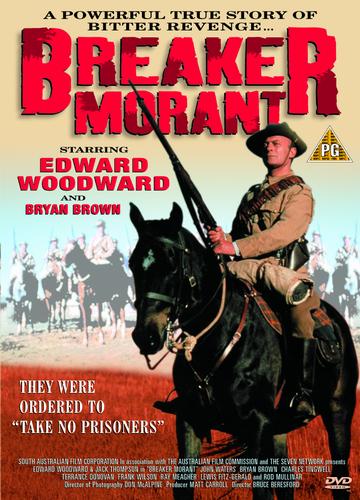
Breaker Morant (1980) or An Australian Look at the Second Boer War

The Australian movie Breaker Morant is one of those movies that leave you thoughtful and pensive for quite a long time. It leaves you feeling helpless and infuriated as well by unmasking the hypocrisy of those in charge. It brilliantly illustrates the absurdity of war and deserves to be named together with the most important anti-war films ever done.

The movie is based on the true story of the court-martial of three Australian officers Lt Harry “Breaker” Morant, Peter Handcock and George Witton by a British court. They were accused of having shot first one, then six POWs and subsequently a German missionary. Their defense attorney Jack Thompson who was inexperienced and soon tried to accuse those in charge of the trial as well.

The movie tells the storiy alternating court-room scenes with flashbacks.

The second Boer war (1899-1902)  was by far worse than the first. The Dutch started to fight a guerilla war against the British who then fought back and organized a special troop, The Bushveldt Carabineers, for wich they appointed Australian soldiers. The idea was to fight the Boer with their own means.

Harry Morant volunteered to go to South Africa because he believed in the British Empire. How utterly tragic.  In Australia he was famous as a breaker of horses and poet. Edward Woodward plays this proud, upright and poised character with an excellence I have rarely seen. This is such a brilliant actor I wonder why he never made it to more fame.

The longer we watch the trial the more we realise that it is a sham. The British need scape goats to save their reputation. What those officers are ultimately accused of is what they were told to do. Only now no one wants to take responsibility for it. Of course this is also a meditation on what is good or bad during war.

Breaker Morant is interesting for cinema historic reasons as well since it is part of the so-called Australian New Wave, of which Gallipoli and The Lighthorsemen are other great examples.

This is without any doubt a 5 star movie.

Mongol: The Rise to Power of Genghis Khan (2007)

What is the best word to describe this movie? I would say it is enthralling. The cinematography is stunning. The vastness of the Mongolian steppe would leave no one indifferent but captured in such wonderful pictures there is no escaping the enchantment. These amazing views are underlined by one of the most convincing scores I have heard in any movie recently. Chanting monks, female singers, musical parts. Picture wise it did remind me of Urga aka Close to Eden, a  gorgeous Mongolian movie I haven seen a few years back. We can easily deduce that material life in the Mongolina steppe has not changed much. People still live in yurts, even the clothes bear a certain resemblance.

The Russian movie Mongol is the first installment of a trilogy on the live of Genghis Khan. It shows his childhood, how he chose his wife Borte (Khulan Chuluun), the great love of his life, how his father is killed and how he later has to fight for his survival until he becomes the unifier of the Mongolian tribes and their leader. He is not yet called Genghis Khan, he is still Temudjin (Tadanobu Asano) a boy from a modest background whose father was one of many Khans.

Life at those times seemed to have been incredibly hard. The tribes were stealing from each other (horses and women),  assaulted each other, killed each other. It is hard to imagine a life of greater insecurity than this. Whenever the future Genghis Khan triumphed over someone he was shown as very just and generous. As a consequence of this behaviour people wanted to follow him, they chose him as their leader.

The Genghis Khan we see is someone who inspires pity because of the hardships he has to endure and admiration for the way he treats people, especially his wife to whom he is very attached.

I cannot say much about the historical accuracy. Usually Genghis Khan, who was once the leader of the greatest empire that ever existed, is shown as a merciless cruel despot. There is not much room for beauty in those tales of his life. I tried to find out more and apparently it depends on the sources that are being used whether his portrait is more negative or more positive.

I was fascinated by the spiritual aspects in the movie, the deity that appeared in the form of a wolf. The wolf  is very meaningful to the people of the Mongolian steppe. Certainly the depiction of the Mongolian religion is not accurate but I liked this  dimension.

I thought the acting was excellent but have read that it has been criticized that a Japanese actor stars as Temudjin. The accents of the actors seem to be painful to Mongolian ears as well. I even read that some actors spoke Mandarin Chinese which was not yet spoken at the time… I don´t speak any of those languages therefore I was not bothered.

I think this is a very special, aesthetic, riveting movie and  I am not surprised it was nominated for an Oscar and won many prizes.

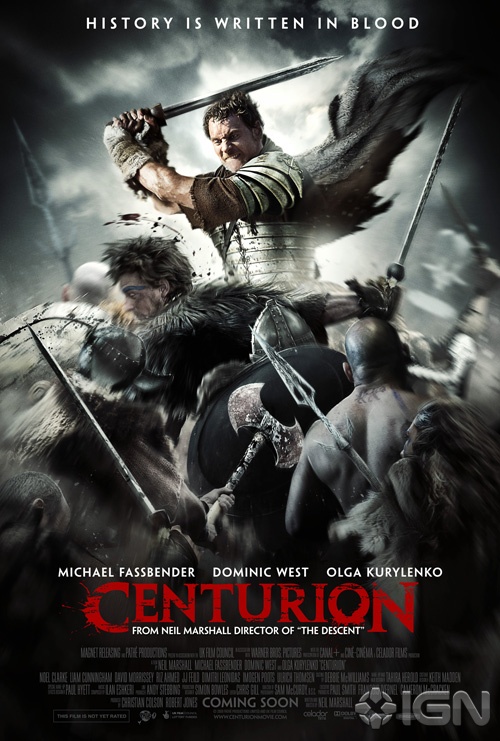
Centurion (2010): A little bit of Gladiator, King Arthur and 300

When I started this blog I wanted to stick to war movies in the strict sense of the term only but now I feel I am in the mood for more liberties. A few months back I would not have included Centurion but now I do. I would not have mentioned Gladiator, King Arthur or 300 either. (If I did, King Arthur would be high up in my Top 10, probaly even making Black Hawk Down step down.)

Be it as it may, to compare Centurion (a British movie by the way) to those above mentioned movies is very unfortunate for it because it is not up to the comparison, I’m afraid. Nevertheless it is  entertaining. However, compared to the three others, Centurion is super gory. And there are a lot of very combative warrior women in it. By the way, Dominic West, from The Wire,  is in this one too but he is not the main character. He stars as General Vilnius. Michael Fassbender has the leading role as the Centurion Quintus Dias. The German actor Fassbender could already be seen in 300, Inglourious Basterds and The Devil’s Whore, to name but a few of his movies.

The year is 117 AD. The Roman Empire stretches from Spain to Egypt and as far as the Black Sea in the East. Only Britain is fighting off its invaders. The Empire is stopped by the savagely fierce Picts.  Centurion Quintus Dias is the only survivor of a Pictish raid. He joins the legendary Ninth Legion of General Vilnius who is on a mission to erase the Picts and their leader Gorlacon from the face of the earth. When they are ambushed and the general is captured Quintus Dias is left alone with a small platoon far behind enemy lines. They first attempt to free their general and after this the real hunt begins. Led by a female warrior tracker (Olga Kurylenko), surnamed she-wolf, who has been mutilated by Romans in her youth and sworn to destroy each and every one of them, the Picts hunt them relentlessly. Without the help of a Pictish outcast, said to be a witch, they would not stand a chance but even so, they are soon highly decimated and in great trouble.

As said before, Centurion is really gory. It reminded me of Gladiator because of the battles in the woods. Of King Arthur because of the way they flee and are hunted,  because of the scenerey, mountains and snow and  also because of the female warriors. Same for 300. A little group outnumbered by a fierce enemy. The end however is quite different from the other three.

As I already said, it is not as good as the other three mentioned movies, since it is not  heavy on psychology and the Picts are shown as savages whereas we are led to believe the Romans were faultless,  but it is an  entertaining watch with loads of  battle and fighting scenes.

For a change the trailer is quite true to the movie.

Sometimes in April (2005) Part I

This is Part I of the HBO production Sometimes in April on the war in Rwanda (see Friday’s post) starring Idris Elba and Debra Winger. As I said, I haven’t seen it yet but it looks as if the whole movie has been posted in bits on YouTube. It seems well worth watching.