Habermann (2010)

The German/Czech/Austrian co production Habermann tells a chapter of German history which is easily forgotten. The movie is based on a true story and tries to exemplify the destiny of the Germans living in Sudetenland. This is one of those movies which touch on a historical fact which is so painfully absurd in its arbitrariness one can hardly believe it.

Habermann is a rich mill owner in Sudetenland. The tragedy of the Sudetenland was that it belonged to Czechoslovakia before the war but almost 90% of the people living there were Germans. When Germany decided to annex the Sudetenland in 1938 this posed a huge problem to people like Habermann who lived peacefully with the Czechs. Habermann’s best friend is a Czech (Karel Roden), many of his mill workers, his accountant and other people in important positions are Czechs. Being so friendly with the Czechs makes him look suspicious to the German authorities who take up residence in the small village in which he lives. When the despotic and sadistic Sturmbannführer Karl Koslowski (Ben Becker) arrives in the village, things go from bad to worse. He wants Habermann to get rid of the Czech workers, spies on him and the Czechs, bullies and controls him.

But the worst isn’t even known to Habermann and his wife yet. Although she grew up as an orphan and was  brought up by Catholic nuns, her father was a Jew. When Koslowski finds out, the tragedy cannot be averted.

Another dramatic story line circles around Habermann’s young brother you joins the Nazi’s.

There were a lot of things I liked about this movie and the story of the Sudeten Germans is a story which needed telling. The real tragedy for most only started after Germany lost the war and the Czechs turned against them. This drama is shown well but what I didn’t find too good is that there is too much emphasis on the character of Koslowski. Ben Becker is one of my favourite actors and I watch every movie he’s in. I think he is simply brilliant but he is also the type of character who just crushes everyone around him. He is often chosen to play a nasty Nazi villain and does that well, only giving him this role, putting so much emphasis on this characters, almost makes you think that the whole tragedy was linked to this one man while this was a collective tragedy and not just related to one sadistic character.

Still overall I think Habermann is well done, not one of the best but a very watchable movie and the actors, Ben Becker, Karl Roden, Mark Waschke as Habermann, Hannah Herzsprung as his wife, are really good.

Stauffenberg (2004 Germany) and Valkyrie (2008 – US) Compared

After having watched the excellent Valkyrie (here is my review), starring Tom Cruise, I wanted to see how the Germans had treated the very same story just a few years prior to the US production. Stauffenberg is a TV production, starring Sebastian Koch (Black Book, Das Leben der Anderen) as Stauffenberg. Ulrich Tukur (Das Leben der Anderen, The White Ribbon) can be seen in the role of Henning von Tresckow. While Carice van Houten who played Stauffenberg’s wife in Valkyrie looks very different from the real Nina von Stauffenberg, Nina Kunzendorf’s likeness is uncanny.

I don’t think it’s of any use to summarize the movie. Since it’s a true story the plots of the two films are almost identical, however there are some significant differences in the way the story is told which make it worthwhile to compare the two movies.

The title Stauffenberg already indicates that the focus is much less on Operation Valkyrie than on the man Stauffenberg himself. And that’s actually the biggest problem of this TV production. It is quite confusing and for someone not familiar with the story, it isn’t clear what Operation Valkyrie is. I was glad I had seen the US film first or I would have been a bit lost as I wasn’t familiar with the whole story.

While Valkyrie starts with Stauffenberg in Africa, it starts much earlier in this film. We see Stauffenberg first in Berlin, whit his fiancée and future wife Nina, later he is in Poland and only then in Africa. This helps to understand his motivations and his development from someone who believed in Hitler to somebody who was entirely disgusted and ready to kill the man.

What worked far better in this TV production is to make us understand why the assassination failed. The characters in this film are portrayed as determined but they are no sleek robots. There are many mishaps and they are far from perfect. We even get the impression that they were a bit too hasty and that the whole project would have needed more planning. In Valkyrie we don’t really understand why it doesn’t work. Everything seemed so perfect.

What also worked far better here is the human and emotional dimension. These people are scared. They are determined but anxious as well and when they are caught, things do not go well. One of them isn’t even capable of shooting himself, he misses first, tries again, ends up badly wounded and has then to be shot by someone else while in Valkyrie he puts the gun to his head, shoots and is dead right away.

While far from perfect and not as carefully – and one would argue artificially -orchestrated as Valkyrie, Stauffenberg feels emotionally true and is very watchable. If you didn’t like Tom Cruise you might even prefer this smaller scale production.

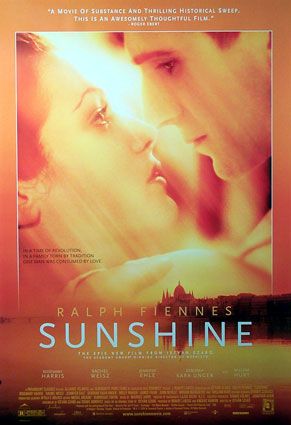
István Szabó’s Sunshine (1999)

I’m in two minds about István Szabó’s epic movie Sunshine. It tells the story of a family of Hungarian Jews, the Sonnenscheins (which means Sunshine in German), from the end of the 19th century until the end of the 20th. While I think it told me a lot about Hungary and the treatment of Jews in Hungary, I was far less thrilled about the length (3hrs) and the choice to have the three main characters, grandfather, father and son played by the very same actor, namely Ralph Fiennes. I would have found this artificial with any actor but given my dislike of Fiennes, it added annoyance. If you do not mind seeing the same actor in three different roles and are fond of Ralph Fiennes, you will probably like this movie a lot. I do not understand why Szabó chose to do it like this, why couldn’t there be three actors? I remember the Archers chose the same approach in The Life and Death of Colonel Blimp in which Deborah Kerr plays three different women but that worked much better.

The Sonnescheins are a modest family but then the patriarch invents a recipe for a tonic which makes them incredibly rich. As a direct result of their social ascendance, the two sons, Gustav and Ignaz, both study and become doctors, of medicine and law respectively. While Ignaz is loyal to the Emperor, Gustav feels more and more alienated by monarchy and becomes a communist. WWI changes not only Hungary but Europe as a whole. The biggest change in the lives of the Sonnenscheins’s however is that they choose to change their name from Sonnenschein to the more Hungarian sounding Sors. Long before WWII breaks out, the Jews are seen as a nuisance and it is very hard for them to integrate.

Ignaz’s and Valerie’s son Adam becomes the Hungarian fencing champion and wins at the Olympics in 1936. After having changed their name, the Sors also change their religion and the family converts to Catholicism. Still, this doesn’t help them, when WWII breaks out, the family first lives in the ghetto, some are killed, some escape and Adam and his son Ivan are sent to a concentration camp where Adam is tortured and killed. His son will never forgive himself that he just stood there and did nothing. After the war he joins the communist party. Anti-Zionist sentiments are spreading. The government changes often and depending on who is in charge, other groups are persecuted but what they all seem to have in common is that anti-Semitism reigns again.

When the end of the communist state has finally come, Ivan realizes that the only way to be really free, is to be true to yourself. He decides to change his name back to Sonnenschein and to be proud of his heritage, no matter what government and changes the future will bring.

While I wasn’t blown away by the movie and would have preferred if the main character had been played by three different actors instead of one, the movie isn’t bad at all. It had a lot of thought-provoking elements. There is the incident in the concentration camp in which three guards control 2000 prisoners. Ivan’s uncle later tells him that it is unforgivable that they didn’t do anything. This is a reproach one hears occasionally. People don’t understand why 2000 wouldn’t fight against 3 or 10 even if those were armed. The movie implies an answer which is interesting. It is obvious that if they had fought back the guards, some of the Jews would have been killed. The majority would have been saved but that would have needed the sacrifice of a few others.

Another interesting element is the fact that Hungarians sent Jews to the camps and not Germans. There were a lot of collaborators among the Hungarians. The movie underlines that the Hungarian society, whether it was during the monarchy or later under communism, was to a large part anti-semitic.

What I really liked is that the movie focusses on one family only and like that manages to give a much better feeling of the incredible changes which took place. To enhance authenticity Szabó included some original footage which in some cases was quite chilling. When Adam takes part in the Olympics of 1936, Szabó included original footage of the opening in which we see Hitler.

Because it’s a very long movie, it’s a very complex movie and I know I didn’t do it justice. There are for example some very troubled love stories which I didn’t mention in my summary but which are quite important. I liked the story between Valerie (Jennifer Ehle) and Ignaz but didn’t care for the love triangle including Adam, Hannah (Molly Parker) and Greta (Rachel Weisz).

I would recommend Sunshine if you like epic films and have an interest in the history of Hungary and the Holocaust from another perspective.

http://www.youtube.com/watch?v=–DgEEmYTm4&feature=player_embedded

Help Needed – We Are Looking for a WWII War Movie With a Pacific Setting

As I wrote before (here and here) I often receive e-mails from people who look for movies. Luckily I find many of them but not all of them. This week I received an e-mail from someone looking for an “obscure WWII Pacific movie”. While I couldn’t find which one it is, I have a feeling, someone else will as for some reason the description sounds familiar and I think it’s a known movie.

Here’s the mail

I haven’t been able to find a movie that sounds like this one on any list of WWII movies.  At the time (admittedly,  I was still pre-teen at the time) it seemed like a very striking movie to me.  I don’t know, perhaps I would think it was terrible now but I’d like to find out.
I saw it, I would say, between 1960-1964, in a movie theater.  I don’t believe I ever heard of it since.  I don’t remember the title.
It’s an American film, in color.  My memory of it is that it was an American destroyer versus a Japanese sub and they’re locked in a struggle to the death.  I think the destroyer gets torpedoed.  Then it rams the sub.  I think that the two vessels are locked together after the ramming and they may even end up beached on some island in the South Pacific.  That’s all I can recall but it seemed very gripping to me at the time.
*****

Does it ring a bell? Any idea? Couldn’t it be a John Wayne movie? It would be great if we would find it.

While hunting for the movie I found this website which looks interesting War of Our Fathers.

The Small Back Room (1949)

In the comments to my recent post on The Archers’ A Matter of Life and Death Guy Savage (Phoenix Cinema) mentioned another of their movies, The Small Back Room based on Nigel Balchin’s eponymous novel. Since I have just read Balchin’s novel on the London Blitz, Darkness Falls From the Air, I was interested in watching The Small Back Room. While I had my problems with A Matter of Life and Death I really liked The Small Back Room a lot. Some say it’s one of the minor movies of Pressburger and Powell. Maybe that is true. It certainly is lesser known but I think that is a shame as it contains many interesting elements. It’s not as exuberant, flashy and over the top as many of the other movies, It’s much darker and thoughtful.

Sammy Rice is an embittered bomb disposal expert, the very best, the British have. He has lost a foot in the war and the constant pain and shame about being not intact make him a cranky fellow. The fact that he is taking heavy medication against the pain which he mixes with strong alcohol doesn’t make things better. Even his very patient girlfriend Susan, who works for the government as well, starts to lose patience. Sammy is part of a research team investigating German booby-traps. They are deadly devices and so far the mechanism isn’t known but it gets more and more urgent to find out what sets them off.

Hi battle with alcoholism, his fear of being alone and his struggles at work put the relationship with Susan under a lot of pressure. Finally she cannot take it any longer and leaves him. While he is on one of his pub crawls, one of the German booby-traps is found on a beach. Sammy needs to clean up as fast as he can and get to the place and deactivate the device.

In many movies set in war-time London we see bombings, people running to air raid shelters. Not in this one. Despite of this it captures the feeling of war-time London perfectly well. The light is dark, many of the shots are rather gloomy, people are dispirited, depressed. The bars are full and everyone seems to indulge in heavy drinking. Sammy may be more extreme than others but I’m sure there was more than one maimed soldier returning from the war, who took it less than gracefully. While Sammy does wallow in self-pity one can still understand him.

I liked the depiction of the relationship a lot. This isn’t a war-time romance but the relationship between two people who seem to have seen a lot, even too much already and whose only consiôlation is their relationship.

One of the best scenes is the bomb disposal scene which is handled in a very interesting way.

This is a very different Archers, it’s sober and dark, not much humor in it. It’s well worth watching though, it has a lot of interesting details and I’m sure it’s even one which will improve when seen a second time.

While I couldn’t find a trailer, I found the whole movie on YouTube.